Laser scanning sensors, often referred to as laser scanners or LiDAR (Light Detection and Ranging) sensors in certain contexts, are pivotal components in modern industrial automation, robotics, and safety systems. Their core principle revolves around the emission, reflection, and detection of laser light to precisely measure distance, detect objects, and map environments in two or three dimensions.
At the heart of a laser scanning sensor is a laser diode that emits a focused beam of coherent light, typically in the infrared or visible spectrum. This beam is directed onto a rotating or oscillating mirror, which deflects the light across a defined field of view (FOV). As the mirror moves, the laser beam sweeps or scans a line or area. When the emitted light strikes an object within its path, a portion of the photons are reflected back towards the sensor. A highly sensitive photodetector, such as an avalanche photodiode (APD) or a position-sensitive device (PSD), captures this returning signal.
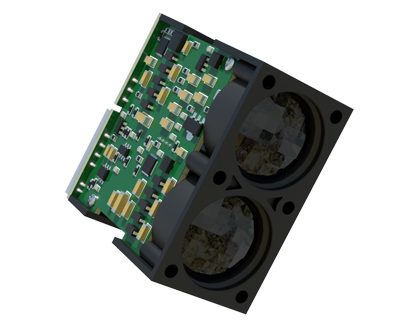
The fundamental measurement is based on the time-of-flight (ToF) principle. The sensor's internal electronics precisely measure the time interval between the emission of the laser pulse and the reception of its reflection. Since the speed of light (c) is a known constant (approximately 3×10^8 m/s), the distance (d) to the object can be calculated using the formula: d = (c × Δt) / 2. The division by two accounts for the round-trip journey of the light. Some systems, particularly for shorter ranges or higher precision, may utilize phase-shift measurement of a modulated continuous-wave (CW) laser instead of pulsed ToF.

The scanning mechanism is what differentiates these sensors from single-point laser distance sensors. By systematically sweeping the beam, the sensor can gather a dense set of distance points, creating a profile or a point cloud. The angular resolution, determined by the mirror's rotational speed and the sampling rate of the detector, defines how finely this profile is detailed. For instance, a scanner with a 180-degree FOV and 0.1-degree resolution would provide 1800 individual distance measurements per scan line.
Key performance parameters include measurement range, scanning frequency, angular resolution, and accuracy. Measurement ranges can vary from a few centimeters for close-range inspection tasks to several hundred meters for large-scale area monitoring. Scanning frequency, measured in Hertz (Hz), indicates how many complete profile scans are performed per second. High-frequency scanners are essential for dynamic applications, such as tracking fast-moving objects on a conveyor or enabling real-time robot navigation.

In industrial settings, laser scanning sensors are deployed for diverse applications. One primary use is in presence detection and object profiling on assembly lines. They can verify the correct size, shape, and position of components, triggering reject mechanisms for out-of-spec parts. Another critical application is in automated guided vehicles (AGVs) and autonomous mobile robots (AMRs), where scanners create a 2D or 3D map of the surroundings for collision avoidance and path planning.
Safety is another paramount domain. Safety laser scanners are configured to create two-dimensional protective fields around hazardous machinery. If the invisible light curtain is breached by a person or object, the system sends an immediate stop signal to the machine, preventing accidents. These safety-rated devices comply with stringent international standards like ISO 13849 and IEC 61496.
Furthermore, in logistics and warehousing, laser scanners mounted on gantries or forklifts perform precise volume measurement of packages and pallets, optimizing storage space and shipping costs. They are also integral to contour and deformation checking in metal fabrication and woodworking.
The choice of laser wavelength is strategic. Infrared lasers (e.g., 905 nm) are common due to their good performance and component availability, while longer wavelengths (e.g., 1550 nm) are sometimes used for eye safety at higher power levels. Environmental factors like ambient light, dust, fog, and the reflectivity of the target surface (from retro-reflective tape to dark, absorbent materials) significantly influence performance. Advanced sensors incorporate algorithms to filter out ambient noise and compensate for varying surface properties.
Modern advancements include the integration of multi-echo evaluation, which allows the sensor to detect multiple reflections from a single pulse. This capability is invaluable for seeing through partial obstructions like foliage, mesh fences, or light rain. Additionally, the fusion of laser scanning data with inputs from other sensors, such as cameras or inertial measurement units (IMUs), is enhancing perception systems for more complex autonomous operations.
In summary, laser scanning sensors operate by combining precise laser-based distance measurement with mechanical or solid-state beam steering. This synergy generates rich spatial data, enabling machines to perceive and interact with their environment with remarkable accuracy and reliability. Their versatility continues to drive innovation across manufacturing, robotics, and safety, forming an invisible yet indispensable layer of intelligence in automated systems.