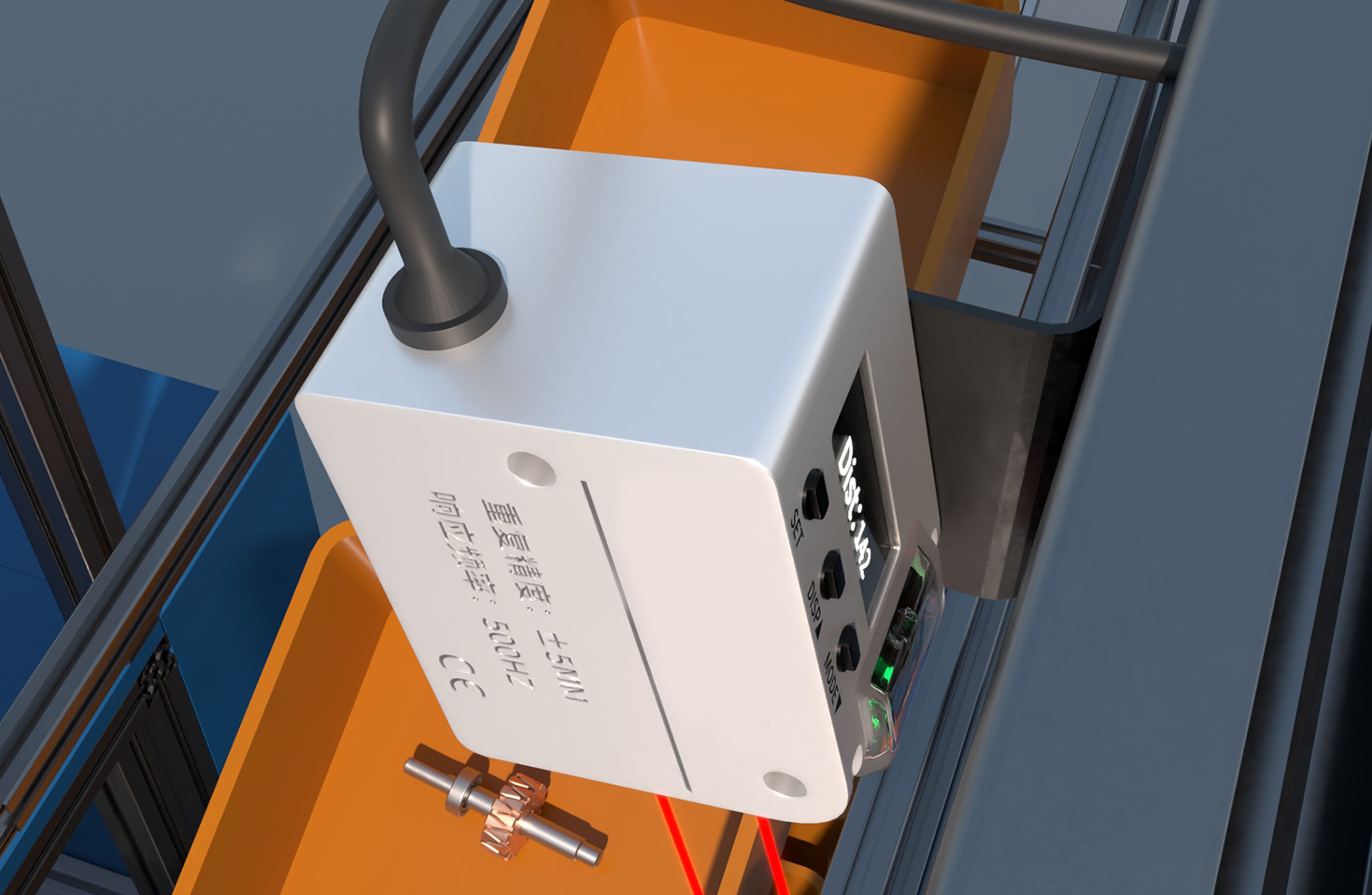
In the realm of industrial automation, quality control, and advanced research, the demand for measurement systems that offer unparalleled accuracy, speed, and reliability has never been greater. At the forefront of this technological evolution are ultra-precision laser sensors, representing the pinnacle of non-contact metrology. These sophisticated devices harness the fundamental properties of coherent light to perform measurements with resolutions reaching the nanometer scale, fundamentally transforming processes across aerospace, semiconductor manufacturing, microelectronics, and precision engineering.
The core principle behind these sensors is laser interferometry or high-resolution triangulation. In interferometric systems, a laser beam is split into two paths: one directed at the target surface and another along a reference path. The reflected light from the target recombines with the reference beam, creating an interference pattern. Minute changes in the target's position—as small as a fraction of the laser's wavelength—alter this pattern, allowing for exquisitely precise calculation of displacement or vibration. Triangulation-based sensors, on the other hand, project a laser spot onto the target. A high-resolution CMOS or CCD array captures the spot's position at an angle. As the target distance changes, the spot shifts on the detector array, enabling precise distance calculation. Modern iterations employ advanced algorithms and specialized optics to achieve sub-micron repeatability even on challenging surfaces.
Key performance metrics that define an ultra-precision laser sensor include resolution, linearity, sampling rate, and stand-off distance. Resolution, often down to 0.1 nanometers in specialized interferometers, defines the smallest detectable change. High linearity ensures measurement accuracy across the entire working range. Megahertz-level sampling rates are crucial for capturing high-frequency vibrations or monitoring fast-moving production lines. Furthermore, advanced models incorporate environmental compensation for air temperature, pressure, and humidity, which can affect the laser wavelength, thereby ensuring data integrity in unstable conditions.

The applications are as diverse as they are demanding. In semiconductor lithography, these sensors are integral to wafer stage positioning, ensuring alignment accuracy critical for producing chips with features smaller than 10 nanometers. In aerospace, they measure blade tip clearance in jet engines under extreme temperatures and vibrations, optimizing efficiency and safety. Within precision metrology labs, they serve as the backbone for calibrating other instruments, establishing the traceability chain to international standards. Additive manufacturing (3D printing) also benefits, where in-process monitoring of layer height and surface topology with laser sensors enables real-time correction, reducing post-processing and waste.
Selecting the appropriate ultra-precision sensor requires a meticulous analysis of the application. Engineers must consider the target material's surface finish (highly reflective, transparent, or rough), the required measurement range, environmental contaminants, and accessibility. For instance, a diffuse, dark surface may require a sensor with a higher-powered laser or a different optical configuration to obtain a reliable signal. Integration with data acquisition systems and factory networks is another critical factor, as the value of high-precision data is fully realized only when it can be analyzed and acted upon in real-time.

Looking ahead, the trajectory for ultra-precision laser sensors points toward even greater integration, intelligence, and miniaturization. The convergence with artificial intelligence and machine learning allows for predictive analytics and adaptive control, where the sensor not only measures but also interprets complex patterns to foresee potential deviations. The development of compact, robust sensor heads facilitates their embedding into tighter spaces within machinery. Furthermore, advancements in blue and violet laser diodes offer shorter wavelengths, potentially enabling higher resolution and improved performance on organic or translucent materials.
In conclusion, ultra-precision laser sensors are not merely measurement tools; they are enablers of innovation and quality. By providing a window into the microscopic world of displacement, vibration, and dimension with extraordinary fidelity, they empower industries to manufacture components with tolerances once thought impossible, conduct groundbreaking scientific research, and build the intelligent, automated systems of the future. Their continued evolution remains inextricably linked to progress in high-technology sectors, solidifying their role as indispensable instruments in the pursuit of perfection.