In the realm of industrial automation, proximity sensor modules play a pivotal role in detecting the presence or absence of objects without physical contact. Among these, the normally closed (NC) proximity sensor module stands out for its specific operational characteristics and safety-oriented design. This article delves into the fundamental principles, typical applications, and key advantages of normally closed proximity sensor modules, providing a comprehensive overview for engineers and technicians in the electrical and automation fields.
A normally closed proximity sensor module, in its default state without an actuating target present, maintains a closed electrical circuit. This means that the output signal circuit is continuously conducting under normal conditions. When a target object enters the sensing range of the sensor, it triggers the module to open the circuit, thereby interrupting the output signal. This behavior is in direct contrast to normally open (NO) sensors, which close the circuit upon detection. The NC configuration is fundamentally linked to fail-safe design philosophies prevalent in critical industrial systems.
The operational principle hinges on the type of sensing technology employed. Inductive NC proximity sensors are predominantly used for detecting metallic objects. They generate an electromagnetic field; when a metal target disrupts this field, the sensor's internal oscillator amplitude changes, prompting the solid-state output switch to transition from its normally closed state to an open state. Capacitive variants can detect both metallic and non-metallic materials by sensing changes in capacitance. Regardless of the technology, the core logic remains: presence of target = open circuit (signal loss).
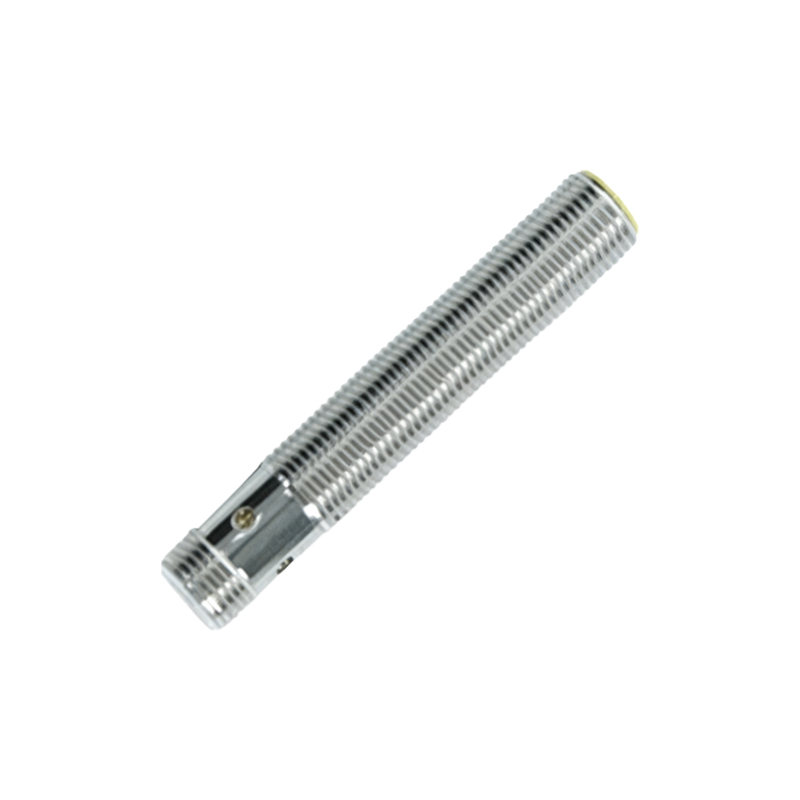
Wiring and integration of an NC module require careful attention. Typically, these sensors have three wires: brown for positive DC supply voltage (e.g., +10 to +30 VDC), blue for common negative or 0V, and black for the output signal. In a standard sinking (NPN) configuration with an NC output, the black wire is connected to the load, which is then connected to the positive supply. When no target is present, current flows from the supply, through the closed sensor switch, through the load (like a PLC input), to ground, keeping the input active. Detection of a target breaks this path, de-energizing the input. This wiring scheme is crucial for correct interpretation by programmable logic controllers (PLCs) and other control systems.
The primary advantage of the normally closed configuration is enhanced safety in fault conditions. Consider a critical safety interlock on a machine guard door. An NC sensor monitors if the door is closed. Under normal operation (door closed), the circuit is closed, and the machine can run. If the door opens, the sensor opens the circuit, sending a "stop" signal to the machine. More importantly, if a wire breaks or the sensor loses power (common failures), the circuit also opens, mimicking the "door open" state and causing a safe shutdown. This "fail-safe" characteristic is paramount for personnel and equipment protection, making NC sensors the default choice for safety-related applications.
Typical applications extend beyond safety interlocks. They are extensively used in error detection and sequence verification in automated assembly lines. For instance, an NC sensor can verify that a part has been picked from a feeder tray. The sensor's output is normally closed while the part is present. When a robotic gripper successfully removes the part, the sensor opens, confirming the pick action. If the part is missing initially, the circuit remains open, signaling an error. This provides a positive confirmation of an absent state, which can be more logically intuitive for certain control sequences.
Selection criteria for an NC proximity sensor module involve several factors. Sensing range, target material, and environmental conditions (like temperature, humidity, and potential contaminants) are primary considerations. The housing material, such as nickel-plated brass or stainless steel, offers varying degrees of resistance to chemicals and physical impact. Electrical specifications like supply voltage range, output current capacity, and switching frequency must match the control system's requirements. Engineers must also decide between two-wire and three-wire designs, with three-wire versions offering more stable performance and easier integration with most DC PLC inputs.
Installation and maintenance practices are straightforward but vital. Ensuring proper alignment, avoiding sensor-to-sensor interference (especially with inductive types), and providing adequate clearance from metal backgrounds are essential for reliable operation. Regular testing is necessary to confirm the fail-safe operation: simulating a wire break or power loss should always result in the safe-state signal (open circuit). Diagnostic LEDs, commonly featured on modern modules, provide visual status indication—often illuminated for power and a separate LED for output state, which extinguishes when the target is detected in an NC sensor.
In conclusion, the normally closed proximity sensor module is an indispensable component in modern industrial control systems. Its inherent fail-safe operation makes it the cornerstone of safety circuits, while its reliability and clear logic for absence detection streamline complex automation processes. Understanding its working principle, correct wiring methodology