In the realm of industrial automation and precision engineering, the demand for accurate, reliable, and high-speed position measurement has never been greater. Multi-point laser position sensors have emerged as a critical technology, offering unparalleled capabilities for non-contact measurement across various applications. Unlike traditional single-point sensors, these advanced systems utilize multiple laser beams or scanning mechanisms to capture positional data at several points simultaneously, providing a comprehensive spatial profile of a target object.
The core operating principle of multi-point laser position sensors typically involves the emission of laser diodes that project structured light patterns—such as lines, grids, or arrays of dots—onto a target surface. High-resolution CMOS or CCD cameras then capture the reflection or distortion of these patterns. Sophisticated algorithms, often based on triangulation, time-of-flight, or phase-shift methodologies, process the image data to calculate precise X, Y, and Z coordinates for each measured point. This allows for the real-time assessment of an object's dimensions, contour, orientation, and even surface defects with micron-level accuracy.

Key advantages of deploying multi-point laser sensors are manifold. Firstly, they enable full-field measurement, drastically reducing inspection time compared to point-by-point scanning methods. This is particularly vital in high-throughput manufacturing lines, such as automotive assembly or electronics production, where every millisecond counts. Secondly, their non-contact nature eliminates mechanical wear and prevents damage to delicate surfaces, ensuring long-term reliability and minimal maintenance. Furthermore, these sensors exhibit remarkable robustness against environmental interference like ambient light fluctuations or vibration, thanks to advanced filtering and signal processing techniques.
Applications span a diverse range of industries. In robotics, multi-point laser sensors facilitate precise guidance for robotic arms in tasks like bin picking, welding, and assembly, enhancing flexibility and accuracy. In quality control for flat panel displays or semiconductor wafers, they perform rapid 3D topography measurements to detect minute imperfections. The automotive sector leverages them for inline inspection of body panel gaps, paint thickness, and component alignment. Even in emerging fields like additive manufacturing, these sensors monitor layer-by-layer deposition to ensure dimensional fidelity and prevent print failures.
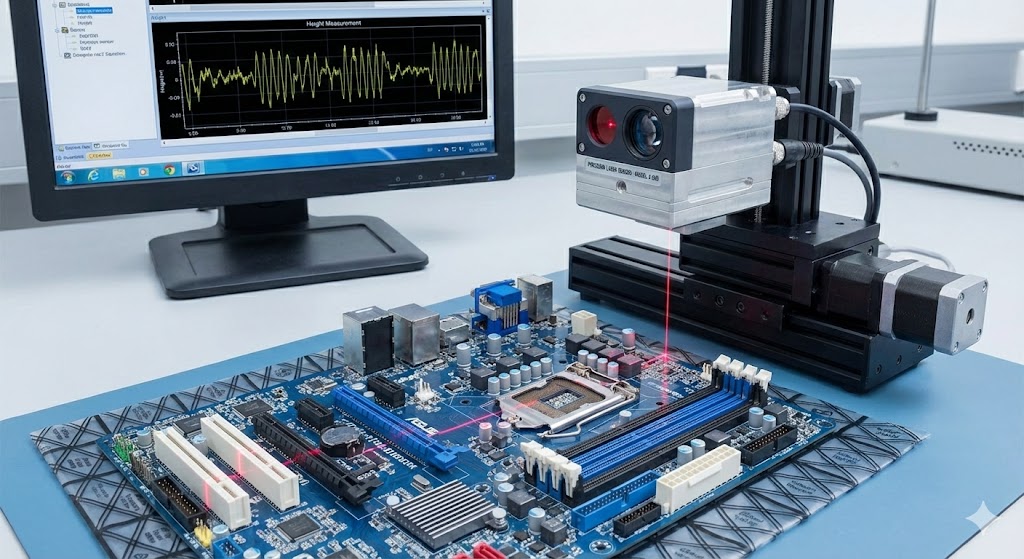
When selecting a multi-point laser position sensor, engineers must consider several technical parameters. Measurement range and resolution are primary determinants of suitability for a given task. The number of measurement points and their spatial distribution should align with the target's geometry and the required data density. Scan rate or sampling frequency is crucial for dynamic applications involving moving objects. Environmental ratings for factors like temperature, humidity, and dust ingress (e.g., IP67) ensure durability in harsh industrial settings. Additionally, compatibility with industrial communication protocols (EtherCAT, PROFINET, IO-Link) and software for data analysis and integration into larger control systems (like PLCs or SCADA) is essential for seamless operation.
Despite their sophistication, challenges persist. Highly reflective, transparent, or absorbent surfaces can complicate measurements, though solutions like using specific wavelengths or polarization filters are available. Calibration remains critical to maintain accuracy over time, and initial system setup requires expertise. However, ongoing advancements in machine vision, artificial intelligence, and miniaturized optics are continuously pushing the boundaries, making these sensors more intelligent, compact, and cost-effective.
In conclusion, multi-point laser position sensors represent a cornerstone of modern precision measurement. By delivering fast, accurate, and comprehensive spatial data, they empower industries to achieve higher levels of automation, quality assurance, and operational efficiency. As technology evolves, their role in enabling smarter, more adaptive manufacturing and inspection processes will only expand, solidifying their status as an indispensable tool for engineers driving the future of industrial innovation.