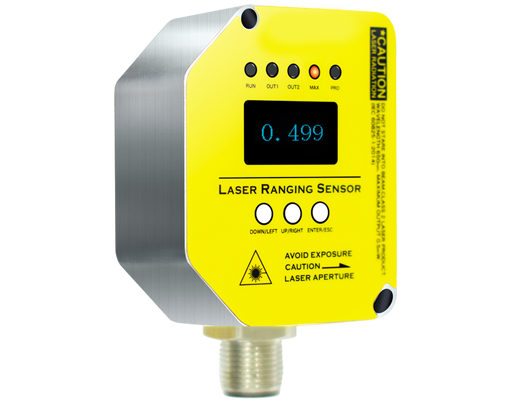
In the demanding world of modern manufacturing and heavy industry, the precise measurement of steel plates is a critical operation. From ensuring uniform thickness in rolling mills to verifying flatness in fabrication shops, accuracy directly impacts product quality, material efficiency, and process safety. Traditional contact measurement methods, while sometimes reliable, often fall short in high-speed, high-temperature, or delicate surface applications. This is where non-contact laser displacement sensors have become an indispensable tool. Specifically designed for robust industrial environments, steel plate laser displacement sensors offer unparalleled precision, speed, and reliability.
The core technology behind these sensors is triangulation. A focused laser beam is projected onto the surface of the steel plate. The reflected light, scattered from the point of incidence, is captured by a high-resolution CMOS or PSD (Position Sensitive Device) receiver lens at a known angle. Any change in the distance to the target (the steel plate's surface) causes the position of the reflected light spot on the receiver to shift. This minute shift is calculated with sophisticated onboard algorithms to determine the exact displacement or distance with micron-level resolution. For steel plates, which can have varying surface finishes—from hot-rolled mill scale to cold-rolled smoothness or even painted surfaces—sensors often employ red or blue laser diodes. Blue lasers, with their shorter wavelength, provide superior performance on low-reflectivity surfaces like dark, oxidized hot-rolled steel.
The applications for laser displacement sensors in steel plate processing are vast and varied. In rolling mills, they are deployed for real-time thickness monitoring and control. Two sensors can be configured in a opposed setup, measuring from both sides of a moving plate to calculate thickness dynamically, allowing for immediate roll gap adjustment. In plate leveling and flattening lines, an array of sensors scans across the plate to create a detailed topographic map of flatness, identifying warps, bows, or edge waves. This data is crucial for corrective mechanical action. During automated cutting or welding processes, such as with plasma cutters or robotic welders, a laser sensor precedes the tool head to track the plate's surface profile. This ensures a consistent stand-off distance, optimizing cut quality and weld penetration regardless of plate warpage. Furthermore, in quality control stations, these sensors perform precise dimensional checks for length, width, and the presence of surface defects like dents or bulges.
Selecting the right laser displacement sensor for a steel plate application requires careful consideration of several key parameters. First is the measuring range, which must encompass the expected variance in distance or position. A sensor with a 50mm range might be perfect for vibration monitoring, while a 500mm range sensor is needed for large plate profiling. Resolution and linearity define the sensor's precision; sub-micron resolution is available for laboratory-grade tasks, while industrial processes may require 0.01% of full-scale linearity. The sampling speed, often in the kilohertz range, must be high enough to capture data on fast-moving plates without aliasing. Environmental robustness is non-negotiable. Look for sensors with high IP ratings (e.g., IP67) for dust and water resistance, robust metal housings to withstand vibration, and protective features like air purge ports for use in environments with airborne particulates common in steel mills. The type of output (analog voltage/current, digital Ethernet, PROFIBUS, etc.) must integrate seamlessly with the existing PLC or control system.

Integration and calibration are final, crucial steps. Proper mounting, ensuring stability and freedom from machine vibration, is essential. The sensor must be calibrated for the specific surface characteristics of the target steel plate. Most modern sensors feature automatic teaching functions or sensitivity adjustments to compensate for different reflectivity levels. Regular maintenance, primarily keeping the lens window clean from oil mist or dust, ensures long-term, drift-free performance.
In conclusion, steel plate laser displacement sensors represent a mature yet continuously advancing technology that bridges the gap between physical industrial processes and digital control. They transform analog, subjective assessments into quantifiable, high-speed data streams. By enabling real-time measurement and closed-loop control, they are fundamental to achieving the stringent tolerances, material savings, and automated efficiency demanded by today's competitive steel processing and manufacturing industries. Their role is not merely observational but actively contributive to building smarter, more precise, and more reliable industrial systems.