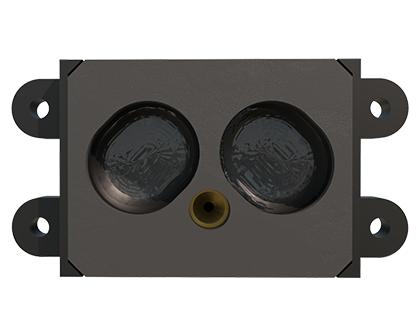
In the rapidly evolving landscape of electrical engineering, the emergence of phonon laser sensors marks a transformative leap in precision measurement technologies. Unlike conventional optical lasers that rely on photons, phonon lasers harness coherent acoustic waves—quantized lattice vibrations known as phonons—to achieve unprecedented accuracy in detecting minute physical changes. These sensors operate by generating stimulated emission of phonons within engineered microstructures, such as optomechanical crystals or nanomechanical resonators, creating a highly focused "sound laser" beam. This principle enables the detection of displacements at the picometer scale, temperature fluctuations within millikelvin ranges, and pressure variations in ultra-low vacuum environments, far surpassing the limits of traditional piezoelectric or capacitive sensors.
The core mechanism involves a gain medium, often a semiconductor or dielectric material, where phonon amplification occurs through external energy pumping—typically via optical or electrical means. When phonons are coherently amplified, they produce a narrowband, intense acoustic output that interacts with target materials or environments. This interaction yields precise data on structural integrity, thermal conductivity, or electromagnetic field distributions, making phonon laser sensors invaluable for applications like semiconductor fabrication monitoring, aerospace component testing, and quantum computing hardware calibration. For instance, in chip manufacturing, these sensors can identify nanoscale defects in silicon wafers by analyzing phonon scattering patterns, thereby enhancing yield rates and reliability.

Advancements in nanofabrication have propelled phonon laser sensors toward miniaturization and integration with existing electronic systems. Modern designs incorporate silicon-on-insulator platforms or gallium arsenide-based devices, which offer low thermal noise and high mechanical quality factors. Engineers are now exploring hybrid systems that combine phonon lasers with photonic circuits, enabling dual-mode sensing where acoustic and optical data complement each other for robust measurements in harsh industrial settings. Challenges remain, such as minimizing energy dissipation in ambient conditions or scaling production costs, but ongoing research in materials science—like using 2D materials such as graphene for phonon confinement—promises to address these hurdles.
From an industry perspective, the adoption of phonon laser sensors aligns with the growing demand for Industry 4.0 automation and IoT connectivity. Their ability to provide real-time, high-fidelity data supports predictive maintenance in power grids, where early detection of transformer vibrations can prevent failures, or in medical devices for ultrasensitive biometric monitoring. As electrical engineers continue to refine these sensors, future iterations may enable breakthroughs in quantum sensing networks, offering secure, low-power alternatives to conventional electromagnetic-based systems. Ultimately, phonon laser sensors represent not just an incremental improvement but a paradigm shift, redefining how we measure and interact with the physical world in an increasingly precise and interconnected era.