In the realm of advanced industrial monitoring and precision measurement, Japan laser vibration sensors stand as a pinnacle of technological innovation. These non-contact measurement devices, leveraging laser Doppler vibrometry principles, offer unparalleled accuracy in detecting and analyzing vibrational characteristics across a vast spectrum of applications. The Japanese engineering ethos—emphasizing meticulous craftsmanship, reliability, and continuous improvement—is deeply embedded in the design and manufacturing of these sophisticated sensors.
The core operational principle of a laser vibration sensor involves directing a coherent laser beam onto a target surface. The vibration of this surface induces a Doppler shift in the frequency of the reflected light. The sensor's interferometric system precisely measures this minute frequency shift, converting it into a highly accurate representation of the target's velocity and displacement over time. This non-contact methodology is a critical advantage, eliminating mass-loading effects and allowing for measurements on hot, fragile, rotating, or otherwise inaccessible components where traditional contact sensors (like accelerometers) would fail or introduce error.
Japanese manufacturers, such as Keyence, Omron, and Fuji Electric, have been at the forefront of refining this technology. Their sensors are renowned for exceptional specifications: sub-micrometer displacement resolution, wide frequency ranges often exceeding 1 MHz, and high linearity. This performance is not merely theoretical; it is achieved through relentless R&D in optics, high-speed signal processing, and noise reduction algorithms. The integration of advanced features like automatic focus adjustment, multi-point measurement, and real-time FFT analysis software further enhances their utility, making complex vibrational analysis more accessible.

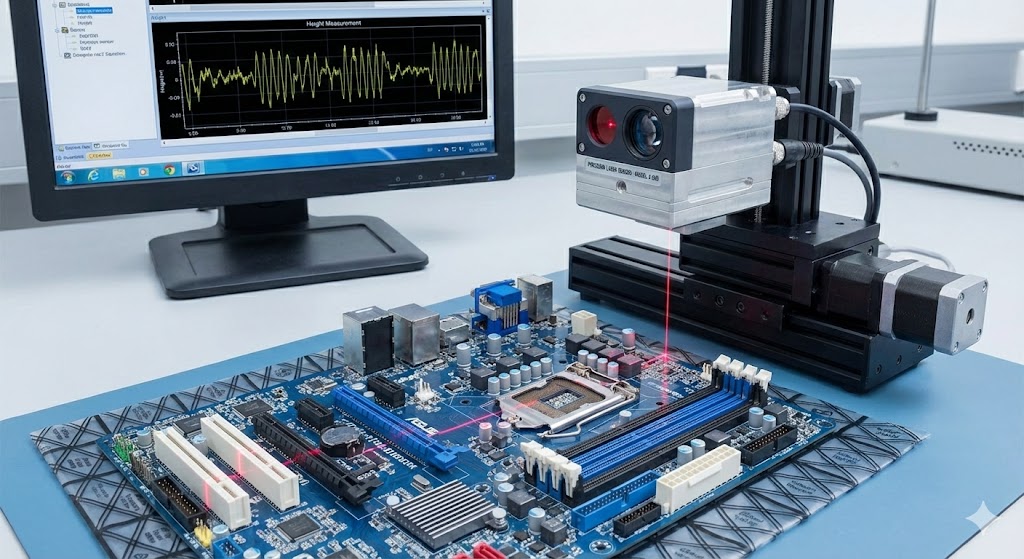
The application landscape for these sensors is extraordinarily diverse. In the automotive and aerospace sectors, they are indispensable for NVH (Noise, Vibration, and Harshness) testing, modal analysis of engine components, and quality inspection of turbine blades. Within electronics manufacturing, they enable precise vibration analysis of micro-components, HDD disk drives, and PCB assemblies, ensuring product longevity and reliability. Furthermore, in the field of infrastructure and civil engineering, they facilitate structural health monitoring of bridges, buildings, and wind turbine blades, detecting subtle anomalies that precede failure. The energy sector utilizes them for predictive maintenance on rotating machinery like pumps, compressors, and generators, minimizing unplanned downtime.
A key differentiator for Japanese laser vibrometers is their robust design for industrial environments. They are often built to withstand challenging conditions—varying temperatures, dust, and electromagnetic interference—without compromising measurement integrity. The user interface and software suites provided are typically intuitive, supporting seamless integration into automated production lines and IoT-based predictive maintenance systems. This alignment with Industry 4.0 and smart factory concepts underscores their role not just as measurement tools, but as critical data nodes for operational intelligence.
Looking ahead, the evolution of Japanese laser vibration sensing technology is geared towards even greater miniaturization, enhanced portability, and lower cost without sacrificing performance. Research into new laser sources and photonic integrated circuits promises next-generation sensors with broader capabilities. The synergy with artificial intelligence for automated fault diagnosis and predictive analytics represents a significant frontier, transforming raw vibration data into actionable insights with unprecedented speed and accuracy.
In conclusion, Japan laser vibration sensors embody a synthesis of deep physics understanding, precision engineering, and practical industrial design. They provide a critical, non-invasive window into the dynamic behavior of machinery and structures, driving quality, safety, and efficiency across global industries. Their continued advancement remains a testament to Japan's enduring leadership in high-precision measurement and automation technology, offering solutions that are as reliable as they are technologically profound.