In the realm of industrial automation and control systems, proximity sensors are indispensable components for non-contact object detection. Among the various form factors and sensing technologies available, the M8 capacitive proximity sensor stands out for its versatility and reliability in challenging environments. This article delves into the operational principles, key advantages, typical applications, and critical selection criteria for M8 capacitive proximity sensors.
At its core, a capacitive proximity sensor functions by generating an electrostatic field. The sensor's active face, or sensing area, is part of an oscillating circuit. When a target object enters this electrostatic field, it causes a change in the circuit's capacitance. This change is detected by the sensor's internal circuitry, which then triggers a switching output—typically a solid-state PNP, NPN, or analog signal. Unlike inductive sensors, which only detect metals, capacitive sensors can detect a vast array of materials, including liquids, powders, granules, plastics, glass, and wood. This makes the M8 capacitive type exceptionally useful where material diversity is a factor.
The "M8" designation refers to the sensor's housing thread size, which is 8 millimeters in diameter. This compact form factor is a significant advantage in space-constrained installations. Despite their small size, M8 capacitive sensors are engineered to be robust. They often feature housings made of nickel-plated brass or stainless steel (e.g., V2A/AISI 303, V4A/AISI 316L), providing excellent resistance to corrosion, chemicals, and mechanical stress. Many models are also available with IP67 or IP69K ingress protection ratings, making them suitable for washdown environments in food and beverage or pharmaceutical industries.
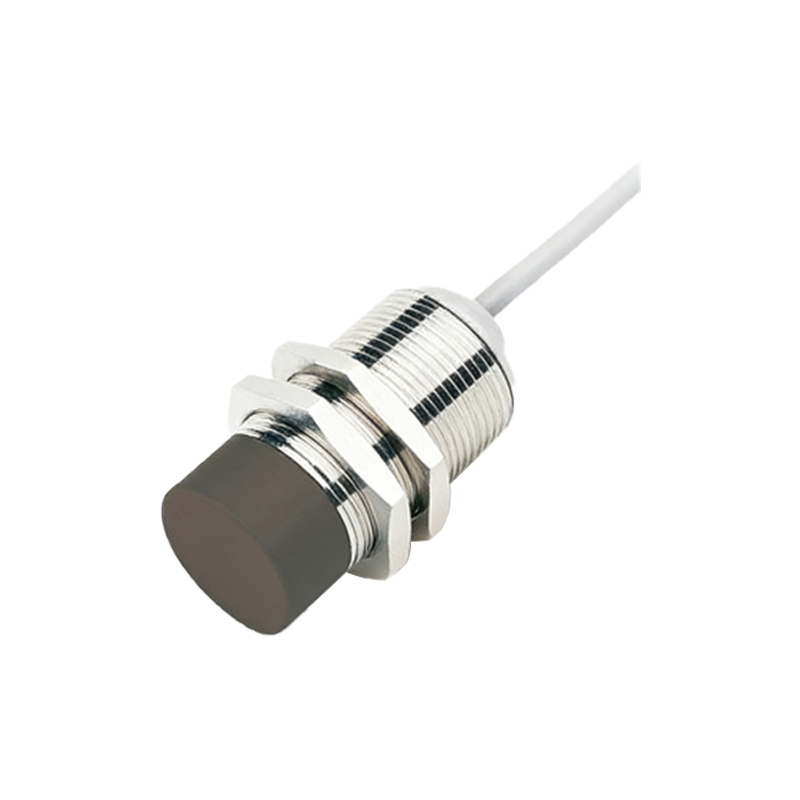
One of the primary technical advantages of the capacitive sensing principle is its ability to detect objects through non-metallic barriers. For instance, an M8 capacitive sensor can reliably detect the level of a liquid inside a plastic or glass tank by sensing through the container wall. This non-invasive detection capability eliminates the need for direct contact with the medium, preventing contamination and simplifying installation. Furthermore, these sensors are largely insensitive to factors like color, transparency, or surface reflectivity, which can pose challenges for optical sensors.
Typical sensing ranges for M8 capacitive sensors vary by model and target material but commonly range from 1.5 mm to 5 mm. It is crucial to note that the sensing distance is influenced by the dielectric constant (εr) of the target material. Materials with a high dielectric constant, such as water (εr ≈ 80), are detected at the sensor's nominal range. Materials with a lower dielectric constant, like plastics (εr ≈ 2-5), require a reduced sensing distance. Manufacturers provide reduction factors in their datasheets to calculate the effective sensing range for different materials.
Applications for M8 capacitive proximity sensors are widespread across industries. In packaging machinery, they detect the presence of plastic bottles or foil lids. In liquid processing, they monitor fill levels in tanks and pipes. In woodworking or plastics manufacturing, they sense the presence of non-metallic workpieces on conveyors. They are also extensively used for end-position detection of pneumatic cylinders with non-metallic pistons. Their immunity to dust, dirt, and moisture accumulation on the sensing face (within limits) further enhances their suitability for harsh industrial settings.
When selecting an M8 capacitive proximity sensor, several parameters must be carefully considered. First, define the target material and its dielectric constant to ensure adequate sensing range. Second, determine the required output type (e.g., 3-wire DC, 2-wire DC, analog 4-20mA) and switching function (normally open or normally closed) to match the control system. Third, verify the environmental conditions, including temperature range, potential chemical exposure, and required IP rating. Fourth, consider the electrical specifications such as supply voltage (commonly 10-30V DC) and load current. Finally, some sensors feature a potentiometer for sensitivity adjustment, which is invaluable for fine-tuning the sensor to ignore the container wall and only detect the material inside, or to compensate for varying environmental conditions.
Installation best practices are also key to optimal performance. Maintain the recommended clearance from metal surroundings to prevent false triggering due to side-effects. Avoid mounting the sensor in direct contact with conductive materials unless specifically designed for flush mounting. Ensure a stable power supply with proper shielding to minimize electrical noise interference. Regular maintenance, primarily cleaning the sensing face from heavy contaminant buildup, will preserve long-term accuracy and reliability.
In conclusion, the M8 capacitive proximity sensor is a powerful and flexible solution for detecting both conductive and non-conductive materials. Its compact, rugged design, combined with the inherent advantages of capacitive technology, makes it a preferred choice for engineers tackling complex material detection tasks in diverse industrial applications. By understanding its operating principles and meticulously applying the selection criteria outlined,