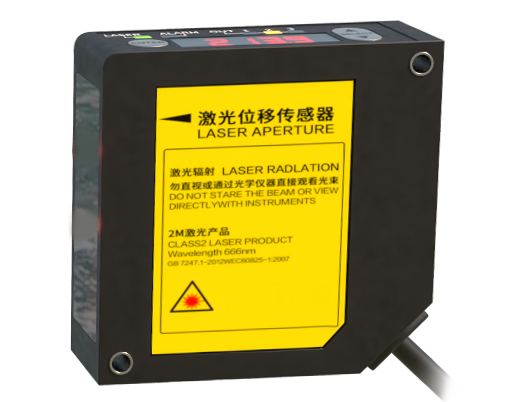
In the rapidly evolving landscape of industrial automation and quality control, the demand for faster, more accurate, and non-contact measurement solutions has never been greater. Among the most transformative technologies meeting this demand is the high-speed line laser sensor. This sophisticated device projects a thin, focused line of laser light onto a target surface. A high-resolution camera, positioned at a known angle to the laser source, captures the deformation or profile of this laser line. Through the principle of triangulation, powerful onboard processors or connected systems can calculate precise 3D coordinates at an astonishing rate, generating detailed height maps or surface profiles in real-time.
The core advantage of a high-speed line laser sensor lies in its ability to perform continuous profile scanning. Unlike single-point laser sensors that measure one spot at a time, the line laser captures thousands of data points across its entire line in a single snapshot. When the sensor or the target object is in motion, this results in the rapid acquisition of dense 3D point cloud data. Modern sensors can achieve profile acquisition rates exceeding 10,000 Hz, meaning they can capture ten thousand cross-sectional profiles every second. This incredible speed is paramount for inline inspection on high-speed production lines, such as those in automotive manufacturing, electronics assembly, and continuous web processes.
The applications for this technology are vast and critical across numerous sectors. In automotive manufacturing, these sensors are indispensable for 100% inline inspection of body-in-white geometries, gap and flush measurement between panels, and weld seam inspection. Any deviation from stringent tolerances can be instantly detected and flagged. In the electronics industry, they ensure the coplanarity of Ball Grid Array (BGA) components, measure solder paste volume, and inspect for warpage on printed circuit boards (PCBs). The food and pharmaceutical industries utilize them for precise volume measurement, package integrity checks, and sorting based on size or shape. Furthermore, in logistics and parcel handling, high-speed line lasers accurately measure box dimensions for cubing and automated sorting systems, optimizing space utilization and shipping costs.
Several key performance parameters define the capability of a high-speed line laser sensor. Profile rate, measured in Hz, dictates how fast it can capture data. Z-axis resolution, often in micrometers, defines the smallest height difference it can reliably detect. The measurement range in the Z-direction (height) and the width of the laser line (X-direction) determine the size of the area it can cover in one profile. Environmental robustness is also crucial; industrial-grade sensors are designed with high Ingress Protection (IP) ratings to withstand dust, coolant, and vibrations commonly found on factory floors. Advanced models incorporate features like automatic exposure control to handle varying surface reflectivity—from shiny metal to dark, absorbent materials—without manual recalibration.

Integration of these sensors into a complete vision system is a critical step. It typically involves mounting the sensor on a stable fixture or a motion stage, calibrating it for the specific working distance and angle, and synchronizing its trigger with an encoder signal from a conveyor or moving stage to ensure accurate spatial registration of each profile. The massive stream of profile data is then processed by dedicated vision controllers or industrial PCs running specialized software. This software performs complex algorithms for tasks like blob analysis, edge detection, pattern matching, and comparison against CAD models or golden samples to make pass/fail decisions in milliseconds.

Looking ahead, the future of high-speed line laser sensing is geared towards even higher speeds, improved resolution, and greater intelligence. The integration of artificial intelligence and machine learning directly at the sensor level, often referred to as edge computing, will enable more complex defect classification and predictive analytics without relying on centralized computing power. Furthermore, the miniaturization of components is leading to more compact sensor designs that can be deployed in space-constrained applications. As Industry 4.0 and smart factory initiatives continue to mature, these sensors will become even more vital data acquisition nodes, feeding critical dimensional data into digital twin models and enabling closed-loop process control for unprecedented levels of manufacturing quality and efficiency.