In the realm of industrial automation and precise object detection, laser background suppression sensors have emerged as a critical technology, offering unparalleled accuracy and reliability in challenging environments. Unlike conventional photoelectric sensors that can be easily fooled by reflective backgrounds or varying surface colors, these advanced devices utilize a triangulation principle with a focused laser beam to distinguish the target object from its background with exceptional precision.
The core operational principle hinges on the precise measurement of the angle of the reflected light. The sensor emits a highly focused, visible red or infrared laser beam onto the target. A receiving element, typically a Position Sensitive Detector (PSD) or a CMOS array, captures the reflected light. The key innovation lies in the sensor's internal logic: it is pre-programmed with a specific "suppression distance" or "background cutoff." The device analyzes the angle at which the light returns. Light reflected from a surface within the set sensing range returns at one angle, triggering the output. Crucially, light reflected from a surface beyond this programmed cutoff distance—the background—returns at a steeper angle and is intelligently ignored or "suppressed." This allows the sensor to detect an object at a precise standoff distance while completely disregarding any objects or surfaces behind it.
This technology confers several decisive advantages in industrial settings. First and foremost is its exceptional insensitivity to color, material, and surface texture. Whether detecting a transparent glass bottle, a shiny metal part, or a matte black object, the sensor provides a consistent and reliable switching signal, eliminating the need for constant recalibration. Secondly, the ability to ignore backgrounds solves persistent problems in packaging, material handling, and assembly. For instance, it can reliably detect a product on a conveyor belt without being triggered by the belt itself or machinery in the far background, even if those surfaces are highly reflective. The visible laser spot also simplifies installation and alignment, reducing commissioning time.
Typical applications are vast and varied. They are indispensable in warehouse logistics for precise pallet detection and height control, ensuring forklifts only engage loaded pallets. In the automotive industry, they verify the presence of components on assembly lines, regardless of their finish. They are used in printing to detect the leading edge of paper or film stacks, and in packaging machinery to count items on a moving belt while ignoring the belt's pattern. Their robust design, often featuring IP67 ratings, makes them suitable for harsh environments with dust, moisture, or vibration.
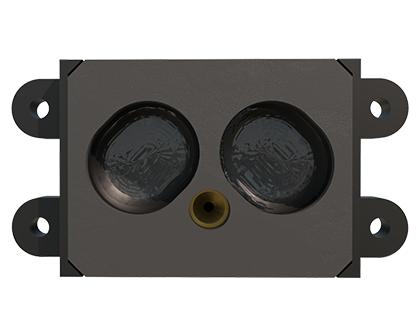
When selecting a laser background suppression sensor, engineers must consider key parameters. The sensing range and the adjustable background suppression distance are paramount. The size of the laser spot—smaller for detecting tiny objects—and the response time are critical for high-speed applications. Output types (PNP/NPN, analog) and housing design (cylindrical, rectangular) must align with the control system and mounting constraints. Regular maintenance involves keeping the lens clean to ensure optimal laser transmission and reception.
In conclusion, laser background suppression sensors represent a sophisticated evolution in photoelectric sensing. By leveraging precise optical triangulation and intelligent signal processing, they deliver foolproof detection in scenarios where traditional sensors fail. Their robustness, versatility, and set-and-forget reliability make them a cornerstone technology for enhancing efficiency, safety, and quality control in modern automated manufacturing and logistics systems, paving the way for more complex and precise automation tasks.