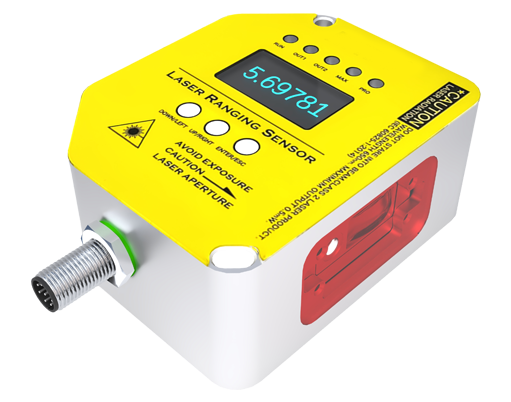
In the realm of industrial automation and precision engineering, laser distance sensors have emerged as indispensable tools for non-contact measurement. Xiangshan, a region increasingly recognized for its technological manufacturing prowess, has become a significant hub for the development and application of these sophisticated devices. This article delves into the core principles, key features, and diverse industrial applications of laser distance sensors, highlighting their critical role in modern manufacturing and quality control processes.
Laser distance sensors operate on the principle of time-of-flight (ToF) or phase-shift measurement. In the ToF method, the sensor emits a short pulse of laser light towards a target. A high-speed receiver then detects the reflected light. By precisely calculating the time difference between the emission and reception of the laser pulse, and knowing the constant speed of light, the sensor computes the distance to the target with remarkable accuracy. Phase-shift sensors, often used for even higher precision over shorter ranges, modulate the amplitude of the laser beam. The distance is determined by measuring the phase difference between the emitted and reflected modulated signal. This technology allows for resolutions down to the micrometer level, making it ideal for ultra-precise positioning and inspection tasks.

The advantages of using laser sensors from advanced manufacturing centers like Xiangshan are numerous. First and foremost is their exceptional accuracy and repeatability, which are paramount in industries such as automotive assembly, electronics production, and aerospace. Unlike mechanical probes or ultrasonic sensors, lasers are unaffected by target surface color (within specified limits), material, or ambient noise, providing stable and reliable measurements. Their high sampling speed enables real-time monitoring and closed-loop control in dynamic production lines, ensuring consistent product quality and minimizing waste. Furthermore, their compact design and robust housing, often meeting IP67 ratings for dust and water resistance, allow for seamless integration into harsh industrial environments.
Industrial applications are vast and varied. In robotics, laser distance sensors are crucial for guidance, obstacle detection, and precise part handling. On assembly lines, they verify component presence, measure dimensions, and control filling levels. In the wood and metal processing industries, they monitor thickness, warpage, and profile dimensions with non-contact efficiency, preventing tool damage. Logistics and warehousing benefit from these sensors in palletizing, dimensioning packages, and automated guided vehicle (AGV) navigation. The construction sector utilizes long-range laser sensors for monitoring structural deformation, alignment, and volume calculation.
When selecting a laser distance sensor from a reputable Xiangshan-based supplier, several technical specifications must be considered. The measuring range defines the minimum and maximum distances the device can handle. Resolution indicates the smallest detectable change in distance. Linearity error specifies the deviation from a perfect straight-line relationship between the actual and measured distance across the entire range. The laser spot size is critical for measuring small objects or edges. Output interfaces, such as analog voltage/current, RS-232, RS-485, or Ethernet/IP, determine how the measurement data is communicated to PLCs (Programmable Logic Controllers) or host systems. Understanding the specific requirements of the application is key to choosing the optimal sensor model.

Installation and environmental factors play a significant role in performance. Ensuring a stable mounting, minimizing vibrations, and avoiding optical interference from other strong light sources are essential best practices. For transparent objects like glass or liquid surfaces, specialized sensors with background suppression or advanced filtering algorithms may be required. Regular calibration, as per the manufacturer's guidelines, maintains long-term accuracy.
The future of laser distance sensing in Xiangshan's industrial landscape is geared towards smarter, more integrated solutions. Trends include the development of multi-point sensors and laser profile scanners for 2D/3D contouring, enhanced connectivity for Industry 4.0 and IoT (Internet of Things) platforms, and embedded intelligence for onboard data processing and decision-making. These advancements will further streamline automation, predictive maintenance, and data-driven optimization across factories.
In conclusion, laser distance sensors represent a cornerstone of modern precision measurement. The technological innovation and manufacturing excellence found in regions like Xiangshan provide industries worldwide with reliable, high-performance sensors. By enabling accurate, fast, and non-contact measurements, these devices are fundamental to enhancing productivity, ensuring quality, and driving the continuous evolution of automated industrial processes. Engineers and system integrators are encouraged to leverage these advanced tools to solve complex measurement challenges and unlock new levels of operational efficiency.