In the realm of industrial automation and control systems, proximity sensors play a pivotal role in enabling non-contact detection of metallic objects. Among the diverse range of available sensors, the PR08-2DN 3-wire proximity switch sensor stands out as a reliable and widely adopted component. This article provides a comprehensive technical overview and application guide for this specific sensor model, catering to engineers, technicians, and procurement specialists in the electrical and automation fields.
The PR08-2DN is a cylindrical, inductive proximity sensor designed for the detection of ferrous metals, typically with a sensing distance of 2mm (hence the "2DN" designation, though exact specifications must always be verified with the manufacturer's datasheet). Its fundamental operating principle is based on electromagnetic induction. The sensor's face contains an oscillator circuit that generates a high-frequency electromagnetic field. When a metallic target enters this field, eddy currents are induced in the target, causing a change in the oscillation amplitude. This change is detected by the sensor's circuitry, which subsequently triggers a solid-state output switch.
The "3-wire" configuration is a key characteristic. Unlike 2-wire sensors that are wired in series with the load, 3-wire sensors require a separate power supply, output, and common (ground) connection. This design offers significant advantages. Primarily, it allows for both NPN (sinking) and PNP (sourcing) output types, providing flexibility in interfacing with different PLC (Programmable Logic Controller) input modules or other control devices. The standard wiring for a 3-wire DC sensor involves: Brown wire connected to the positive DC supply voltage (typically 10-30V DC), Blue wire connected to the negative DC supply (0V/common), and the Black wire serving as the switched output signal. The output is typically in a normally-open (NO) configuration, closing when a target is detected.
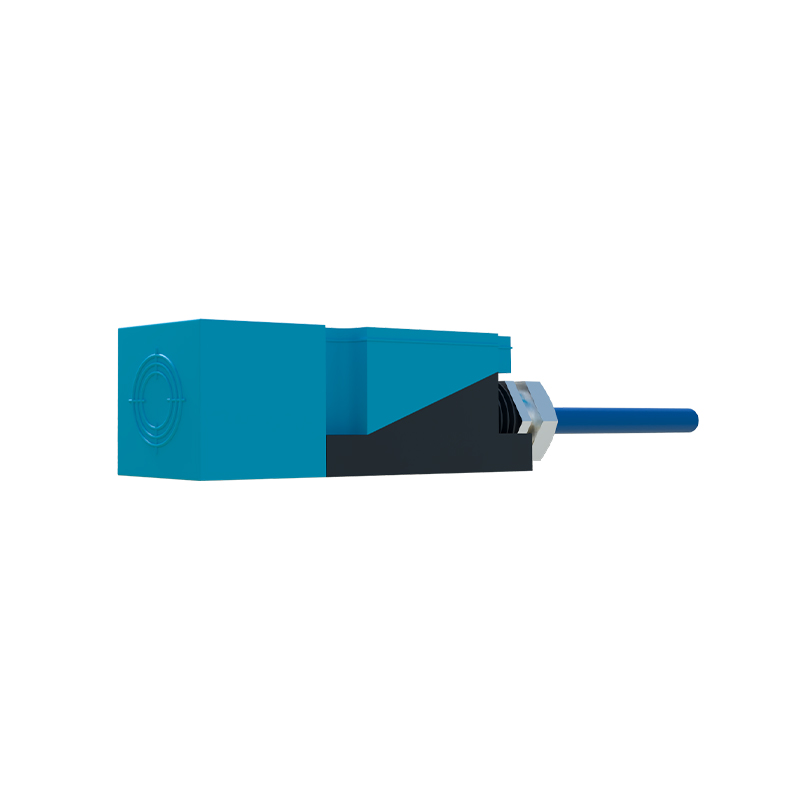
Key technical specifications for the PR08-2DN series generally include:
Supply Voltage: A wide DC range, commonly 10-30V DC, ensuring compatibility with standard industrial control voltages.
Output Current: A rated switching current, for instance, up to 200mA, sufficient to drive relays, PLC inputs, or small solenoids directly.
Switching Frequency: A high response speed, often in the range of several hundred Hz to 1 kHz, allowing for detection of rapidly moving objects on production lines.
Housing Material: Typically constructed with a nickel-plated brass or stainless-steel barrel, offering robustness and resistance to industrial environments, including coolants and mild chemicals.
Protection Class: A high Ingress Protection rating such as IP67, making it dust-tight and capable of withstanding temporary immersion in water, which is crucial for washdown areas or harsh conditions.
Connection: Usually equipped with a 2-meter PVC cable or a quick-disconnect (M8 or M12) connector for easy installation and maintenance.
In practical applications, the PR08-2DN sensor is ubiquitous. It is commonly used for position sensing, such as detecting the presence of a metal part on a conveyor, verifying the end position of a cylinder, or counting metallic objects. It serves as a limit switch in machinery without the mechanical wear and tear associated with traditional contact switches. Other applications include rotary speed monitoring, jam detection in assembly lines, and safety interlocking.
For optimal performance and longevity, correct installation and consideration of the operating environment are paramount. The sensor should be mounted securely, paying attention to its recommended flush or non-flush mounting style, as this affects the effective sensing distance. It is critical to maintain the specified gap between the sensor face and the target to prevent physical damage. While inductive sensors are insensitive to non-metallic contaminants like dust or oil, installing them away from strong electromagnetic fields generated by motors, transformers, or welding equipment is advisable to avoid false triggering. Always ensure the electrical load connected to the output does not exceed the sensor's maximum current rating.
Troubleshooting a malfunctioning PR08-2DN sensor typically involves a systematic approach. First, verify the power supply voltage at the sensor's leads. Next, check the output state with a multimeter or a simple indicator lamp to see if it switches when a target is presented. Inspect the cable for any cuts, pinch points, or damage. Finally, ensure the target material is ferrous (like iron or steel) and of adequate size; some sensors may not reliably detect thin foils or certain stainless-steel grades.
In conclusion, the PR08-2DN 3-wire inductive proximity sensor is a fundamental, versatile, and durable component in modern industrial control panels and machinery. Its simple yet effective design, combined with standardized wiring and robust construction,