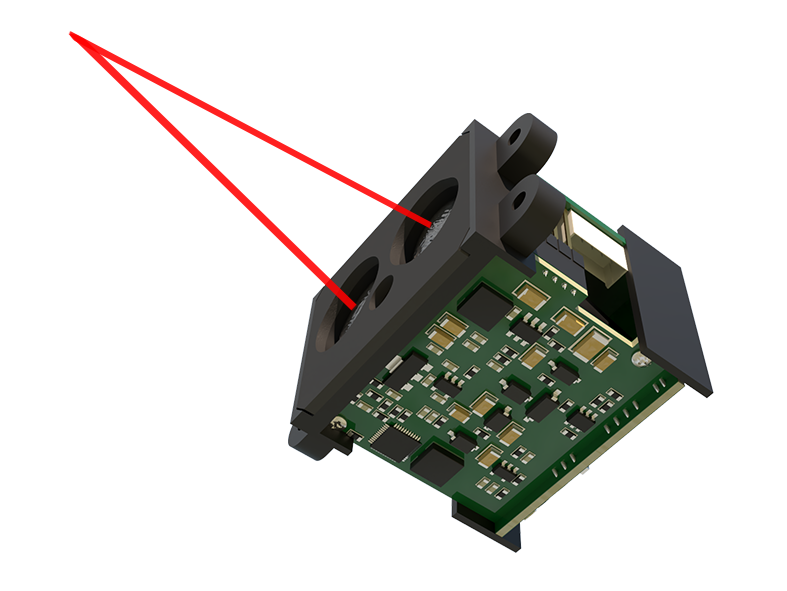
Point laser sensors are indispensable tools in modern industrial automation, offering high-precision, non-contact measurement for tasks ranging from object detection and positioning to thickness gauging and profile scanning. Their operation is based on the principle of triangulation: a laser diode projects a focused point of light onto a target surface, and the reflected light is captured by a receiving lens at a specific angle onto a position-sensitive detector (PSD) or a CMOS/CCD array. The displacement of the reflected spot on the detector is directly correlated to the distance or height of the target. However, the accuracy and reliability of these sensors can be significantly compromised by various forms of interference, leading to measurement errors, signal dropout, or complete operational failure. Understanding the sources and implementing effective mitigation strategies is crucial for maintaining system integrity.
The primary categories of interference affecting point laser sensors are optical, environmental, and electrical.
Optical Interference is perhaps the most direct challenge. It occurs when extraneous light enters the receiver, confusing the detector. The most common source is ambient light, particularly strong, direct sunlight or intense artificial lighting (e.g., halogen, LED strobes) that shares a spectral component with the sensor's laser wavelength. While many sensors use narrow-band optical filters to block out-of-band light, high-intensity in-band light can still saturate the detector. Cross-talk is another critical form, where the laser beam from one sensor is detected by the receiver of a neighboring sensor in multi-sensor setups. Specular reflections from shiny, polished, or mirror-like surfaces can cause the beam to reflect away from the receiver entirely, resulting in a loss of signal, or create multiple reflection paths that generate ghost signals.
Environmental Interference encompasses physical and chemical factors in the operating milieu. Contaminants like dust, oil mist, steam, or smoke can scatter or absorb the laser beam, attenuating the signal. In severe cases, buildup on the sensor's front window can completely block the optical path. Vibration and mechanical shock can misalign the sensitive optical components within the sensor or cause relative movement between the sensor and target, introducing noise and drift into the measurement signal. Temperature fluctuations affect the laser diode's wavelength and output power, as well as the electronic components' performance, potentially leading to calibration drift over time.
Electrical Interference, or Electromagnetic Interference (EMI), involves unwanted noise induced in the sensor's signal or power lines. This can originate from high-power equipment such as variable frequency drives (VFDs), motors, solenoids, welding machines, or radio transmitters. EMI can be conducted through shared power supplies or coupled inductively/capacitively through the air or cable harnesses. It typically manifests as erratic readings, signal spikes, or communication errors between the sensor and the controller.
Mitigation Strategies and Best Practices:
1. Optical Countermeasures: Utilize sensors equipped with modulated laser light and synchronous detection. The sensor emits a pulsed laser at a specific frequency, and the receiver electronics are tuned to recognize only signals at that frequency, effectively rejecting constant ambient light. For cross-talk, employ sensors with selectable or programmable operating frequencies/pulses so adjacent units operate on different "channels." For specular surfaces, adjust the sensor's angle of incidence relative to the target, use diffuse laser models with a wider, less coherent beam pattern, or apply a temporary matte coating to the target.
2. Environmental Protection: Select sensors with appropriate Ingress Protection (IP) ratings (e.g., IP67, IP69K) for dusty or wet environments. For windows prone to contamination, consider models with integrated air purge connections to maintain a clean surface. Implement robust mechanical mounting using vibration-damping brackets to isolate the sensor from machine vibrations. Ensure the operating environment stays within the sensor's specified temperature and humidity ranges, or choose models with extended operating ranges and built-in temperature compensation.
3. Electrical Shielding and Grounding: Always use shielded cables for sensor connections and ensure the shield is properly grounded at the controller end, typically using a drain wire. Maintain separation of signal cables from high-current power lines and motor leads. Route them in separate conduits or trays. Use ferrite cores or chokes on cables near known EMI sources to suppress high-frequency noise. Provide a clean, stable, and appropriately rated power supply for the sensor, preferably one with isolation and filtering.
4. Configuration and Calibration: Properly configure the sensor for the specific application. Adjust the response time or filtering settings to average out rapid noise without sacrificing necessary measurement speed. Perform regular calibration on a known reference target under stable conditions to correct for any long-term drift. For critical applications, implement software-based plausibility checks in the PLC or SCADA system to flag physically impossible readings.
In conclusion, while point laser sensors are robust and versatile, their performance is inherently tied to the stability of their operational environment. A proactive approach—involving careful sensor selection based on the application's specific interference profile, proper installation following manufacturer guidelines and industrial best practices, and ongoing maintenance—is essential. By systematically addressing optical, environmental, and electrical interference, engineers can ensure that point laser sensors deliver their full potential of precision and reliability, thereby safeguarding productivity and quality in automated processes.