In the realm of precision measurement and industrial automation, laser displacement and inclination sensors have emerged as indispensable tools. These sophisticated devices offer non-contact, high-accuracy solutions for a myriad of applications, from quality control on manufacturing lines to structural health monitoring. This article delves into the operational principles, key technologies, diverse applications, and critical factors for selecting the right sensor for specific industrial needs.
At their core, laser displacement sensors operate on the principle of optical triangulation or time-of-flight measurement. In the widely used triangulation method, a laser diode projects a focused beam onto the target surface. The reflected light is then captured by a receiving lens at a specific angle and focused onto a position-sensitive detector, such as a CCD or CMOS array. Any change in the distance to the target causes a shift in the position of the light spot on the detector. This positional shift is processed by the sensor's internal electronics to calculate the precise displacement value with micron-level resolution. For measuring inclination or tilt, sensors often integrate MEMS (Micro-Electro-Mechanical Systems) accelerometers or electrolytic tilt sensors. These components detect changes in the angle relative to the earth's gravity vector, providing accurate readings of pitch and roll.
The convergence of displacement and inclination measurement into a single device or system unlocks powerful capabilities. Modern sensors often feature integrated processors that can calculate complex parameters like flatness, parallelism, and warp based on combined distance and angle data. Key performance specifications include measuring range, resolution, linearity, sampling rate, and environmental robustness. For instance, blue laser sensors are gaining popularity for their superior performance on challenging surfaces like shiny metals or transparent materials, as the shorter wavelength minimizes penetration and diffuse reflection issues.
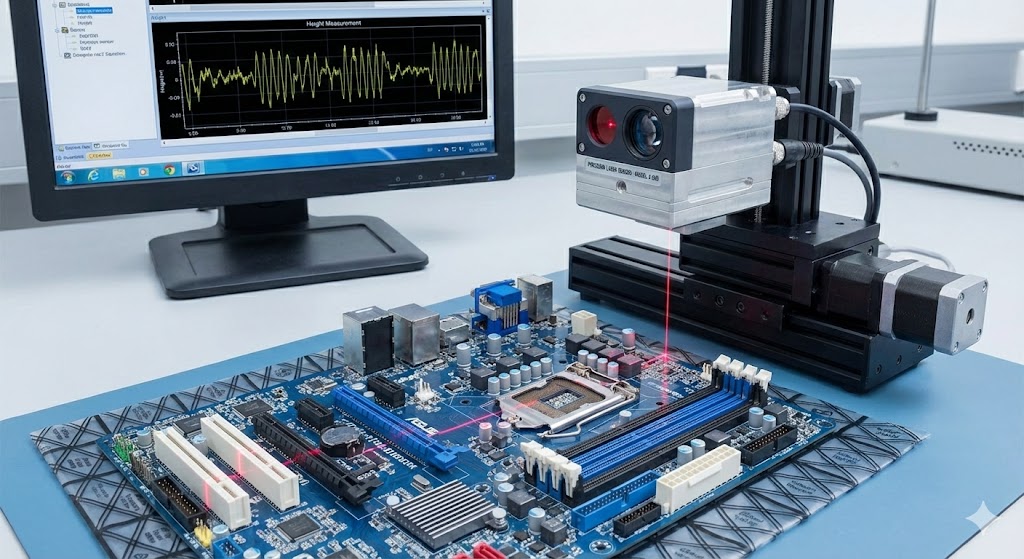
The applications of these sensors span virtually every industrial sector. In automotive manufacturing, they are crucial for inspecting panel gaps, measuring brake disc thickness, and ensuring the precise alignment of robotic welding arms. In the electronics industry, they verify the coplanarity of BGA (Ball Grid Array) solder balls and measure the warpage of circuit boards after reflow soldering. In civil engineering and construction, high-precision inclination sensors monitor the settlement of foundations, tilt of dams, and deflection of bridges over time. Furthermore, in aerospace, they are used to align large aircraft components and inspect turbine blade profiles.

Selecting the appropriate laser displacement and inclination sensor requires a careful analysis of the application requirements. The first consideration is the target material and surface characteristics. Dark, absorbent, or rough surfaces may require a sensor with higher laser power or a different wavelength. Highly reflective or transparent surfaces often need specialized sensors with controlled laser optics or background suppression technology. The required measurement range and stand-off distance directly influence the choice of sensor model. For dynamic measurements on fast-moving production lines, a high sampling rate is essential to avoid motion blur in the data.
Environmental conditions are paramount. Industrial settings may expose sensors to dust, oil, coolant, vibration, and significant temperature fluctuations. Therefore, ingress protection ratings (e.g., IP67) and operating temperature ranges must be evaluated. The output interface is another key decision point; common options include analog voltage/current, digital interfaces like RS-485 or Ethernet, and industrial fieldbus protocols such as PROFINET or EtherCAT. The choice depends on the existing control system architecture.
Integration and software support should not be overlooked. Many sensor manufacturers provide powerful configuration software for setting measurement windows, filters, and logic functions. Some advanced sensors offer built-in algorithms for edge detection, profile analysis, and even statistical process control (SPC). Ease of alignment and calibration, often assisted by visible pilot lasers or digital readouts, significantly reduces setup time and potential errors.
In conclusion, laser displacement and inclination sensors represent a pinnacle of optoelectronic measurement technology. Their ability to deliver fast, accurate, and reliable data without physical contact makes them vital for enhancing product quality, optimizing processes, and ensuring safety in modern industry. As technology advances, we can expect these sensors to become even more compact, intelligent, and integrated with Industry 4.0 platforms, enabling predictive maintenance and fully automated, data-driven manufacturing ecosystems. A thorough understanding of their principles and a methodical selection process are the keys to unlocking their full potential in any engineering application.
