In the realm of precision measurement and industrial automation, analog laser displacement sensors have established themselves as indispensable tools. Unlike their digital counterparts that output discrete values, these sensors provide a continuous analog signal—typically voltage (e.g., 0-10V) or current (e.g., 4-20mA)—that is directly proportional to the measured distance or displacement. This continuous output offers high-resolution, real-time data crucial for dynamic control systems and high-speed inspection tasks.
The fundamental operating principle is based on optical triangulation. The sensor's internal laser diode projects a focused beam of visible red or laser light onto the target surface. The reflected light is then captured by a receiving lens and focused onto a position-sensitive detector (PSD) or a CMOS/CCD linear image sensor. When the target distance changes, the position of the light spot on the detector shifts accordingly. This positional change is converted internally into a proportional analog electrical signal. The key advantage of this method is its ability to perform non-contact measurements, eliminating the risk of damaging delicate surfaces and allowing measurements on hot, moving, or otherwise inaccessible objects.
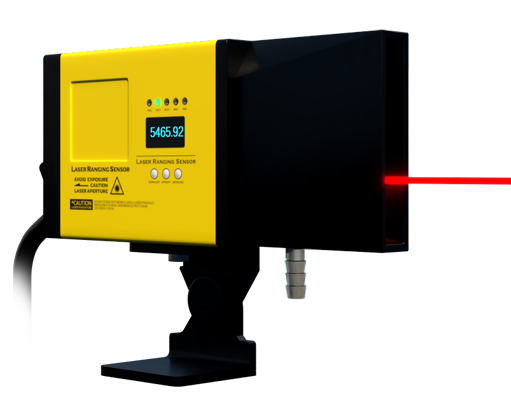
The performance of an analog laser displacement sensor is characterized by several critical specifications. The measuring range defines the minimum and maximum distances over which the sensor can operate accurately. Resolution refers to the smallest detectable change in distance, often in the micrometer or sub-micrometer range for high-end models. Linearity indicates the deviation of the sensor's output from a perfect straight-line relationship between actual distance and output signal; lower nonlinearity error means higher accuracy. Response time or sampling rate determines how quickly the sensor can update its output, which is vital for high-speed production lines. Furthermore, the characteristics of the target surface—such as color, material, roughness, and inclination—significantly influence the measurement stability and must be carefully considered during selection and setup.
The applications of these sensors are vast and span numerous industries. In automotive manufacturing, they are used for precise gap and flush measurement between body panels, thickness inspection of brake pads, and vibration analysis. In electronics, they verify the coplanarity of IC leads, measure solder paste height, and inspect component placement on PCBs. Within the metalworking sector, they monitor thickness during rolling processes, control vibration in machining centers, and measure runout of rotating shafts. Their analog output is particularly beneficial in closed-loop control systems, where the continuous signal is fed directly into a PLC or motion controller to instantly adjust actuator positions, maintaining tight tolerances in real-time. They are also extensively used for profile scanning, where the sensor is moved across an object to create a detailed 2D height map.
Selecting the right analog laser displacement sensor requires a thorough analysis of the application requirements. Key factors include the required measuring range, resolution, and accuracy. The target material and surface condition dictate the choice of laser type and power; for instance, a diffuse reflection model with automatic gain control is better for varying surface colors, while a coaxial model might be necessary for shiny or mirror-like surfaces. The environmental conditions are equally important; sensors may need protective housings with IP ratings for dust and water resistance, or specialized cooling for high-ambient-temperature environments. The choice between voltage and current output depends on the noise immunity needed and the distance to the receiving controller; 4-20mA signals are generally more robust over long cable runs in electrically noisy industrial settings. Finally, features like programmable analog output scaling, teach-in functions for setting measurement windows, and built-in amplifiers simplify integration and calibration.
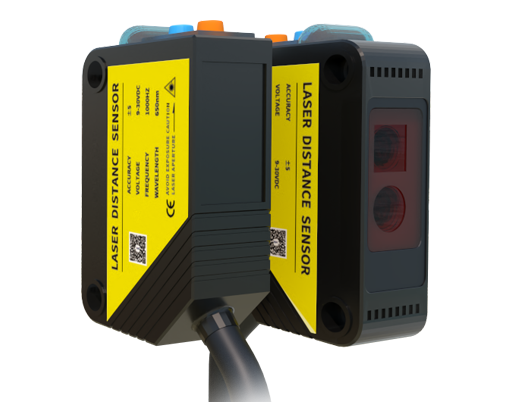
While offering exceptional performance, these sensors have limitations. They can be sensitive to ambient light interference, though most modern models incorporate optical filters to mitigate this. Highly transparent, specular, or steeply angled surfaces can pose measurement challenges, often requiring special accessories like retro-reflective targets or fixed-angle mounts. Regular maintenance, such as keeping the lens clean, is essential for consistent accuracy.
In conclusion, analog laser displacement sensors are powerful, versatile instruments that deliver continuous, high-precision measurement data. Their role in enhancing quality control, enabling automation, and facilitating research and development continues to grow. By carefully matching the sensor's specifications to the specific demands of the application—considering target properties, environmental factors, and system integration needs—engineers can leverage this technology to achieve new levels of precision, efficiency, and reliability in their measurement and control processes. As technology advances, we see trends towards miniaturization, higher speeds, and smarter sensors with embedded diagnostics, further expanding their potential in the industrial landscape.