In the realm of industrial automation, the reliable detection of objects is paramount. Among the myriad of sensing technologies available, the inductive proximity sensor stands as a cornerstone for countless applications involving metallic targets. This article delves into the specifics of a common and highly versatile configuration: the NPN 2mm 3-wire DC proximity sensor. We will explore its operating principle, wiring methodology, key characteristics, and typical use cases to provide a comprehensive understanding for engineers and technicians.
At its core, an inductive proximity sensor generates an electromagnetic field from its sensing face. When a metallic object enters this field, eddy currents are induced within the target, causing a change in the oscillation amplitude within the sensor's internal circuit. This change is detected and triggers a switching action in the sensor's output stage. The "2mm" designation refers to the nominal sensing distance, or Sn. For a standard 2mm sensor, this is the guaranteed operating distance for a defined mild steel target (typically a 1mm thick square). It is crucial to note that the effective sensing range can vary with different metals; for instance, aluminum or copper may reduce the effective range due to their lower permeability.
The "NPN" and "3-wire" descriptors define the electrical output configuration. An NPN sensor utilizes an NPN transistor as its switching element. In a 3-wire DC sensor, you will find three distinct wires: Brown (typically for DC positive supply, +V), Blue (typically for DC common or 0V), and Black (the switched output signal wire). In an NPN configuration, the Black wire is connected to the load (such as a PLC input, relay coil, or indicator lamp). The other side of the load is connected to the positive supply (+V). When the sensor detects a target, the internal NPN transistor switches ON, effectively connecting the Black output wire to the Blue wire (0V). This completes the circuit to the load, allowing current to flow from +V, through the load, into the Black wire, and out through the Blue wire to 0V. Therefore, an NPN sensor is often described as a "sinking" output—it sinks current from the load to common.
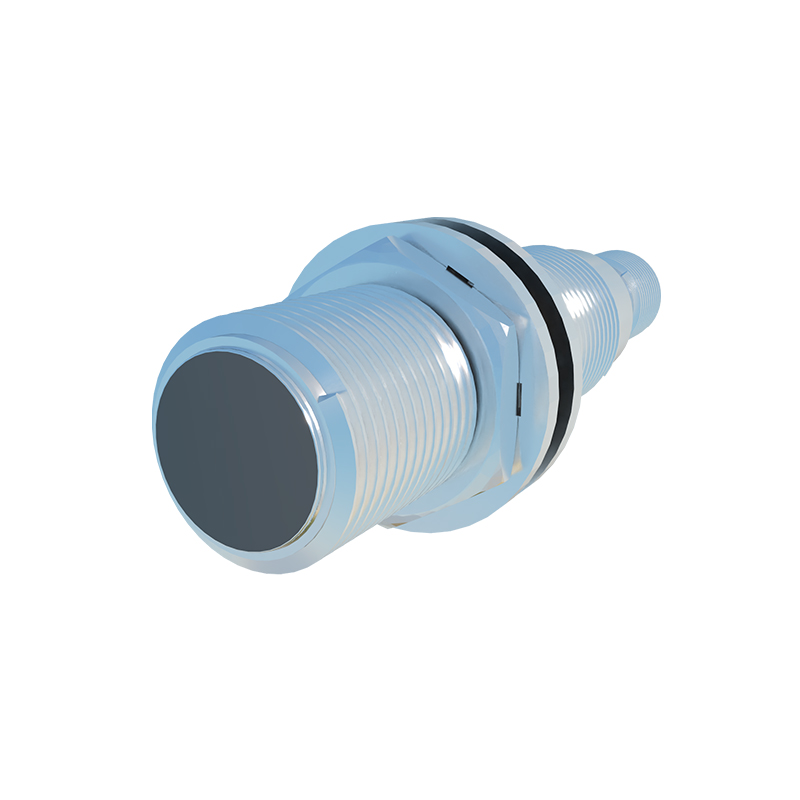
This contrasts with a PNP sensor, which is a "sourcing" output. Understanding this distinction is critical for proper integration with programmable logic controllers (PLCs) and other control devices. Many PLC digital input modules are designed to accept either sinking (NPN) or sourcing (PNP) signals, but the wiring must be consistent. Incorrect wiring will result in no operation or potential damage.
The three-wire design offers significant advantages over two-wire sensors. It provides a dedicated output wire, allowing for a clear separation between the power supply circuit and the switching signal. This leads to lower leakage current, more stable operation, and the ability to handle a wider range of load currents. The 2mm sensing distance is ideal for applications requiring precise detection of small parts or where space constraints are severe. Common applications include:
Detecting the presence of screws, nuts, or small metal components on assembly lines.
End-of-travel or homing sensing for compact linear actuators or slides.
Confirming the position of miniature pneumatic cylinders.
Counting teeth on small gears or detecting perforations in metal strips.
Integration into jigs and fixtures for machining centers to verify part placement.
When selecting and installing a 2mm NPN 3-wire sensor, several factors must be considered. Environmental conditions such as temperature, humidity, and the presence of cutting fluids or metallic dust should be matched to the sensor's IP (Ingress Protection) rating. The switching frequency, or response time, must be fast enough for high-speed applications. Furthermore, the sensor should be mounted securely, ensuring that only the target metal approaches the sensing face axially to achieve the rated 2mm distance. Adjacent metal (mounting brackets, machine frames) can cause interference and must be avoided by maintaining the recommended lateral and flush-mounting clearances specified in the datasheet.
In summary, the NPN 2mm 3-wire inductive proximity sensor is a precision tool for industrial automation. Its sinking NPN output, derived from a robust three-wire circuit, offers reliable interfacing with modern control systems. The compact 2mm sensing range enables detection in tight spaces, making it indispensable for intricate machinery and high-precision manufacturing tasks. A thorough grasp of its wiring, operating principles, and application boundaries ensures optimal performance and longevity in demanding industrial environments.