Proximity sensors are indispensable components in modern industrial automation, providing non-contact detection of objects within a defined sensing range. Their ability to operate without physical contact eliminates mechanical wear, ensures high reliability, and enables fast response times, making them superior to traditional mechanical limit switches in countless applications. Understanding their fundamental operating principles is the first critical step toward proper selection and implementation.
The core principle of all proximity sensors is to generate an electromagnetic field or beam and detect changes in that field caused by the presence of a target object. The primary technologies are Inductive, Capacitive, Ultrasonic, and Photoelectric, each with distinct operating mechanisms and ideal use cases.
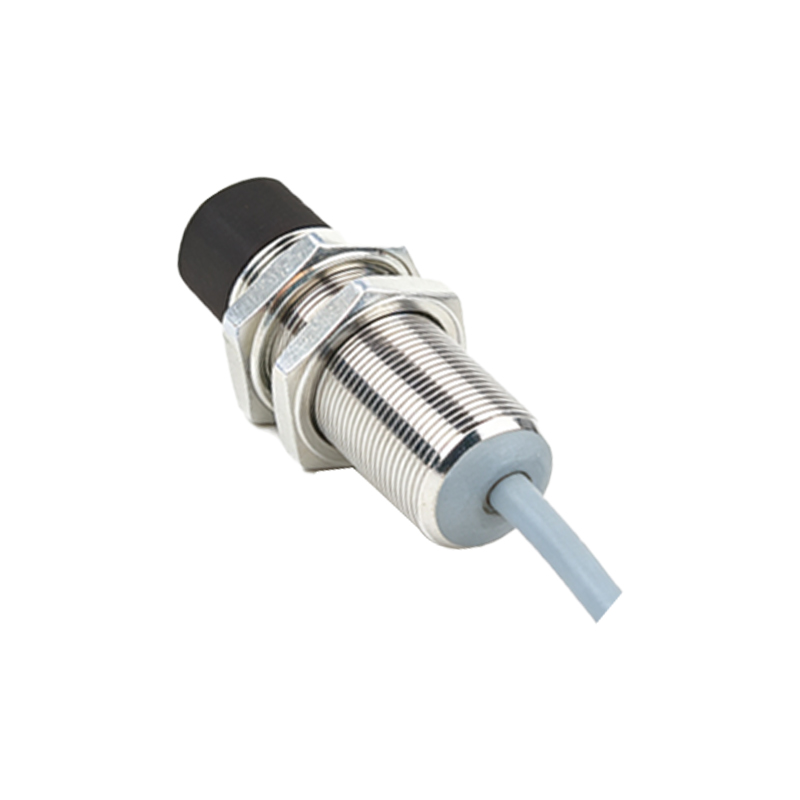
Inductive Proximity Sensors are the most common type for metal detection. They consist of an oscillator circuit that generates a high-frequency electromagnetic field at the active sensing face. When a metallic target enters this field, eddy currents are induced on the target's surface. These currents draw energy from the sensor's oscillator, causing a reduction in oscillation amplitude. This change is detected by a threshold circuit, which subsequently switches the sensor's output state. Inductive sensors are highly robust, insensitive to non-metallic materials like dust or oil, and are ideal for detecting ferrous and non-ferrous metals in machinery, position sensing, and counting applications.
Capacitive Proximity Sensors can detect both metallic and non-metallic materials, including liquids, plastics, wood, and granules. They function by generating an electrostatic field. The sensor and the target act as two plates of a capacitor. As a target approaches, it alters the dielectric constant of the space between the plates, changing the capacitance of the sensor's circuit. Once this change reaches a preset threshold, the output switches. This makes capacitive sensors perfect for level detection in tanks (liquids or powders), material handling of non-metals, and detecting filled containers through thin walls.
Ultrasonic Proximity Sensors operate on a time-of-flight principle. They emit high-frequency sound pulses and measure the time interval between the emission and the reception of the reflected echo from a target. The distance to the object is calculated based on the speed of sound. These sensors are excellent for detecting objects regardless of color, transparency, or material, and are suitable for distance measurement, presence detection of complex-shaped objects, and level sensing in harsh environments with dust or vapor.
Photoelectric Sensors use a light beam (typically infrared, visible red, or laser) to detect objects. They come in three main styles: Through-beam (separate emitter and receiver), Retro-reflective (single unit with a reflector), and Diffuse (single unit sensing reflected light from the target). An object is detected when it interrupts or reflects the light beam, changing the amount of light received. Photoelectric sensors offer the longest sensing ranges and can detect tiny objects, but their performance can be affected by environmental factors like ambient light, dust, and the color or reflectivity of the target.
Key Selection Criteria:
1. Target Material: This is the foremost consideration. For metals only, choose inductive. For virtually any material including liquids, choose capacitive or ultrasonic. For precise small-part detection, photoelectric may be best.
2. Sensing Distance: The required nominal sensing range and the necessary safety margin (usually 70-80% of nominal rating). Consider the sensor's hysteresis (difference between switch-on and switch-off points).
3. Output Type: Digital outputs (PNP/NPN sinking/sourcing) for connection to PLCs, or analog outputs (4-20mA, 0-10V) for distance-proportional signals. Relay outputs are used for high-power switching.
4. Environmental Conditions: Factor in temperature extremes, presence of chemicals, washdown requirements (IP67/IP69K ratings), and potential for electrical noise or physical impact.
5. Size and Mounting: The sensor must physically fit the installation space. Consider flush-mountable or non-flush designs (inductive), and threaded barrel or block-style housings.
6. Response Frequency: The maximum number of detection cycles per second. Critical for high-speed counting or sorting applications.
7. Electrical Connection: 2-wire, 3-wire, or 4-wire designs; pre-wired cables or quick-disconnect connectors.
A systematic approach to selection involves clearly defining the application: What is the target? What is the required sensing distance? What are the environmental challenges? What output is needed? By matching the sensor's core technology and specifications to these answers, engineers can ensure reliable, maintenance-free operation. Proper installation is also crucial; ensuring correct alignment, avoiding sensor-to-sensor interference, and providing stable power supplies are essential for optimal performance. In summary, proximity sensors are powerful tools for automation. A deep understanding of their principles