In the intricate world of industrial automation, the reliability and precision of sensing technology form the backbone of efficient operations. Among the myriad of components, proximity sensors stand out for their critical role in non-contact detection. This article provides a comprehensive technical analysis of the GX-5MU/GX5M series proximity sensor, exploring its design, functionality, and application scenarios to aid engineers and system integrators in making informed decisions.
The GX-5MU/GX5M represents a class of inductive proximity sensors, engineered primarily for the detection of metallic objects without physical contact. Its core operating principle is based on electromagnetic induction. The sensor generates a high-frequency oscillating electromagnetic field from its active face. When a metallic target enters this field, eddy currents are induced within the target, causing a change in the oscillation amplitude within the sensor's internal LC circuit. This change is detected, processed, and triggers a switching action in the sensor's output circuit. This fundamental mechanism ensures high-speed, wear-free operation, which is paramount in high-cycle industrial environments.
Delving into the specifications, the "5" in the model designation typically refers to the sensing distance, which is 5mm for this series. This standardized sensing range offers a optimal balance for many applications, providing sufficient distance for mechanical clearance while maintaining detection reliability. The housing is commonly constructed from nickel-plated brass or stainless steel, offering excellent resistance to corrosion, oils, and coolants, making it suitable for harsh manufacturing settings like machining centers or assembly lines. The sensor is often available in both shielded (flush-mountable) and unshielded (non-flush-mountable) variants. The shielded type (likely denoted by a specific suffix) allows for side-by-side mounting without mutual interference, a crucial feature in space-constrained installations.
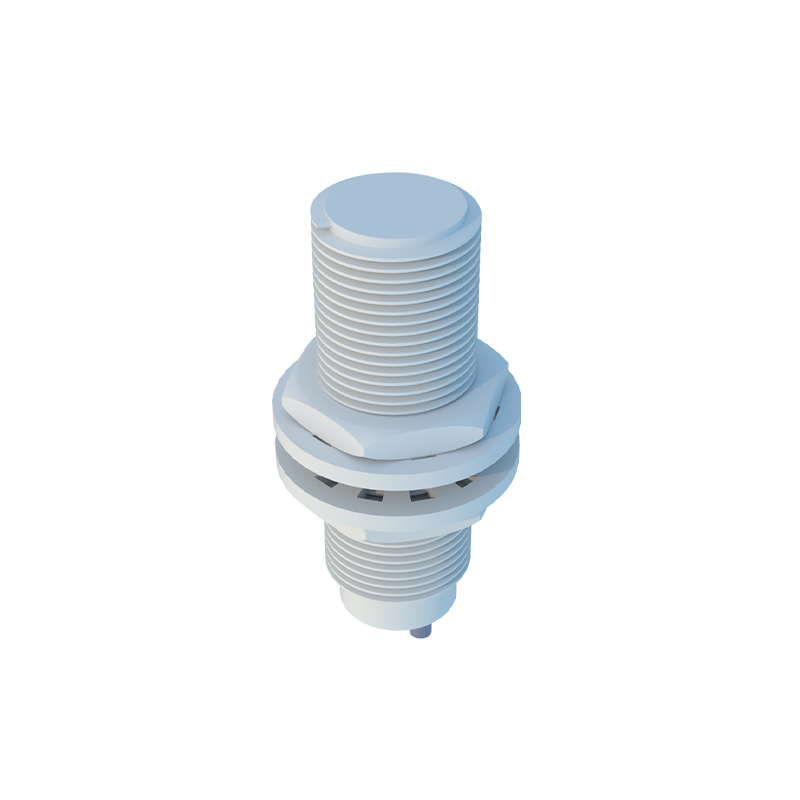
Electrical characteristics are a key consideration. The GX-5MU/GX5M series is predominantly available in DC configurations (e.g., 10-30V DC), with options for NPN (sinking) or PNP (sourcing) transistor outputs. The choice between NPN and PNP depends on the control system's input card configuration (sourcing vs. sinking input). The output is typically in a normally-open (NO) or normally-closed (NC) configuration, providing flexibility for different logic control needs. Its switching frequency can reach several hundred Hertz, enabling it to detect objects on fast-moving conveyors. Furthermore, these sensors usually incorporate protection against short-circuit, reverse polarity, and surge voltages, enhancing system durability and reducing downtime.
A standout feature often associated with this series is its built-in diagnostic capability, sometimes indicated by an integrated LED indicator. This LED provides visual confirmation of power status and output switching, which is invaluable for quick troubleshooting and maintenance during installation and operation. The compact, cylindrical form factor (commonly M8 or M12 threaded barrel) facilitates easy installation into standard mounting brackets or directly into machined holes.
Application scenarios for the GX-5MU/GX5M are vast. It is extensively used for position verification, such as confirming the presence of a metal part in a fixture or the end position of a cylinder. In counting applications, it can tally metallic products on a line. It serves as a limit switch for robotic arms or linear actuators, providing precise positional feedback. In machine tools, it ensures tool presence or monitors workpiece positioning. Its robustness also makes it ideal for detecting metal targets in dirty or wet environments where optical sensors might fail.
When selecting and implementing the GX-5MU/GX5M, several best practices should be observed. First, ensure the target material is ferrous (like iron or steel) for optimal sensing distance; non-ferrous metals like aluminum or copper have a reduced effective range. The target size should generally be equal to or larger than the sensor's face diameter for reliable detection. Environmental factors such as ambient temperature, presence of strong electromagnetic fields, or conductive dust must be considered. Proper mounting, alignment, and wiring according to the manufacturer's datasheet are non-negotiable for achieving specified performance.
In conclusion, the GX-5MU/GX5M proximity sensor exemplifies a mature, reliable, and versatile solution for metallic object detection in automation. Its robust construction, consistent performance at a 5mm range, and diagnostic features make it a workhorse component in control panels, machinery, and automated systems. By understanding its technical nuances and application parameters, engineers can leverage this sensor to enhance machine safety, improve process accuracy, and boost overall operational efficiency. As with any critical component, always refer to the official technical data sheet for the specific model variant to confirm exact specifications and compatibility with your system requirements.