Selecting the appropriate laser sensor is a critical decision that directly impacts the efficiency, accuracy, and reliability of industrial automation, quality control, and measurement systems. With a vast array of technologies and specifications available, navigating the selection process requires a methodical approach based on application requirements. This guide outlines the key parameters and considerations for engineers and system integrators to ensure optimal sensor performance.
The first and foremost step is to clearly define the application. What are you trying to measure or detect? Common applications include distance measurement, precise positioning, contour profiling, edge detection, object presence, and thickness gauging. Each application imposes different demands on the sensor. For instance, high-speed assembly line presence detection prioritizes response time, while micron-level thickness measurement demands exceptional resolution and linearity.
Once the application is defined, evaluate the core performance specifications. Measurement Range is the distance over which the sensor can operate reliably. Ensure your target distance falls comfortably within the sensor's specified range, not at its extreme limits. Resolution is the smallest change in distance the sensor can detect. For precise profiling or dimensional checks, sub-micron resolution may be necessary. Accuracy and Linearity define how close the measurement is to the true value and how consistent the output is across the entire range, respectively. High-precision machining requires sensors with excellent accuracy and linearity.

Spot Size is a crucial, often overlooked, factor. The laser spot diameter at the target determines the sensor's ability to measure small features or edges. A smaller spot allows for higher spatial resolution but may be more susceptible to surface imperfections. For measuring narrow gaps or sharp edges, a sensor with a focused, small spot is essential. Conversely, for averaging surface texture on rough materials, a slightly larger spot might be beneficial.
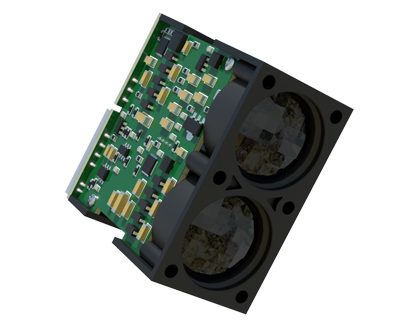
The Response Time or sampling rate dictates how quickly the sensor can take and output measurements. High-speed applications, such as monitoring vibrating parts or objects on a fast conveyor, require sensors with very high sampling rates (often in the kHz range) to capture data without aliasing.
Next, consider the Target Characteristics. The material, color, surface finish, and orientation of the target object significantly affect sensor performance. Standard diffuse reflection sensors work well on most matte surfaces, but shiny, mirror-like, or transparent materials (like glass or polished metal) pose challenges. For these, a triangulation sensor with a fixed angle between the laser emitter and receiver is often robust. For the most demanding surfaces, confocal chromatic sensors or specialized background suppression sensors may be required. Always consult with the sensor manufacturer about your specific target material.
Environmental conditions are a major determinant of sensor selection. Industrial settings can be harsh. Temperature fluctuations can affect electronic stability and laser wavelength. Choose sensors with a wide operating temperature range and low temperature drift coefficients if used in non-climate-controlled areas. Ambient Light immunity is vital, especially from other lasers or strong IR sources. Look for sensors with modulated laser light and narrow-band optical filters. Contaminants like dust, oil mist, or coolant can obscure the lens. Sensors with a high IP rating (e.g., IP67) for dust and water ingress protection are necessary for wash-down or dirty environments. Some sensors feature integrated air purge connections to keep the lens clean.
The Output Interface must be compatible with your control system. Common outputs include analog (voltage or current), digital (PNP/NPN switches), and serial communication (RS-422, USB, EtherCAT, PROFINET). Analog outputs provide continuous measurement data, while digital outputs are for simple on/off detection. Industrial networks offer high-speed, multi-sensor integration capabilities. Also, consider mounting options, physical size, and whether a built-in display for configuration is needed.
Finally, factor in Installation and Alignment. Ease of setup can reduce downtime. Some sensors offer visible red lasers for easy alignment, while others use Class 1 invisible infrared lasers for eye safety. Remote sensor heads connected via fiber optics can be useful in space-constrained or high-temperature locations.
In conclusion, there is no universal "best" laser sensor. The optimal choice results from a careful balance of application needs, target properties, environmental constraints, and system integration requirements. Creating a detailed specification list based on the parameters discussed—range, resolution, spot size, target type, environment, and output—will guide you to a reliable and effective solution. Always leverage the expertise of sensor manufacturers and consider requesting a sample for on-site testing under real-world conditions to validate performance before finalizing your selection.