In the realm of industrial automation and precision measurement, laser displacement sensors have emerged as indispensable tools. Their non-contact nature, high accuracy, and rapid response time make them ideal for a wide array of applications, from quality control on assembly lines to robotic guidance and vibration analysis. Understanding their operational principles and optimal implementation strategies is crucial for maximizing their potential and ensuring reliable, long-term performance.
At its core, a laser displacement sensor operates by projecting a focused laser beam onto a target surface. The reflected light is captured by a receiving element, typically a Position Sensitive Detector (PSD) or a Charge-Coupled Device (CCD). The position of the light spot on this detector changes proportionally to the distance to the target. By precisely calculating this shift, the sensor outputs a highly accurate distance measurement. Two primary methods dominate: the triangulation method and the confocal method. Triangulation sensors, the most common, offer excellent balance between range, resolution, and cost for most industrial settings. Confocal sensors, using chromatic aberration principles, provide exceptional resolution for measuring transparent or multi-layered materials.
Successful deployment begins with meticulous selection. Key specifications must be aligned with the application's demands. Measurement range, the distance over which the sensor can operate, must encompass all expected target positions. Resolution, the smallest detectable change in distance, dictates the fineness of measurement. Repeatability, the sensor's ability to produce the same reading for the same position, is often more critical than absolute accuracy for comparative measurements. Spot size is another vital consideration; a smaller spot allows for measurement on intricate features but requires more precise alignment and a smoother surface. For shiny or transparent surfaces, models with specialized algorithms or coaxial optical designs are necessary to mitigate errors from diffuse or specular reflection.
Installation and environmental factors significantly impact sensor performance. Proper mounting is paramount to minimize vibration, which can introduce noise into the signal. The sensor should be positioned to ensure the laser beam is perpendicular to the target surface within the specified tolerance to avoid cosine error. Ambient light, particularly strong direct sunlight or other laser sources, can interfere with the sensor's receiver. Using sensors with modulated laser light or installing protective shrouds can effectively combat this. Temperature fluctuations can also affect electronic components and optical properties; selecting sensors with wide operating temperature ranges or built-in temperature compensation is advisable for unstable environments.
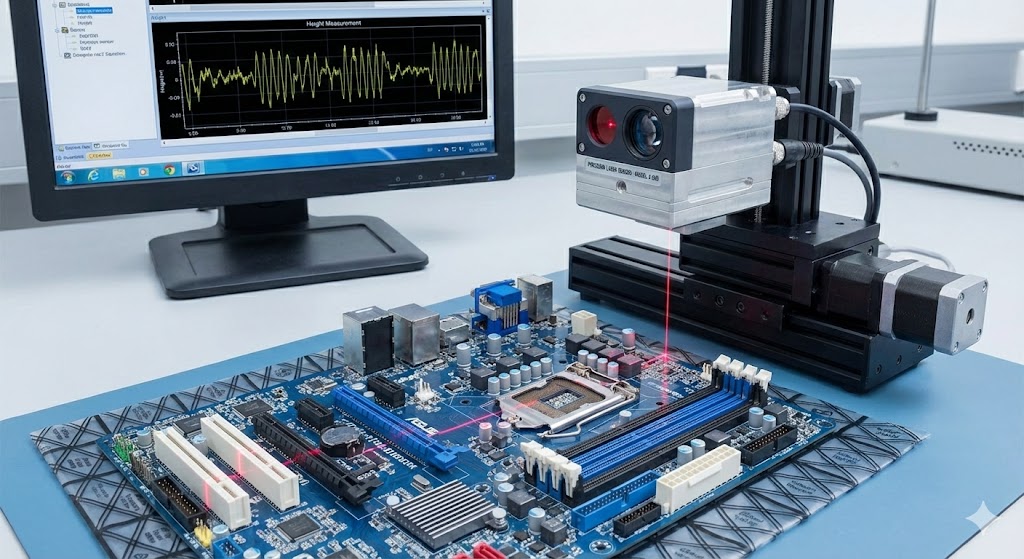
Integration into a control system is the final step. Most modern laser sensors offer analog outputs (e.g., 4-20mA, 0-10V) and digital interfaces (e.g., RS-485, Ethernet/IP, PROFINET). The choice depends on the required data transmission speed, distance, and network architecture. Signal conditioning is often necessary. Applying averaging filters can smooth out high-frequency noise, while peak-hold or valley-hold functions are useful for measuring moving or vibrating targets. Setting appropriate thresholds for go/no-go decisions in quality inspection stations automates the rejection of out-of-tolerance parts.
Regular maintenance and calibration ensure sustained accuracy. Lenses should be kept clean from dust and oil mist using appropriate cleaning materials. Periodic verification against a known standard, such as gauge blocks, confirms the sensor's performance has not drifted. Many high-end sensors feature self-diagnostic functions to alert users to potential issues like lens contamination or unstable power supply.

From verifying the gap in automotive door panels to monitoring the thickness of rolled steel or guiding a robotic arm for precise pick-and-place, laser displacement sensors are the silent guardians of precision. By adhering to fundamental principles of selection, installation, and integration, engineers can unlock their full capability, driving efficiency, quality, and innovation in modern manufacturing. Their role will only expand as the demand for micron-level accuracy and real-time process feedback continues to grow across advanced industries.