In the realm of industrial automation and quality control, precision measurement is paramount. Among the various technologies enabling this precision, 3D laser displacement sensors stand out for their speed, accuracy, and versatility. Gocator, a leading series of 3D smart sensors from LMI Technologies, has become a benchmark in this field. This article delves into the working principles, key features, and diverse applications of Gocator sensors, providing a comprehensive overview for engineers and decision-makers.
At its core, a Gocator sensor is a self-contained, embedded 3D measurement system. It utilizes laser triangulation to capture high-resolution profiles of a target object. The sensor projects a laser line onto the object's surface. This line becomes distorted based on the object's height and contour. A high-speed, high-resolution camera, precisely calibrated and integrated within the same housing, captures this distorted laser line. Sophisticated onboard algorithms then process this image data in real-time to generate precise 3D point cloud data—a dense collection of (x, y, z) coordinates representing the object's surface geometry. This all-in-one design eliminates the need for external controllers or PCs for basic operation, simplifying system integration.
The Gocator series is distinguished by several powerful features. First is its embedded intelligence. Each sensor runs a real-time operating system and includes a powerful processor, enabling it to perform complex measurement and inspection tasks directly on the sensor. Users can program measurement routines, set pass/fail criteria, and output results via digital I/O or industrial Ethernet protocols like EtherNet/IP or PROFINET without a separate computer. This "sensor as a system" approach reduces latency and system complexity.
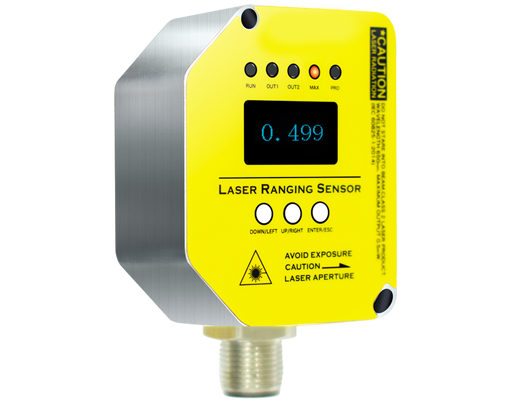
Second, Gocator sensors offer exceptional measurement performance. They are available in various models with different measurement ranges, standoffs, and field of views to suit specific applications. Key performance metrics include high Z-resolution (down to sub-micron levels on certain models), fast measurement speeds (thousands of profiles per second), and excellent repeatability. The sensors are also designed for industrial ruggedness, featuring robust housings with IP67 or IP69K ratings to withstand harsh environments involving dust, moisture, and vibration.
Third, the software ecosystem is a significant strength. Gocator sensors are configured and programmed using intuitive, browser-based interface software. This software provides tools for sensor setup, measurement tool configuration (like gap, flush, height, and volume), and real-time visualization of 3D data. For more advanced applications, LMI offers powerful SDKs for integration into custom software platforms, ensuring flexibility for system builders.
The applications of Gocator laser displacement sensors span numerous industries. In automotive manufacturing, they are used for robotic guidance, weld seam inspection, part presence verification, and dimensional inspection of critical components like brake pads and gaskets. In electronics, they inspect solder paste volume, component coplanarity, and connector pin height. In tire manufacturing, they perform precise tread and sidewall inspection. In logistics, they enable parcel dimensioning and volume calculation. Furthermore, they are instrumental in wood processing, food and beverage packaging, and metal fabrication for tasks like flatness measurement and defect detection.
When integrating a Gocator sensor, several factors must be considered. The choice of model depends on the required field of view, working distance, and the level of detail needed. Environmental factors such as ambient light, reflective or dark surfaces, and target speed must be accounted for; many Gocator models include features like multiple exposure modes and laser power control to handle challenging surfaces. Proper mechanical mounting and calibration are crucial for achieving specified accuracy.
In conclusion, Gocator 3D laser displacement sensors represent a fusion of advanced optical engineering, embedded computing, and user-centric design. They transform complex inspection and measurement challenges into reliable, high-speed, and easily deployable solutions. By delivering factory-calibrated precision in a compact, smart package, they empower engineers to enhance quality control, improve production efficiency, and enable new levels of automation. As Industry 4.0 continues to evolve, the role of intelligent sensors like the Gocator in creating connected, data-driven manufacturing environments will only become more critical.