Capacitive proximity sensors have become indispensable components in modern industrial automation, offering reliable non-contact detection capabilities for a wide range of materials. Among the various form factors available, the M8 capacitive proximity sensor stands out for its compact design, robust performance, and versatility in challenging environments. This article delves into the operational principles, key features, selection criteria, and practical applications of M8 capacitive sensors, providing engineers and technicians with essential knowledge for effective implementation.
At its core, a capacitive proximity sensor operates by generating an electrostatic field. The M8 sensor, with its 8mm threaded barrel housing, emits this field from its active face. When a target object enters this field, it causes a detectable change in capacitance. The sensor's internal oscillator circuit monitors this change, and once it reaches a predetermined threshold, the sensor's output switches state. Unlike inductive sensors, which only detect metals, capacitive sensors can detect virtually any material—liquids, plastics, glass, wood, and granular substances—provided the material has a sufficient dielectric constant. This makes the M8 capacitive sensor exceptionally versatile.
The compact M8 form factor is a significant advantage in space-constrained applications. Despite its small size, it is engineered for durability, typically featuring a housing made of nickel-plated brass or stainless steel, providing high resistance to corrosion, chemicals, and mechanical impact. Many models comply with IP67 or IP69K ingress protection ratings, ensuring reliable operation in washdown areas or dusty conditions. The sensing distance for a standard M8 capacitive sensor is typically up to 2mm, though some models offer adjustable sensitivity via a potentiometer, allowing users to fine-tune the detection range and ignore background materials like container walls.
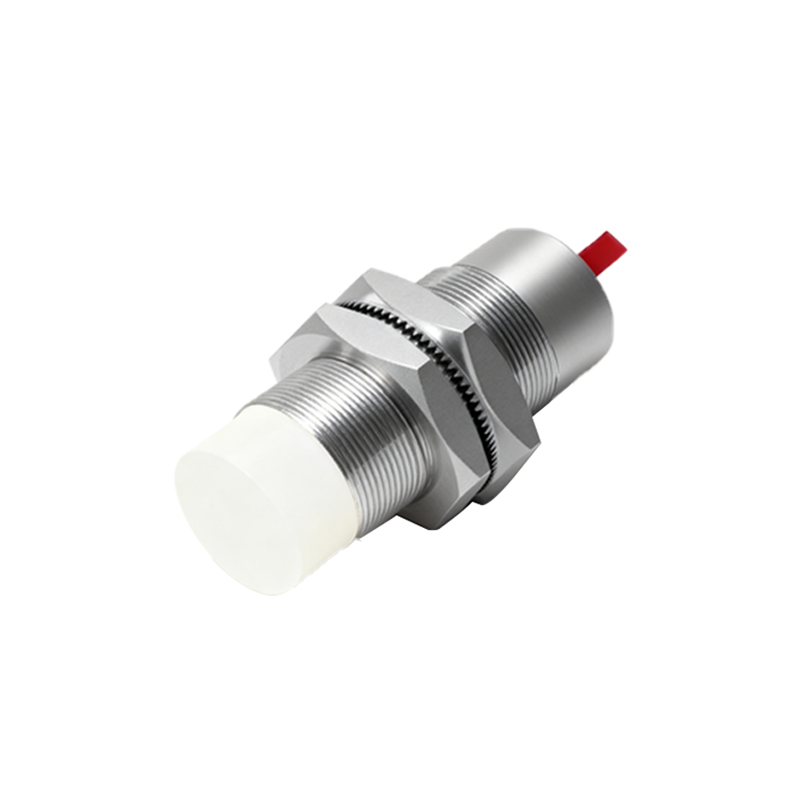
Output configurations are another critical consideration. M8 capacitive sensors are commonly available in both PNP (sourcing) and NPN (sinking) transistor outputs, as well as analog (4-20mA or 0-10V) and IO-Link variants for smart factory integration. The choice depends on the control system's requirements. The standard connection is achieved via a pre-wired cable or a quick-disconnect M8 connector, facilitating easy installation and maintenance.
Selecting the right M8 capacitive sensor requires careful analysis of the application. Key parameters include the target material's dielectric constant, the required sensing distance, the operating voltage (commonly 10-30V DC), switching frequency, and environmental conditions such as temperature extremes or exposure to aggressive media. For instance, detecting a low-dielectric material like plastic pellets may require a sensor with high sensitivity, while detecting liquid levels through a glass or plastic tank wall necessitates a model capable of compensating for the container material.
In practice, M8 capacitive sensors excel in numerous industrial scenarios. A primary application is liquid level detection in transparent or opaque containers, ensuring precise control in filling stations or preventing overflows. They are equally effective in detecting non-metallic objects on conveyor belts, such as cardboard boxes, bottles, or plastic components, enabling accurate counting and positioning. In packaging machinery, they verify the presence of labels, films, or adhesives. Furthermore, their ability to function despite dust, moisture, or buildup makes them ideal for harsh environments like food processing, woodworking, or agricultural equipment.
Installation and setup are straightforward but demand attention to detail. Mounting the sensor correctly is paramount; flush-mounted sensors have a reduced sensing range but are immune to lateral interference, while non-flush models offer longer ranges. Engineers must ensure that no other conductive objects are within the sensor's lateral area to prevent false triggering. Regular maintenance involves cleaning the active face from residues that could alter the dielectric environment and verifying the sensor's performance through its indicator LED.
In conclusion, the M8 capacitive proximity sensor is a powerful and flexible tool for industrial automation. Its ability to detect diverse materials in compact, rugged packaging solves complex sensing challenges. By understanding its technology, specifications, and application nuances, engineers can leverage these sensors to enhance system reliability, efficiency, and intelligence. As Industry 4.0 advances, the integration of smart M8 sensors with IO-Link will further unlock predictive maintenance and data-driven optimization, solidifying their role in the connected factory of the future.