In the realm of industrial automation and machine control, proximity sensors are indispensable components for non-contact object detection. Among the various configurations available, the 4-wire proximity sensor stands out for its unique capabilities and widespread use in demanding applications. This article delves into the technical specifics, operational principles, and practical considerations of 4-wire DC proximity sensors, providing a comprehensive guide for engineers and technicians.
Fundamentally, a proximity sensor detects the presence or absence of a target object without physical contact, typically using electromagnetic, capacitive, or ultrasonic principles. Inductive proximity sensors, the most common type for metallic target detection, operate on the principle of electromagnetic induction. A 4-wire DC sensor integrates both the sensing element and a solid-state switching output into a single device, requiring four distinct electrical connections for proper functionality.
The core distinction of the 4-wire design lies in its wiring configuration and output type. Unlike 2-wire sensors that are wired in series with the load, or 3-wire sensors that have separate power, ground, and signal wires, the 4-wire sensor provides two additional critical paths. The standard wiring for a DC sensor is as follows:
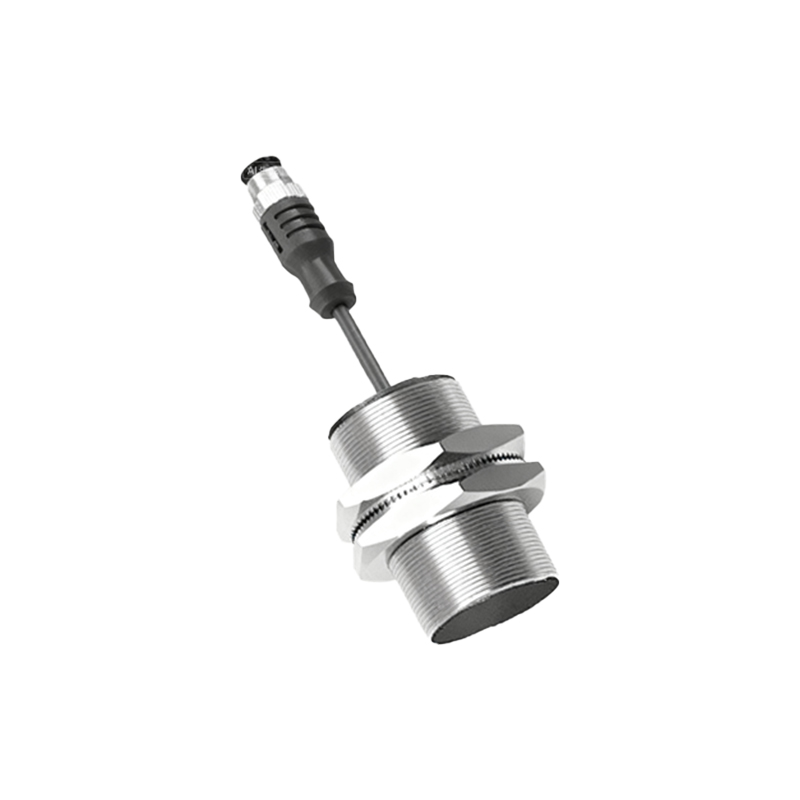
Brown Wire (+V): This is the positive DC supply voltage terminal. Common operating voltages range from 10-30 VDC, with 24 VDC being the industry standard for most control systems.
Blue Wire (0V): This is the negative DC supply voltage return or ground terminal.
Black Wire: This is the output signal wire for one switching channel.
White Wire: This is the output signal wire for a second switching channel.
The key operational feature is that the black and white wires provide two independent output signals. These outputs can be configured in several ways, offering significant flexibility. The most prevalent configuration is one Normally Open (NO) and one Normally Closed (NC) output from the same sensing head. In the absence of a target, the NO output is inactive (open circuit), while the NC output is active (closed circuit, allowing current to flow). When a target enters the sensor's sensing range, the states switch: the NO output becomes active, and the NC output becomes inactive. This complementary output scheme is invaluable for creating control logic that requires both presence and absence signals, enhancing safety and diagnostic capabilities.
Another possible configuration is dual NO or dual NC outputs, though less common. The outputs are typically solid-state switches, often using MOSFET or transistor technology, capable of switching small to moderate loads directly. It is crucial to consult the sensor's datasheet for the specific output type (PNP-sourcing or NPN-sinking), voltage ratings, and maximum load current (often around 100-200mA per output).
The advantages of using a 4-wire proximity sensor are substantial. First, the dual outputs reduce the need for multiple sensors in control panels where both states of a process are monitored, saving space, wiring, and cost. Second, the independent wiring for power and output simplifies troubleshooting and circuit design compared to 2-wire models. The separate supply ensures stable operation unaffected by load variations. Third, the complementary NO/NC outputs provide built-in redundancy and fail-safe monitoring. For instance, a system can be programmed to trigger an alarm if both outputs are simultaneously active or inactive, indicating a sensor fault.
In practical industry applications, 4-wire sensors are frequently deployed in:
Safety Interlocking: Using the NC output for a safety circuit that must be maintained in a closed state for machine operation.
Position Verification: In automated assembly lines, confirming a part is both present (via NO) and properly seated or absent (via NC) before initiating the next cycle.
State Monitoring: On rotary machines or indexing tables, detecting the "home" position and a "limit" position with a single sensor.
Pneumatic Valve Control: Directly controlling the two solenoids of a 5/2 or 4/2 directional control valve for bidirectional cylinder movement.
Installation and maintenance require attention to detail. Ensure the correct voltage polarity is observed. Metallic mounting surfaces can reduce the effective sensing range (sn), so non-metallic brackets are recommended. Maintain adequate clearance around the sensing face to prevent interference from adjacent metal. Always follow the manufacturer's specifications for sensing distance, which is typically defined for a standard mild steel target. For other metals, a correction factor must be applied.
In conclusion, the 4-wire proximity sensor is a versatile and robust solution for advanced sensing tasks in industrial environments. Its dual-output design offers enhanced control logic possibilities, improved diagnostics, and system reliability. By understanding its wiring, operational modes, and ideal applications, engineers can effectively integrate these sensors to create more efficient, safe, and intelligent