In the realm of industrial automation and precision engineering, laser sensor measurement modules have emerged as indispensable tools. These devices utilize laser technology to perform non-contact, high-accuracy measurements of distance, displacement, height, thickness, and profile. Their operation is fundamentally based on the principle of triangulation or time-of-flight (ToF). In triangulation sensors, a laser diode projects a visible spot onto the target surface. The reflected light is focused onto a position-sensitive detector (PSD) or a CMOS/CCD array. Any change in the target's distance causes the reflected spot to shift position on the detector, which is then calculated to determine the precise measurement. Time-of-flight sensors, on the other hand, measure the time it takes for a laser pulse to travel to the target and back, calculating distance based on the speed of light. This method is often used for longer ranges.
The advantages of laser measurement modules are numerous. They offer exceptional resolution, often down to the sub-micron level, and high repeatability. Their non-contact nature eliminates the risk of damaging delicate surfaces and allows for measurements on hot, moving, or otherwise inaccessible objects. High sampling speeds enable real-time process control in dynamic environments. Furthermore, modern modules are increasingly compact, robust, and integrated with intelligent features like onboard processors for data evaluation and various digital interfaces (e.g., IO-Link, Ethernet/IP, PROFINET) for seamless integration into industrial networks.

Applications span across diverse industries. In automotive manufacturing, they are used for gap and flush measurement on body panels, brake disc thickness monitoring, and robotic guidance. In electronics, they ensure the coplanarity of semiconductor packages and measure component heights on PCBs. The pharmaceutical industry employs them for fill level inspection in vials and blister pack quality control. In logistics, they facilitate dimensioning systems for parcels. Metal processing utilizes them for thickness gauging of sheets and profile monitoring during rolling processes. Even in R&D laboratories, these sensors are crucial for material testing and prototype validation.
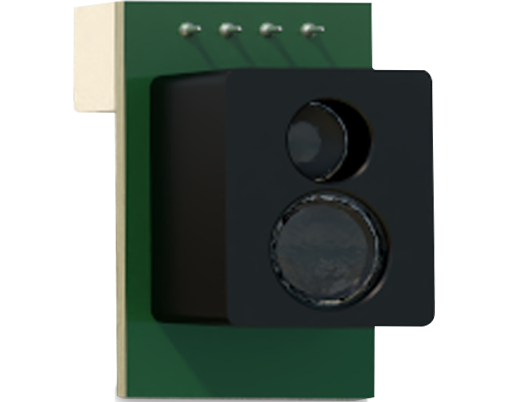
Selecting the appropriate laser sensor module requires careful consideration of several key parameters. The measuring range defines the minimum and maximum distances over which the sensor can operate accurately. Resolution and linearity specify the smallest detectable change and the maximum deviation from a straight-line response, respectively. The spot size is critical; a smaller spot allows for measurements on edges or small features but may be affected by surface texture. The type of laser (typically red visible or Class 1/Class 2 infrared) and its wavelength influence performance on different materials. Environmental factors are paramount: the sensor's housing rating (IP67, IP69K), operating temperature range, and resistance to ambient light, dust, or vibrations must match the installation conditions. Finally, the output type (analog voltage/current, switching signals, serial data) and connectivity must align with the existing control system architecture.
Recent advancements are pushing the boundaries further. Confocal chromatic sensors offer even higher precision for transparent or reflective surfaces. Line laser profilers generate 2D/3D profiles instead of single-point measurements, enabling shape inspection. Integration with AI and machine vision systems allows for complex pattern recognition and adaptive quality decisions. The trend is towards smarter, more connected sensors that provide not just raw data, but actionable insights for predictive maintenance and Industry 4.0 initiatives.
In conclusion, laser sensor measurement modules are a cornerstone of modern precision measurement. Their ability to deliver fast, accurate, and reliable data without physical contact makes them vital for quality assurance, process optimization, and automation across countless sectors. Understanding their operating principles, vast application potential, and critical selection criteria is essential for engineers and technicians aiming to leverage their full capability to enhance productivity and product quality.