In the realm of industrial automation, precision and reliability are paramount. Among the myriad of sensing technologies available, laser sensors with background suppression have emerged as a critical tool for enhancing operational accuracy and efficiency. These advanced sensors utilize a focused laser beam to detect objects, while intelligently ignoring irrelevant background surfaces, making them indispensable in complex manufacturing and logistics environments.
The fundamental principle behind laser background suppression sensors lies in their ability to differentiate between the target object and its background based on distance or reflectivity. Unlike standard diffuse reflection sensors that might be triggered by any reflective surface within range, these sensors employ triangulation or time-of-flight methods to measure the exact position of the target. For instance, in a triangulation-based design, the emitted laser light reflects off the target and is received by a photodetector at a specific angle. The sensor's integrated electronics calculate the distance by analyzing the angle of the reflected beam, allowing it to suppress signals from objects beyond a set threshold—effectively "ignoring" the background. This capability is crucial in applications where the sensing environment is cluttered or where the target and background have similar colors or textures.
Key applications of laser sensors with background suppression span various industries. In automotive assembly lines, they ensure precise detection of components on conveyor belts, regardless of the belt's movement or surrounding machinery. In packaging, these sensors accurately identify labels on contrasting backgrounds, reducing errors in sorting and labeling processes. Additionally, in material handling, they enable reliable object detection in bins or pallets, even when the background consists of reflective metal surfaces. The high resolution and fast response time of laser sensors—often in the microsecond range—make them ideal for high-speed production lines where milliseconds matter.
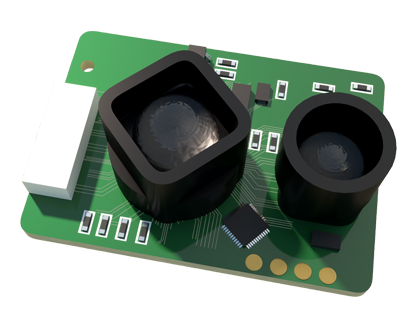
When selecting a laser background suppression sensor, engineers must consider several technical parameters. The sensing range, typically from a few millimeters to several meters, should align with the application's requirements. The laser class (usually Class 1 or 2 for safety) ensures compliance with international standards, minimizing risks to operators. Environmental factors such as ambient light, dust, and temperature fluctuations also play a role; many models feature robust housings (e.g., IP67 ratings) and filters to mitigate interference. Furthermore, programmability via teach-in functions allows users to set suppression thresholds on-site, enhancing flexibility. For example, a sensor can be configured to detect only objects within 50-100 mm, ignoring anything farther away, which is invaluable in automated storage systems.
Despite their advantages, challenges exist. Highly reflective or transparent objects may cause false readings, requiring careful calibration or complementary sensor types. Regular maintenance, including lens cleaning and alignment checks, is essential to sustain performance. However, advancements in technology, such as the integration of IO-Link for digital communication and smart diagnostics, are addressing these issues, paving the way for Industry 4.0 integration.
In conclusion, laser sensors with background suppression represent a sophisticated solution for modern industrial automation. By combining precise laser measurement with intelligent signal processing, they overcome limitations of traditional sensors, driving improvements in quality control, safety, and productivity. As industries continue to evolve toward smarter factories, the adoption of these sensors is set to grow, underscoring their role as a cornerstone of efficient and reliable automation systems.