In the realm of precision measurement and industrial automation, laser displacement sensors have become indispensable tools. Among the prominent manufacturers, Ruidu stands out with its advanced and reliable laser displacement sensor solutions. These devices are engineered to deliver high-accuracy, non-contact measurements, making them vital across diverse sectors from manufacturing and robotics to quality control and research.
At the core of Ruidu laser displacement sensors is the principle of triangulation. A laser diode projects a focused beam onto the target surface. The reflected light is then captured by a high-resolution CMOS or CCD linear image sensor at a specific angle. By precisely calculating the position of the light spot on the receiver, the sensor determines the distance to the target with exceptional accuracy. Ruidu has refined this technology to achieve sub-micron resolution and high repeatability, even on challenging surfaces with varying reflectivity or color.
One of the key strengths of Ruidu sensors is their robust performance in industrial environments. They are typically housed in rugged, compact casings with high IP ratings, ensuring resistance to dust, water, oil, and mechanical vibrations. This durability is crucial for continuous operation on production lines. Furthermore, many models feature advanced algorithms for surface compensation, allowing stable measurements on glossy, transparent, or dark materials that traditionally pose difficulties for optical sensors.
The application spectrum for Ruidu laser displacement sensors is remarkably broad. In automotive manufacturing, they are used for precise gap and flush measurement between body panels, thickness inspection of brake discs, and vibration analysis. In electronics, they ensure the coplanarity of chip components on PCBs and measure the warpage of semiconductor wafers. Within the metalworking industry, these sensors monitor thickness during rolling processes, inspect surface profiles, and control robotic welding or cutting paths. Their high-speed response, often in the kilohertz range, makes them perfect for dynamic measurements on moving production lines.
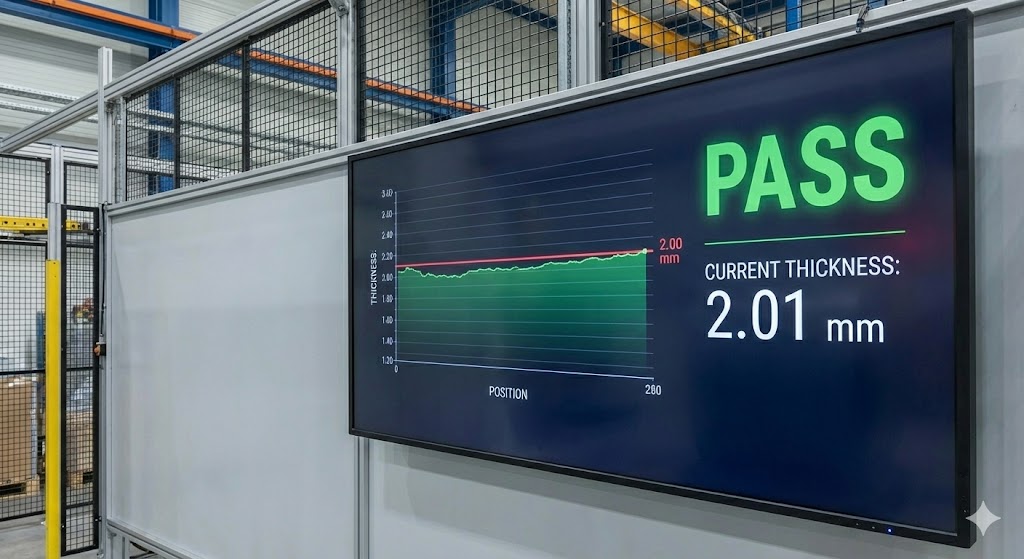
Integration is another area where Ruidu excels. Their sensors commonly support standard industrial communication protocols like Ethernet/IP, PROFINET, EtherCAT, and analog/digital I/O, facilitating seamless connection to PLCs, robots, and data acquisition systems. The accompanying software often provides intuitive interfaces for configuration, real-time data visualization, and advanced analysis, enabling quick setup and sophisticated application development.
When selecting a Ruidu laser displacement sensor, engineers must consider several parameters to match the device to the specific task. The measuring range, spot size, resolution, linearity error, and sampling speed are primary factors. For instance, a smaller spot size allows for measurement on tiny features or edges, while a larger measuring range offers more flexibility in mounting positions. Environmental factors like ambient light, temperature fluctuations, and the presence of steam or smoke must also be evaluated, as Ruidu offers models with specialized optics or filters to mitigate these interferences.
Looking ahead, the evolution of Ruidu laser displacement sensors is aligned with Industry 4.0 trends. Future developments may include enhanced embedded intelligence for edge computing, tighter integration with AI for predictive quality control, and even more miniaturized designs for micro-measurement tasks. The ongoing demand for higher precision, faster speeds, and greater reliability in automation ensures that these sensors will remain at the forefront of technological advancement.

In conclusion, Ruidu laser displacement sensors represent a sophisticated fusion of optical engineering, electronics, and software. Their ability to provide fast, accurate, and reliable non-contact measurements solves critical challenges in modern industry, driving efficiency, ensuring quality, and enabling innovation. For any engineer tasked with precision dimensional control, understanding and leveraging the capabilities of these sensors is a significant step toward optimizing automated processes.