In the realm of industrial automation and smart systems, large-scale proximity sensors play a pivotal role in enabling non-contact detection, object positioning, and process control. These sensors are engineered to operate efficiently over extended ranges and in complex environments, making them indispensable in applications such as automotive manufacturing, robotics, material handling, and security systems. This article delves into the structural blueprint of these sophisticated devices, breaking down their key components and operational principles.
At its core, a large-scale proximity sensor typically comprises several integral parts: the sensing element, oscillator circuit, signal conditioning unit, output stage, and housing. The sensing element, often based on inductive, capacitive, or ultrasonic technology, is responsible for generating an electromagnetic field or emitting waves. When a target object enters this field, it causes a detectable change—such as a shift in oscillation amplitude or frequency—that triggers the sensor's response. For instance, inductive sensors use a coil and ferrite core to create an alternating magnetic field, ideal for detecting metallic objects, while capacitive sensors rely on electrode plates to sense both conductive and non-conductive materials by measuring changes in capacitance.
The oscillator circuit is crucial for maintaining the sensor's active field. In inductive models, it drives the coil to produce a high-frequency electromagnetic field. Any metallic object within the proximity disturbs this field, leading to energy loss that the circuit detects. Capacitive sensors, on the other hand, utilize an oscillator that responds to variations in dielectric properties between the electrodes. This circuit is finely tuned to minimize false triggers and enhance sensitivity, especially in large-scale setups where environmental factors like temperature fluctuations or electromagnetic interference may pose challenges.
Following detection, the signal conditioning unit processes the raw data from the oscillator. This stage involves amplification, filtering, and conversion of analog signals into digital formats. Advanced sensors incorporate microcontrollers or digital signal processors (DSPs) to analyze the input, allowing for programmable features such as adjustable sensing ranges, hysteresis settings, and diagnostic functions. This intelligence enables the sensor to adapt to diverse industrial scenarios, from monitoring conveyor belts in logistics centers to ensuring precise alignment in assembly lines.
The output stage translates the processed signal into actionable commands. Common output types include digital switches (e.g., NPN or PNP transistors), analog voltage or current signals (e.g., 0-10V or 4-20mA), and serial communication protocols like IO-Link or PROFINET. These outputs interface with control systems, such as PLCs (Programmable Logic Controllers), to automate operations. For large-scale applications, sensors often feature robust output designs with overload protection and short-circuit resilience, ensuring reliability in high-demand environments.
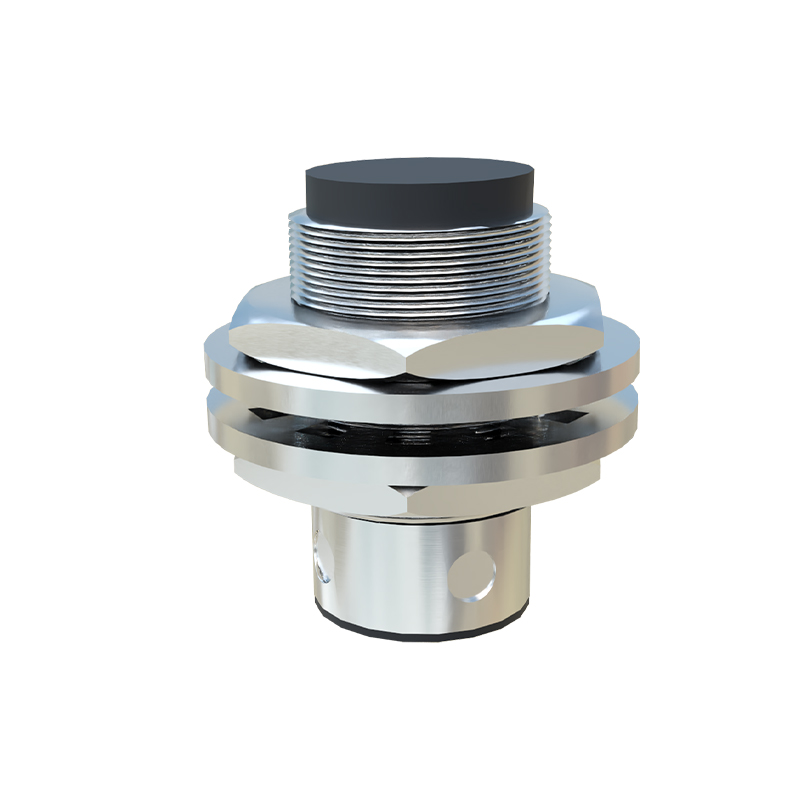
Housing and mechanical design are equally vital, particularly for durability and installation flexibility. Large-scale proximity sensors are typically encased in rugged materials like stainless steel or engineering plastics, rated for IP67 or higher ingress protection to withstand dust, moisture, and mechanical shocks. Their form factors may include cylindrical, rectangular, or ring-shaped configurations, with mounting options tailored for specific industrial layouts. Additionally, many models incorporate LED indicators for status monitoring and teach-in buttons for easy configuration without external tools.
In practice, the architecture of these sensors is optimized for scalability and integration. For example, in automotive plants, arrays of inductive proximity sensors are deployed along production lines to track vehicle components, with their structural design allowing for daisy-chaining or network connectivity. Similarly, in warehouse automation, ultrasonic proximity sensors with advanced signal processing can map large areas for inventory management, leveraging their ability to ignore background noise.
Emerging trends are further shaping sensor architecture, with innovations like IoT-enabled sensors embedding wireless modules for real-time data transmission and predictive maintenance. These smart sensors often include self-diagnostic capabilities, reducing downtime and enhancing system efficiency. As industries evolve toward Industry 4.0, the design of large-scale proximity sensors continues to emphasize modularity, interoperability, and energy efficiency, ensuring they meet the growing demands of connected ecosystems.
Ultimately, understanding the structural diagram of large-scale proximity sensors provides insights into their reliability and versatility. By dissecting each component—from the sensing element to the output interface—engineers can better select, deploy, and maintain these devices, driving advancements in automation and safety across global industries.