Laser distance sensors, also known as laser rangefinders or LiDAR sensors, are pivotal in modern industrial automation, robotics, and surveying. A common inquiry among engineers and technicians is how these sensors manage to achieve penetration through certain materials, enabling measurements where line-of-sight is obstructed by semi-transparent or diffuse surfaces. This article delves into the principles, limitations, and applications of laser penetration in distance sensing.
The core technology behind laser distance sensors typically involves time-of-flight (ToF), phase-shift, or triangulation methods. For penetration, the key lies in the interaction between laser light and the material. Lasers used in industrial sensors often operate in the infrared spectrum, such as 850 nm or 905 nm wavelengths. These wavelengths can partially penetrate materials like thin plastics, glass, smoke, dust, and certain liquids. The degree of penetration depends on factors like material transparency, thickness, surface finish, and the laser's power and wavelength. For instance, a sensor with a 905 nm infrared laser might measure through a clean polycarbonate sheet, as the material is semi-transparent to that wavelength, allowing some light to pass through, reflect off a background object, and return to the sensor.
However, it is crucial to distinguish between true penetration and signal reflection from the obstructing surface itself. In many cases, what appears as penetration might actually be the sensor detecting the dominant reflected signal from the rear surface of a transparent material or from a secondary target behind a diffuse barrier. Advanced sensors with echo-processing capabilities can differentiate between multiple returns, enabling them to ignore the reflection from a front glass pane and instead measure the distance to a target behind it. This is particularly useful in applications like measuring liquid levels in transparent tanks or detecting objects behind protective windows.
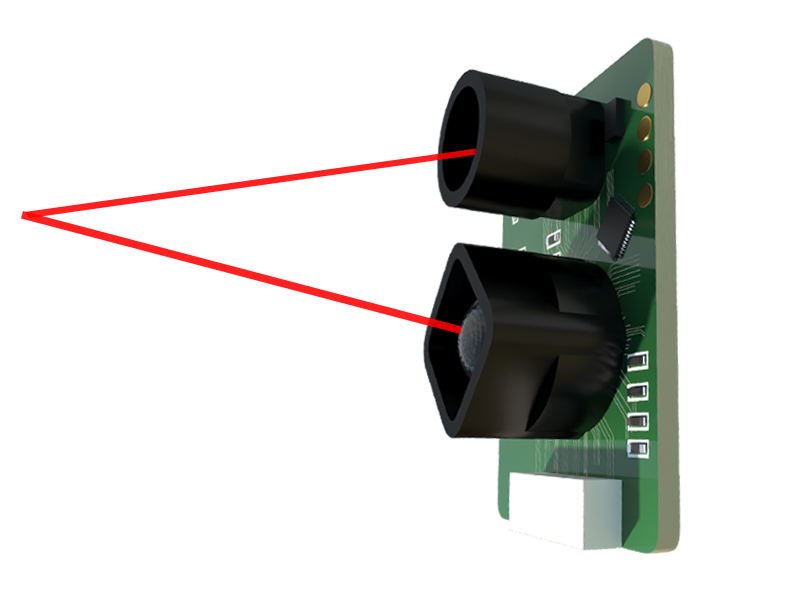
The limitations are significant. Most laser sensors cannot penetrate opaque materials like metals, thick walls, or heavily pigmented solids. Excessive material thickness or high opacity will attenuate the laser beam, leading to signal loss or inaccurate readings. Environmental factors such as ambient light interference, temperature, and humidity also affect performance. Engineers must carefully select sensors based on the specific material properties and application requirements. For example, in automotive LiDAR systems, sensors are designed to penetrate light rain or fog but may struggle with heavy precipitation.

Applications of laser sensors with penetration capabilities are diverse. In manufacturing, they are used for monitoring processes behind safety glass or inside enclosures. In logistics, they measure pallet dimensions through plastic wrapping. Agricultural robots employ them to see through light foliage for navigation. Furthermore, in level sensing, they can gauge substance heights in containers with transparent walls without direct contact.

To optimize penetration performance, consider these practices: choose a sensor with a wavelength suitable for the target material, ensure adequate laser power (within safety limits), use sensors with multi-echo evaluation, and maintain clean surfaces on obstructive materials. Calibration and testing in real conditions are essential for reliability.
In summary, laser distance sensors achieve penetration not by magic, but through careful engineering of optical properties and signal processing. While they offer versatile non-contact measurement through certain barriers, understanding their constraints is vital for successful implementation in industrial settings. Future advancements in laser technology and algorithms may expand these capabilities further, enhancing automation and precision across sectors.