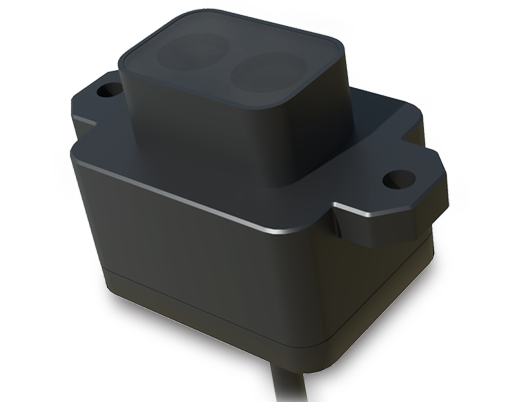
Laser displacement sensors represent a cornerstone of modern industrial measurement and automation. These non-contact devices provide high-precision, high-speed distance and position measurements, enabling critical quality control, process monitoring, and robotic guidance across countless sectors. Their operation is fundamentally based on the principle of optical triangulation, though more advanced methods like time-of-flight (ToF) and confocal imaging are employed for specific challenges.
At the heart of the most common type—the triangulation sensor—lies a simple geometric concept. The sensor emits a focused laser beam (typically a visible red laser or a Class 2 infrared laser for eye safety) onto the target surface. The diffused reflection from this point is then focused onto a position-sensitive detector (PSD) or a Charge-Coupled Device (CCD) or CMOS linear image sensor within the receiver unit. The position of this light spot on the detector shifts proportionally to the distance of the target. By precisely calculating this shift using the known baseline distance between the emitter and receiver lenses (forming a triangle), the sensor's internal processor determines the target's displacement with remarkable accuracy, often down to the sub-micron level.
Key performance specifications define a sensor's suitability for an application. Measurement range indicates the minimum and maximum distances over which it can operate accurately. Resolution refers to the smallest detectable change in distance, while linearity defines the maximum deviation of the sensor's output from a perfectly straight line across its range. Spot size, the diameter of the laser on the target, is crucial for measuring small features or uneven surfaces. Finally, sampling speed, often in the kilohertz range, determines how quickly the sensor can take measurements, a vital factor for high-speed production lines.
Several laser displacement sensor types cater to diverse needs. Standard diffuse reflection models are versatile for most surfaces but can be influenced by color and angle. Through-beam (or opposed) types, with separate emitter and receiver units, offer the longest range and highest stability, ideal for detecting presence or measuring transparent objects. Retro-reflective types use a reflector, maintaining a strong signal over long distances. For challenging surfaces like shiny metals or transparent glass, specialized models with coaxial optics or confocal chromatic principles are deployed. Confocal sensors use multi-wavelength light, and the detector reads the specific wavelength that focuses precisely on the target surface, providing exceptional accuracy even on mirror-like finishes.

The industrial applications are vast and transformative. In automotive manufacturing, these sensors measure critical component dimensions like piston protrusion, brake disc thickness, and body panel gaps with relentless precision. In electronics, they verify the coplanarity of IC leads, the height of solder paste, and the thickness of wafer substrates. In metal processing, they monitor sheet flatness, roll gap dimensions, and vibration in rolling mills. They guide robotic arms for precise picking and placing, control the standoff distance in welding and dispensing heads, and ensure perfect focus in laser cutting machines. Furthermore, they are indispensable for profile measurement, where a single-point sensor is scanned across an object, or a line laser is used to capture a complete 2D or 3D contour for inspection.

Selecting the right sensor requires careful analysis. Engineers must consider the target material (its color, reflectivity, and texture), the required accuracy and speed, environmental conditions (temperature, dust, ambient light), and installation constraints. For instance, a shiny crankshaft requires a confocal sensor, while detecting a black rubber belt on a conveyor might need a high-power diffuse reflection model with background suppression. Integration with PLCs, data acquisition systems, and industrial networks (like EtherCAT or PROFINET) is also a standard requirement for real-time process control.
The future of laser displacement sensing is geared towards even higher speeds, smarter onboard processing, and enhanced connectivity for Industry 4.0. Miniaturization continues, allowing integration into tighter spaces. Advanced algorithms compensate for surface variations in real-time, and multi-point sensors capture more data in a single snapshot. As a critical enabler of precision, efficiency, and quality, the laser displacement sensor remains an essential tool, continuously evolving to meet the ever-increasing demands of advanced manufacturing and automation.