In the realm of industrial automation, where reliability, speed, and precision are paramount, inductive proximity sensors stand as fundamental components for non-contact object detection. These robust electronic devices are engineered to detect the presence or absence of metallic objects without any physical contact, making them indispensable in countless manufacturing, packaging, and material handling applications. Their operation hinges on a simple yet elegant electromagnetic principle, offering a blend of durability and performance that few other sensing technologies can match.
The core working principle of an inductive proximity sensor involves an oscillator circuit that generates a high-frequency electromagnetic field at its active face, typically emanating from a coiled wire wound around a ferrite core. When a metallic object enters this oscillating field, eddy currents are induced on the surface of the target. These eddy currents draw energy from the oscillator, causing a reduction in the amplitude of its oscillations. An integrated evaluation circuit within the sensor monitors this amplitude change. Once the amplitude drop exceeds a predefined threshold—corresponding to the object being within the specified sensing range—the sensor's output state switches, sending a signal to a programmable logic controller (PLC) or other control system. It is crucial to note that these sensors are primarily designed for ferrous metals like steel and iron, which cause the most significant effect. Non-ferrous metals such as aluminum, copper, or brass have a reduced sensing range, a factor that must be carefully considered during system design.
The advantages of employing inductive proximity sensors are numerous. Their non-contact nature eliminates mechanical wear and tear, leading to exceptionally long service life and minimal maintenance requirements. They are capable of extremely high switching frequencies, often in the kilohertz range, making them suitable for detecting very fast-moving objects on high-speed production lines. Furthermore, they are inherently resistant to environmental challenges. Housed in robust casings made of materials like nickel-plated brass, stainless steel, or PBT plastic, they are well-protected against dust, dirt, moisture (many are IP67 or IP69K rated), oil, coolants, and even welding spatter. This resilience allows them to perform reliably in harsh factory conditions where optical sensors might fail due to contamination.
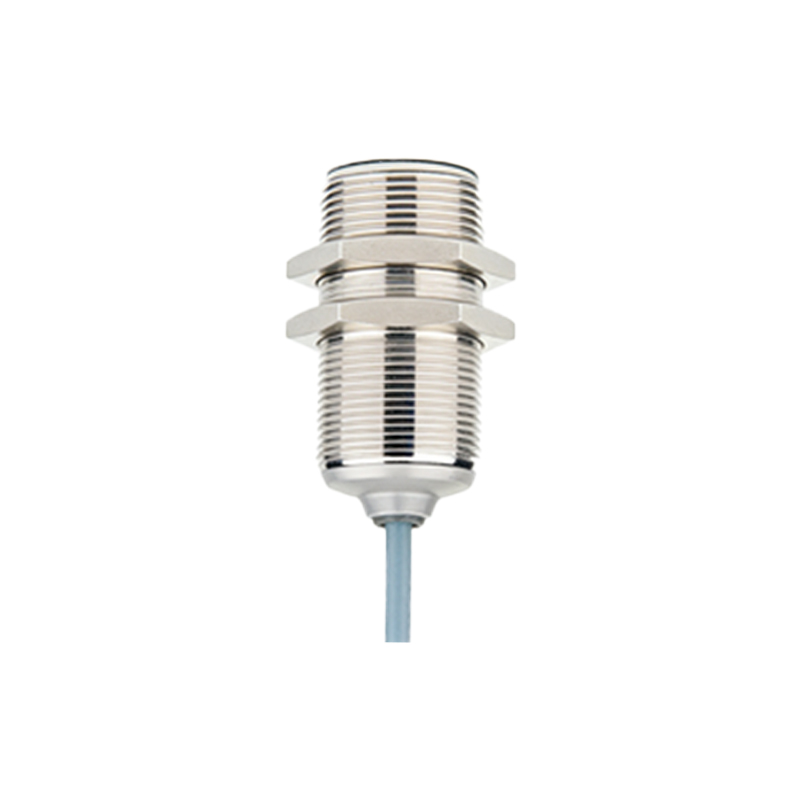
The applications for inductive sensors are vast and varied. Common uses include position verification (e.g., confirming a cylinder is fully extended or retracted), part counting on conveyor belts, monitoring bin levels for metal parts, detecting the end of a roll of metal sheet, and ensuring proper indexing in rotary tables. They are also frequently used as safety interlocks to confirm machine guards are in place before operation can commence. Specialized variants are available for specific needs, such as analog output sensors for distance measurement, factor-1 sensors that offer the same sensing distance for all metals, and high-temperature models designed for foundries or oven applications.
Selecting the right inductive proximity sensor for a given task requires careful analysis of several key parameters. The most critical is the nominal sensing distance (Sn), which is the rated operating distance for a standard target. The actual installation must account for a reduction factor based on the target metal and ensure a safe mounting distance to avoid false triggers. The sensor's housing style—tubular (e.g., M8, M12, M18, M30 threaded barrels) or rectangular block—must fit the mechanical constraints. The output type is another vital choice: NPN (sinking) or PNP (sourcing) transistor outputs are standard for DC sensors, while 2-wire AC/DC and analog current/voltage outputs are also available. The operating voltage range, switching frequency, and degree of ingress protection (IP code) must all align with the application's electrical and environmental demands.
Installation and wiring practices significantly impact performance. Sensors should be mounted securely to prevent vibration-induced errors. It is essential to maintain the specified lateral and axial spacing between multiple sensors to prevent mutual interference, a phenomenon known as "crosstalk." For flush-mounted cylindrical sensors, the sensing field emerges only from the front, allowing installation in metal without interference. Non-flush models have a larger sensing range but require a non-metallic surround. Proper shielding of cables in electrically noisy environments is recommended to ensure signal integrity.
In conclusion, inductive proximity sensors are a cornerstone technology in modern industrial control systems. Their simple, wear-free operation, combined with exceptional ruggedness and versatility, makes them a default choice for detecting metallic objects. A thorough understanding of their operating principles, key specifications, and application nuances empowers engineers and technicians to design more reliable, efficient, and intelligent automated systems. As Industry 4.0 and smart manufacturing evolve, these sensors continue to adapt, integrating advanced diagnostics and IO-Link communication capabilities to provide not just detection, but valuable process data, securing their role in the factories of the future.
SEO