In the realm of industrial automation and machine design, proximity sensors are indispensable components for non-contact object detection. A fundamental and frequently asked question by engineers and system integrators is: "How far can a proximity sensor detect an object?" The answer is not a single, universal figure but rather a complex interplay of several critical factors. This article delves into the technical parameters that define the sensing range of various proximity sensor technologies.
The primary specification governing detection distance is the rated operating distance (Sn). This value, provided by the manufacturer, indicates the nominal sensing range under ideal, standardized conditions. It is crucial to understand that Sn is typically defined using a standard target—often a square of mild steel (Fe360) with a side length equal to the sensor's diameter or the diameter of the sensing face. Real-world detection distances for different materials or shapes will vary.
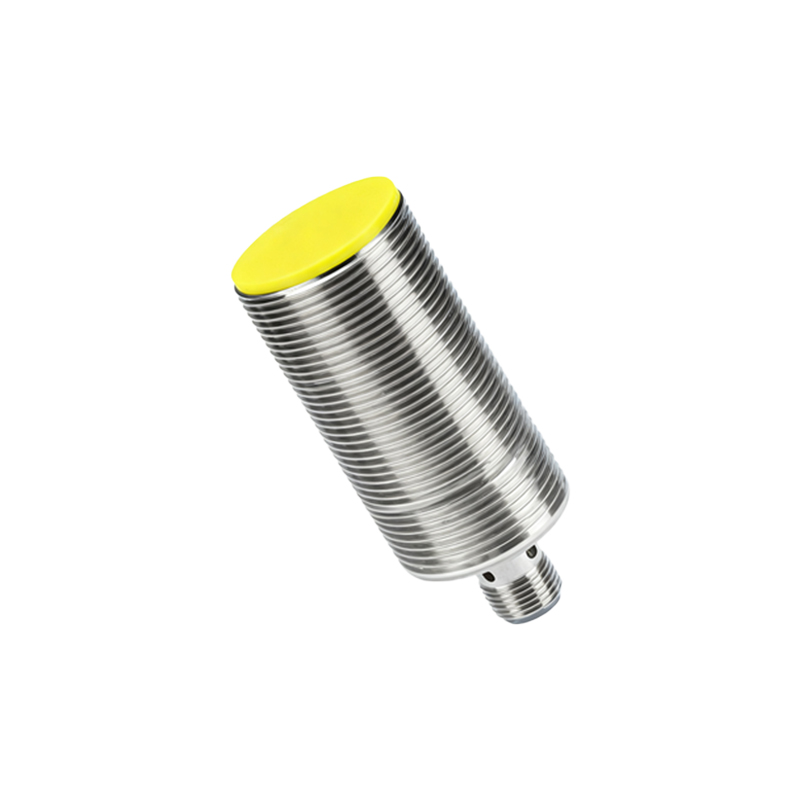
The core technology of the sensor is the most significant determinant of its range. The most common types are:
1. Inductive Proximity Sensors: These sensors detect metallic objects, primarily ferrous metals like steel. Their operating principle is based on generating an electromagnetic field. The sensing range is relatively short, typically from 1 mm to 60 mm, with longer-range specialized models reaching up to 120 mm. The range is heavily influenced by the target metal type. For instance, steel is detected at 100% of Sn, while stainless steel might be detected at 70-90%, brass at 30-50%, and aluminum at 25-40%.
2. Capacitive Proximity Sensors: These can detect both metallic and non-metallic materials (liquids, plastics, wood, etc.) by sensing changes in capacitance. Their typical sensing range is similar to or slightly less than inductive sensors, generally from 3 mm to 40 mm. The dielectric constant of the target material is the key variable. Materials with high water content or high dielectric constants can be detected at greater distances.
3. Ultrasonic Proximity Sensors: These sensors emit high-frequency sound waves and measure the time for the echo to return. They offer the longest sensing ranges among common proximity sensors, from a few centimeters up to several meters (e.g., 20 mm to 8,000 mm). Their performance can be affected by the target's surface texture (soft materials absorb sound), angle, and environmental factors like temperature gradients, air turbulence, and dust.
4. Photoelectric Sensors: While often categorized separately, they perform proximity sensing. Their range varies dramatically by type (through-beam, retro-reflective, diffuse). Diffuse (proximity-mode) photoelectric sensors have ranges from a few centimeters to a few meters, dependent on target color, reflectivity, and surface finish. A white, matte target can be detected at a much greater distance than a shiny black one.
Beyond sensor type, several application-specific factors critically affect the achievable sensing distance:
Target Material and Size: As noted, the material's properties (permeability for inductive, dielectric constant for capacitive, reflectivity/absorption for photoelectric and ultrasonic) are paramount. A target smaller than the sensor's sensing face or the standard test piece will reduce the effective range.
Installation and Environment: Metal mounting (flush vs. non-flush for inductive sensors), adjacent sensors causing interference, and environmental contaminants like oil, dust, or heavy vibration can all degrade performance. Temperature extremes can also affect electronic components and, in the case of ultrasonics, the speed of sound.
Hysteresis: All proximity sensors incorporate hysteresis—a difference between the switch-on point (as the target approaches) and the switch-off point (as it moves away). This prevents chatter but means the effective, repeatable detection point is slightly less than the maximum possible "trip" distance.
To ensure reliable operation, engineers must apply a safety margin. The common practice is to derate the sensor. For example, if a 10 mm Sn inductive sensor is required, one might select a 15 mm or 20 mm Sn sensor and install it to use only 60-70% of its rated range. This accounts for supply voltage tolerances, temperature drift, target material variations, and mounting inconsistencies.
In conclusion, the question of detection distance is answered by first selecting the appropriate sensor technology for the target and environment, then carefully consulting the manufacturer's datasheet—paying close attention to correction factors for different materials and installation conditions. The rated operating distance (Sn) is a starting point for comparison, not a guaranteed in-application performance figure. Successful implementation hinges on understanding these nuances, applying generous derating factors, and ultimately, validating the setup under real operating conditions. Always prioritize a stable, repeatable switching signal over maximizing the absolute detection