In the realm of industrial automation and control systems, proximity sensors are indispensable components for detecting the presence or absence of metallic objects without physical contact. Among the various configurations available, the two-wire metal proximity sensor stands out for its simplicity, reliability, and cost-effectiveness. This article delves into the operational principles, key characteristics, wiring considerations, and typical applications of these robust sensors, providing essential insights for engineers and technicians.
At its core, a two-wire metal proximity sensor operates on the principle of electromagnetic induction. The sensor contains an oscillator circuit that generates a high-frequency electromagnetic field from its sensing face. When a ferrous or non-ferrous metal target enters this field, eddy currents are induced on the target's surface. This causes a change in the oscillation amplitude within the sensor. An integrated evaluation circuit detects this change and triggers a switching action. The defining feature of the two-wire design is its integration into the power supply loop; it requires only two wires for both power supply and signal output, simplifying installation significantly compared to three-wire or four-wire counterparts.
The primary advantage of the two-wire sensor lies in its straightforward wiring. It connects in series with the load (such as a PLC input module, relay, or indicator lamp) directly to the power supply, typically 10-30V DC or 20-250V AC. This series connection means the sensor itself has a voltage drop (often 2-5V) and a small residual current (leakage current) when in the "OFF" state. These factors are critical for proper circuit design. The load must be sensitive enough to recognize the voltage difference between the "ON" and "OFF" states. A key specification is the "Off-state current" or leakage current, which must be lower than the holding current of the connected load to prevent unintended activation.
Two-wire sensors are predominantly available in two output types: Normally Open (NO) and Normally Closed (NC). In a NO configuration, the switch closes (allows current to flow) when a target is detected. In an NC configuration, the switch opens (stops current flow) upon detection. The choice depends on the safety and logic requirements of the application. For instance, an NC sensor might be used in a safety circuit where a wire break is interpreted as a fault condition.
When selecting and installing a two-wire metal proximity sensor, several practical considerations are paramount. First, ensure compatibility between the sensor's voltage rating (AC or DC) and the available power supply. Mixing AC and DC can lead to failure. Second, calculate the voltage drop and leakage current to verify the connected load will function correctly. Using a load with high input impedance is generally advisable. Third, pay attention to the sensing distance, which is typically shorter than equivalent three-wire models and is rated for a standard target (often mild steel). Factors like target material, size, and shape can affect the actual sensing range. For non-ferrous metals like aluminum or copper, the sensing distance is reduced, and a correction factor provided by the manufacturer must be applied.
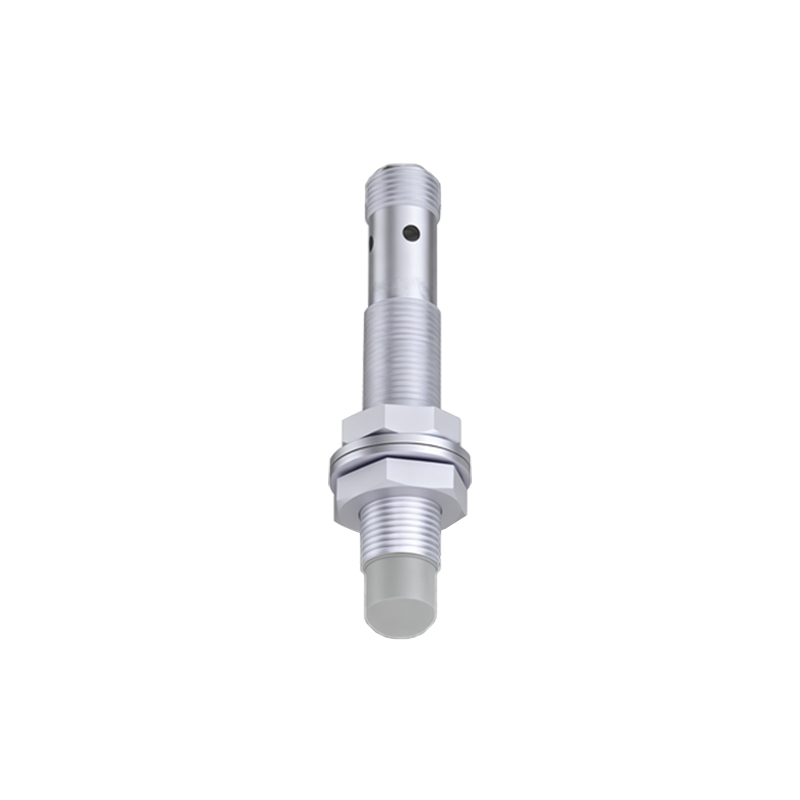
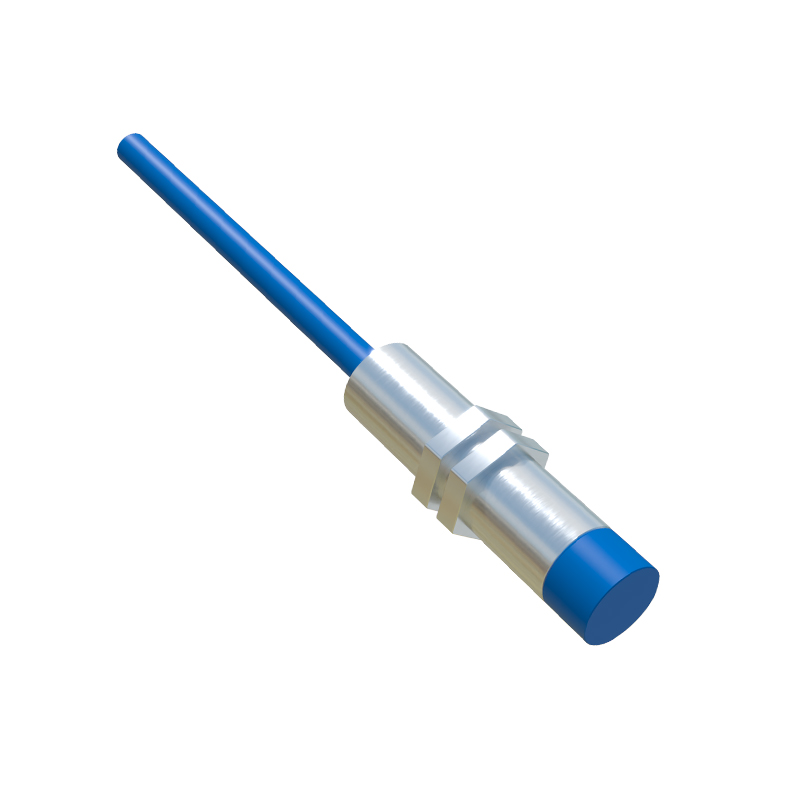
Environmental robustness is another hallmark. Most industrial-grade two-wire proximity sensors feature rugged housing materials like nickel-plated brass or stainless steel (e.g., IP67, IP69K ratings), making them resistant to dust, moisture, oils, and mechanical impacts. This durability is essential for harsh environments found in machine tools, material handling, and automotive manufacturing.
Typical applications are vast. They are commonly used for simple presence detection tasks: counting metal parts on a conveyor, monitoring the position of a cylinder piston (via a built-in metal trigger), verifying the closure of a metal door or guard, and detecting the end position in automated machinery. Their two-wire nature makes them ideal for retrofitting into existing simple control circuits or in applications where cabinet space and wiring complexity are major constraints.
In comparison to three-wire sensors, the two-wire version offers easier installation and lower initial wiring cost but may have limitations in switching capacity, response speed, and available output configurations. Three-wire sensors, with separate power, ground, and signal wires, typically offer higher switching frequencies and can handle larger loads directly, but require more wiring.
In conclusion, the two-wire metal proximity sensor is a fundamental and highly practical solution for countless industrial detection tasks. Its design elegance—combining power and signal in a single loop—provides a reliable, durable, and economical means of non-contact metal detection. A thorough understanding of its operating parameters, especially regarding electrical characteristics in the control circuit, is crucial for successful implementation. By carefully matching the sensor specifications to the application requirements, engineers can ensure robust and trouble-free operation, contributing to enhanced efficiency and safety in automated systems.
SEO