In modern industrial automation, laser sensor measurement modules have emerged as critical components for achieving high-precision, non-contact detection and monitoring. These modules utilize laser technology to deliver accurate measurements of distance, displacement, thickness, and position, making them indispensable in sectors such as manufacturing, robotics, automotive, and aerospace. Unlike traditional mechanical or ultrasonic sensors, laser sensors offer superior resolution, faster response times, and enhanced reliability in challenging environments.
A typical laser sensor measurement module consists of a laser emitter, a receiver, and sophisticated signal processing electronics. The emitter projects a focused laser beam onto a target surface, while the receiver captures the reflected light. By analyzing parameters like time-of-flight, triangulation, or interferometry, the module calculates precise measurements. For instance, time-of-flight sensors measure the round-trip time of the laser pulse to determine distance, ideal for long-range applications. Triangulation-based sensors, on the other hand, use geometric principles for high-accuracy short-range measurements, commonly applied in quality control inspections.
Key advantages of laser sensor modules include their ability to operate without physical contact, eliminating wear and tear and reducing maintenance needs. They perform consistently across various materials, including reflective, transparent, or rough surfaces, thanks to adaptive algorithms and filtering techniques. Additionally, their compact design and integration capabilities with PLCs, IoT systems, and data analytics platforms enable seamless implementation in smart factories. For example, in automotive assembly lines, laser sensors verify component alignment with micron-level precision, ensuring safety and compliance. In semiconductor manufacturing, they monitor wafer thickness in real-time, minimizing production errors.
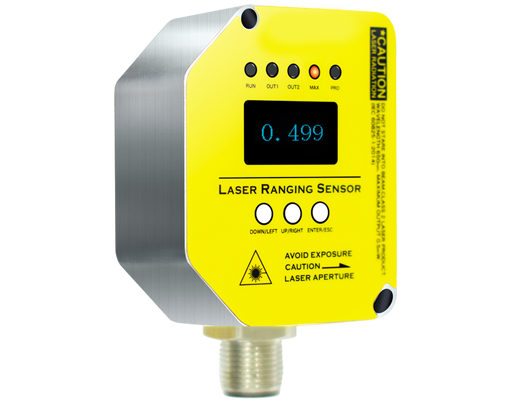
However, selecting the right laser sensor module requires careful consideration of factors such as measurement range, resolution, environmental conditions (e.g., temperature, humidity, and ambient light), and target material properties. Innovations like blue laser technology have improved performance on dark surfaces, while advancements in AI-driven calibration enhance adaptability. As Industry 4.0 evolves, laser sensors are increasingly integrated with predictive maintenance systems, contributing to higher efficiency and reduced downtime.
In summary, laser sensor measurement modules represent a cornerstone of precision engineering, driving advancements in automation and quality assurance. Their continued development promises even greater accuracy and versatility, solidifying their role in the future of industrial innovation.
