In industrial automation and control systems, proximity sensors are indispensable components for detecting the presence or absence of objects without physical contact. Among their critical operational characteristics, the concepts of Normally Open (NO) and Normally Closed (NC) configurations are fundamental. This distinction defines the electrical state of the sensor's output circuit in its non-actuated, or "normal," condition, directly impacting system design, safety, and logic. A deep understanding of these modes is essential for any engineer specifying, installing, or troubleshooting automated systems.
A Normally Open (NO) proximity sensor has an output circuit that is open (non-conducting) when no target is within its sensing range. This is its "normal" state. When a valid target enters the detection field, the sensor activates, and its output switch closes, completing the circuit and allowing current to flow. This action typically signals a "true" or "active" condition to the controller (PLC, relay, etc.). For instance, an NO inductive sensor monitoring a metal part on a conveyor will only send a signal when the part is present. This configuration is often used for initiating actions, such as starting a process, counting items, or triggering a downstream event upon detection.
Conversely, a Normally Closed (NC) proximity sensor has an output circuit that is closed (conducting) in its non-actuated state. Current flows through it under normal conditions. When a target enters the sensing field, the output switch opens, breaking the circuit and stopping the current flow. This break in continuity is interpreted as an "active" signal. NC configurations are frequently employed in safety-critical and monitoring applications. A classic example is a guard door sensor; under normal safe conditions (door closed), the NC circuit is closed, allowing the machine to operate. If the door opens, the sensor is actuated (or de-actuated, depending on perspective), the circuit opens, and this "break" signal immediately halts the machine for safety.
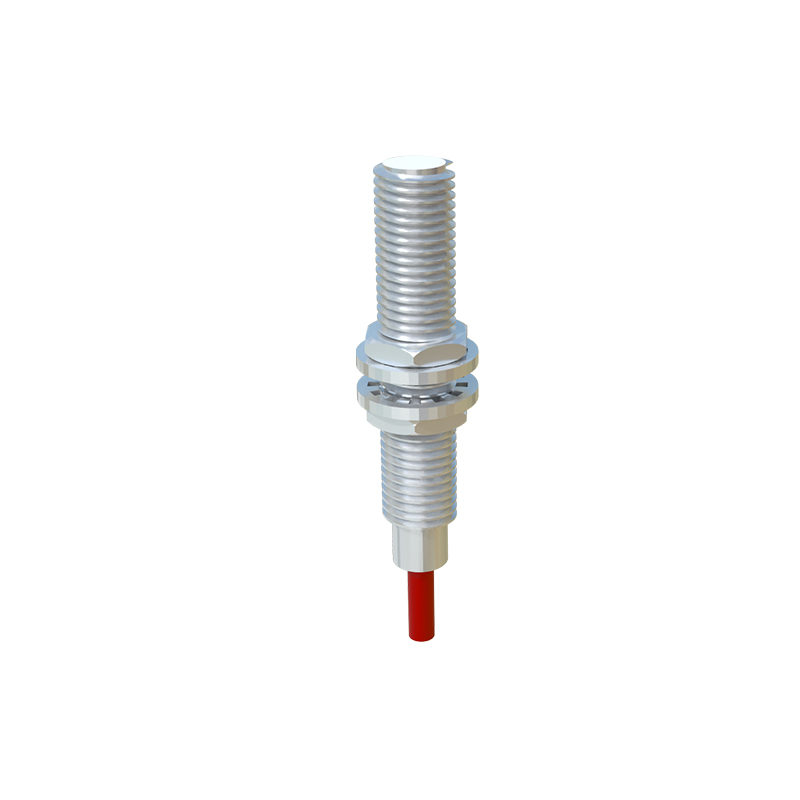
The choice between NO and NC is not arbitrary; it is dictated by system logic and, most importantly, safety philosophy. A core principle in machine safety is "fail-safe" design. This principle dictates that a system should default to a safe state in the event of a failure, such as wire breakage, loss of power to the sensor, or sensor malfunction. An NC circuit aligns naturally with this principle for monitoring safe conditions. Consider a safety interlock loop wired in series with NC sensors. If a wire is cut or a sensor fails, the circuit opens, mimicking the "unsafe" signal and causing a protective stop. This is a positive break detection. Using an NO sensor for the same safety loop would be dangerous: a wire break would be indistinguishable from the "safe" (door closed) state, as both result in an open circuit, creating a hidden fault.
From an electrical wiring perspective, the difference is clear. A 3-wire DC sensor (with Brown/+V, Blue/0V, and Black/output wires) will source or sink current from the Black wire depending on its PNP or NPN transistor output and its NO/NC programming. For a PNP NO sensor, the Black output wire is off (0V) normally and switches to +V when activated. For a PNP NC sensor, the Black wire is at +V normally and switches to 0V when activated. Understanding this voltage state is crucial for connecting the sensor correctly to PLC input modules, which are typically designed to read either a sourcing (PNP) or sinking (NPN) signal.
Many modern programmable proximity sensors offer a selectable NO/NC function via a switch or software, providing flexibility. However, fixed-configuration sensors are still common. When specifying, always denote the required output mode clearly on drawings and purchase orders. In ladder logic programming, the choice influences whether a normally open (XIC) or normally closed (XIO) instruction is used to represent the sensor's field device status. An NC field device often uses an XIO instruction in the ladder to represent its "normal" closed state logically.
In summary, the Normally Open and Normally Closed designations define the resting electrical state of a proximity sensor's output. NO sensors close on detection, while NC sensors open on detection. The selection is a critical design decision. For standard event detection and process initiation, NO is common and intuitive. For safety monitoring, machine guarding, and applications requiring fail-safe operation, the NC configuration is typically mandated by standards and best practice. Engineers must evaluate the required system behavior under both normal and fault conditions to make the correct, and safe, choice.