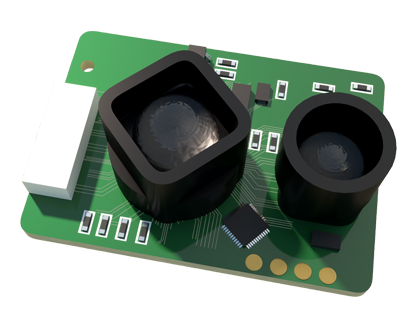
In the realm of industrial automation and precision engineering, small laser measurement sensors have emerged as indispensable tools. These compact devices leverage laser triangulation or time-of-flight principles to deliver non-contact, high-accuracy measurements of distance, position, thickness, and profile. Their miniaturized form factor allows integration into tight spaces on production lines, robotic arms, and automated inspection systems where traditional sensors cannot fit.
The core technology typically involves emitting a focused laser beam onto a target surface. The reflected light is captured by a sensitive receiver, such as a CCD or CMOS array. By calculating the angle or time shift of the returned beam, the sensor's internal processor determines the exact distance to the target. Advanced models incorporate background suppression algorithms to filter out ambient light interference, ensuring stable readings even in challenging environments. Key performance parameters include measuring range, resolution (often down to micrometer levels), linearity error, response time, and laser class (usually Class 2 or Class 1 for safety).
Applications span diverse sectors. In electronics manufacturing, these sensors verify component placement height on PCBs or measure solder paste thickness. Automotive assembly lines use them for gap and flush measurement between body panels. In logistics, they assist in dimensioning packages for warehouse automation. Furthermore, they are pivotal in quality control for monitoring material warp, detecting surface defects, and ensuring dimensional conformity of machined parts. Their non-contact nature prevents damage to delicate or moving objects, a significant advantage over tactile probes.
When selecting a small laser measurement sensor, engineers must consider several factors. The target material and surface finish greatly influence performance; dark, absorbent, or transparent materials may require sensors with specialized laser wavelengths or enhanced receiver sensitivity. Environmental conditions like dust, steam, or vibration necessitate models with robust housings (often IP67-rated) and built-in compensation features. Interface options (analog output, digital I/O, Ethernet, or fieldbus protocols) must align with the existing control system. Additionally, ease of calibration and availability of configuration software are practical concerns for maintenance and setup.

Recent advancements focus on enhancing intelligence and connectivity. Smart sensors now feature integrated data logging, real-time statistical analysis, and Ethernet-AP connectivity for remote monitoring. The trend toward Industry 4.0 drives the development of sensors with OPC UA or MQTT support, enabling seamless data integration into cloud platforms for predictive maintenance and process optimization. Despite their small size, these sensors deliver robust performance, contributing to improved productivity, reduced waste, and higher product quality across manufacturing and research domains.
Looking ahead, ongoing miniaturization and cost reduction will further expand their adoption. Innovations in blue laser technology offer better performance on organic materials, while multi-point sensors enable simultaneous profile capture. As factories become smarter and more agile, the role of precise, reliable, and compact laser measurement sensors will only grow more critical, solidifying their status as a cornerstone of modern metrology and automation.