In the realm of industrial condition monitoring and precision measurement, laser vibration sensors have emerged as a pivotal technology. Unlike traditional contact-based sensors such as accelerometers, these non-contact instruments measure vibration velocity or displacement by analyzing the Doppler shift of a laser beam reflected from a target surface. This fundamental principle allows for highly accurate, remote assessment of machinery health, structural integrity, and dynamic behavior without influencing the measured object.
The core operating principle is laser Doppler vibrometry. The sensor emits a coherent laser beam towards the target. The vibration of the target modulates the frequency of the reflected light—a phenomenon known as the Doppler effect. This reflected light, now with a shifted frequency, is interfered with a reference beam inside the sensor. The resulting interference signal is processed to extract precise vibration data, typically presented as velocity (mm/s) or displacement (μm). Key advantages of this method include a wide frequency range, often from near DC to several MHz, and exceptional resolution, capable of detecting sub-nanometer displacements. This makes them indispensable for applications where mass loading from a contact sensor would alter the measurement, or where the surface is hot, rotating, or otherwise inaccessible.
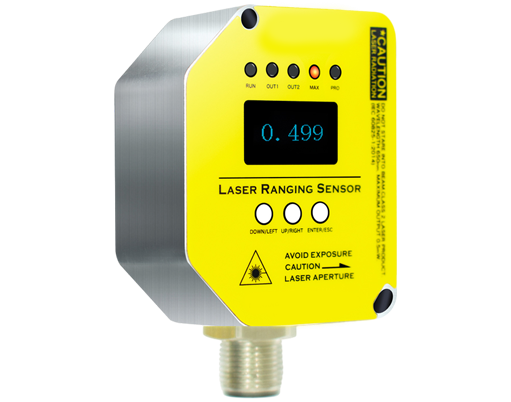
Industrial applications are vast and critical. In predictive maintenance for rotating machinery like turbines, compressors, and electric motors, laser vibrometers can detect imbalances, misalignments, and bearing defects at their earliest stages by capturing subtle changes in vibration signatures. In the automotive and aerospace sectors, they are used for modal analysis and operational deflection shape testing to validate designs and identify resonance points in components like brake discs, turbine blades, and entire body structures. Furthermore, they play a vital role in microelectronics for characterizing the performance of MEMS devices and in civil engineering for monitoring the dynamic response of bridges, buildings, and wind turbine blades under load or environmental excitation.
Selecting the appropriate laser vibration sensor requires careful consideration of several parameters. First, define the measurement objective: is it absolute displacement, velocity, or merely relative change? Next, consider the target surface properties. Rough, dark, or non-cooperative surfaces can scatter light, reducing signal quality; some advanced models offer enhanced sensitivity for such challenging materials. The required stand-off distance and spot size are also crucial. Longer ranges require more laser power and precise alignment, while a smaller spot size allows for measurements on very small components. Key specifications to evaluate include frequency range, velocity/displacement range, resolution, and linearity. For high-frequency applications, such as ultrasonic testing, a sensor with a MHz-range capability is necessary. Additionally, the output interface (analog voltage, digital protocols like Ethernet) must be compatible with existing data acquisition systems.
Integration into a monitoring setup involves more than just pointing the laser. Proper alignment is paramount to ensure the beam is perpendicular to the vibration direction for accurate amplitude measurement. Environmental factors like ambient light, air turbulence (for long-path measurements), and temperature stability can affect performance. Modern sensors often incorporate integrated video cameras for precise targeting and software suites for real-time data visualization, frequency analysis (FFT), and long-term trend monitoring.
Looking ahead, advancements in laser diode technology, digital signal processing, and integrated optics are driving trends toward more compact, robust, and cost-effective sensors. The integration with Industrial Internet of Things (IIoT) platforms is enabling wireless, distributed sensor networks for plant-wide health monitoring. Furthermore, the development of 3D scanning vibrometers, which use multiple laser beams to capture full-field vibration patterns instantaneously, is revolutionizing how engineers understand complex structural dynamics.
In conclusion, laser vibration sensors represent a sophisticated, non-intrusive solution for a multitude of vibration measurement challenges. Their ability to deliver precise data from a distance unlocks insights into machine health and structural behavior that are difficult or impossible to obtain with contact methods. For engineers and maintenance professionals aiming to enhance reliability, safety, and efficiency, understanding and leveraging this technology is becoming increasingly essential in the modern industrial landscape.