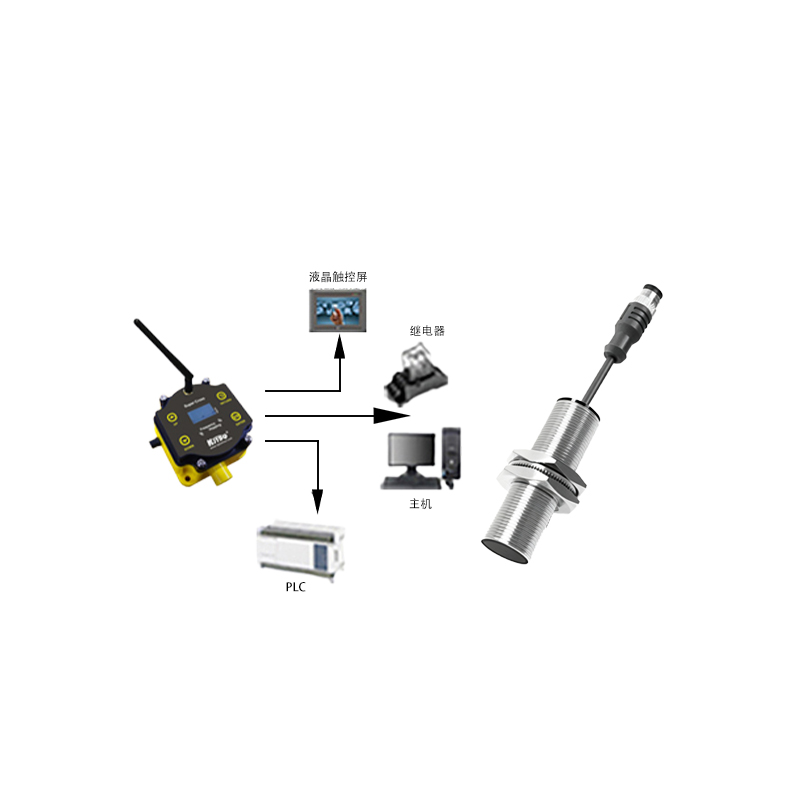
In the realm of industrial automation and control systems, proximity sensors stand as fundamental components for non-contact object detection. Among the various configurations available, the 3-wire proximity sensor is arguably the most prevalent and versatile type encountered in modern machinery. This article delves into the operational principles, wiring configurations, advantages, and key application considerations for these essential devices.
At its core, a 3-wire proximity sensor is a solid-state electronic device designed to detect the presence or absence of a target object without physical contact. It operates by generating an electromagnetic field (in the case of inductive sensors for metals) or a beam of light (for photoelectric sensors). When a target enters this field, it causes a change in the sensor's internal oscillation or light reception, triggering a switching action in the output circuit. The "3-wire" designation specifically refers to the electrical connections required: one wire for the positive DC supply voltage (typically labeled brown or +V), one wire for the negative or common ground (typically blue or 0V), and one wire for the output signal (typically black or white).
The output configuration is a critical distinction. Three-wire sensors are predominantly available in two types: NPN (sinking) and PNP (sourcing). An NPN output switches the negative (0V) line to the load. In this configuration, the load is connected between the positive supply and the sensor's output wire. When activated, the NPN transistor inside the sensor closes the circuit to ground, allowing current to flow through the load to complete the path. Conversely, a PNP output switches the positive voltage line to the load. Here, the load is connected between the sensor's output wire and ground. Upon activation, the PNP transistor provides the positive voltage to the load. Selecting between NPN and PNP is paramount and depends on the input specifications of the connected controller (e.g., PLC). Asian and European designs often favor PNP, while NPN is common in North America, though this is not a strict rule.
Wiring these sensors correctly is straightforward but demands attention. For a standard DC sensor: connect the brown wire to the positive DC voltage (e.g., +24V DC), the blue wire to the common ground (0V DC), and the black (or white) output wire to the input terminal of the PLC, relay, or indicator lamp. Always consult the manufacturer's datasheet for the specific color code, as variations exist. A critical best practice is to implement proper circuit protection, such as a fuse, and to use shielded cables in electrically noisy environments to prevent false triggering.

The advantages of 3-wire sensors over their 2-wire counterparts are significant. They offer lower voltage drop and minimal leakage current, which allows for more precise switching and the ability to connect multiple sensors in parallel without affecting performance. They also provide a clear distinction between the power supply and the signal output, simplifying troubleshooting and system design. Their solid-state construction ensures a long operational life with high reliability, capable of millions of switching cycles, and fast response times critical for high-speed automation.
When integrating 3-wire proximity sensors, several application factors must be considered. First, ensure the sensing distance (rated operating distance) is suitable for the application, accounting for target material, size, and approach direction. Inductive sensors, for instance, have different sensing ranges for steel, aluminum, and copper. Environmental factors like temperature extremes, humidity, dust, and chemical exposure dictate the required housing material and IP (Ingress Protection) rating. For inductive sensors, the presence of other metals in the background or adjacent sensors can influence performance, necessitating proper mounting and spacing. Regular maintenance, though minimal, should include checking for physical damage, buildup of debris on the sensing face, and verifying electrical connections.
In conclusion, the 3-wire proximity sensor is a robust, reliable, and flexible solution for a vast array of detection tasks in packaging, material handling, automotive assembly, and CNC machining. Understanding the nuances between NPN and PNP outputs, adhering to correct wiring practices, and carefully selecting a sensor based on the specific operational environment are the keystones to achieving optimal performance and longevity in any automated system.