In the realm of industrial automation and precision measurement, side-view laser sensors have emerged as a critical technology for non-contact inspection, alignment, and quality control. Unlike traditional top-down sensors, these devices are engineered to emit a laser beam perpendicular to their mounting axis, enabling them to profile the sides of objects—such as edges, grooves, or contours—that are otherwise inaccessible from a vertical perspective. This article delves into the operational principles, key components, and typical applications of side-view laser sensors, providing a comprehensive overview for engineers and technicians in the electrical and automation sectors.
The fundamental principle of a side-view laser sensor revolves around triangulation. At its core, the sensor projects a focused laser beam—typically from a laser diode—onto the target surface at a specific angle. The reflected light from the surface is then captured by a receiving lens and focused onto a position-sensitive detector, such as a CMOS or CCD array. The position where the reflected light strikes the detector changes linearly with the distance to the target. By precisely measuring this displacement on the detector, the sensor's internal processor calculates the exact distance or profile of the target object. This triangulation method allows for high-resolution measurements, often in the micrometer range, making it ideal for detecting minute variations in surface height, width, or presence.
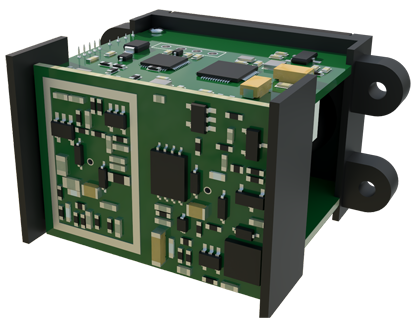
Key components of a side-view laser sensor include the laser source, optical system, photodetector, and signal-processing electronics. The laser diode generates a coherent, visible red or infrared beam, which is collimated and shaped by lenses to form a thin, sharp line or spot. The side-view configuration is achieved through a 90-degree deflection prism or mirror integrated into the sensor housing, redirecting the beam laterally. The receiver optics are aligned to capture the diffuse reflection from the target. Advanced models incorporate features like automatic gain control to compensate for varying surface reflectivity and environmental filters to mitigate interference from ambient light.
Industrial applications of side-view laser sensors are vast and diverse. In manufacturing, they are extensively used for edge detection in web guiding systems, ensuring material alignment in printing, packaging, and textile industries. They perform gap and flush measurement in automotive assembly, verifying the precise alignment of doors, panels, and windows. In electronics, these sensors inspect solder paste height on PCB boards or measure component coplanarity. Furthermore, they facilitate profile scanning for 3D contouring of machined parts and detect minute defects like scratches or dents on side surfaces. Their non-contact nature prevents damage to delicate materials and allows for high-speed, continuous inspection on production lines.
When selecting a side-view laser sensor, engineers must consider parameters such as measurement range, resolution, response time, and environmental robustness. The sensing distance typically ranges from a few millimeters to several hundred millimeters. Resolution can be as fine as 0.1 µm, while response times can reach microsecond speeds for dynamic applications. Housing is often rated IP67 or higher for resistance to dust, moisture, and vibration in harsh industrial environments. Communication interfaces like IO-Link, analog outputs, or Ethernet enable seamless integration into PLC-based control systems.
In conclusion, side-view laser sensors represent a sophisticated fusion of optics, electronics, and software, providing indispensable capabilities for lateral dimensional analysis. Their principle of laser triangulation offers exceptional accuracy and reliability for side-oriented measurements. As industries increasingly demand higher precision and automation, understanding and leveraging these sensors is paramount for optimizing inspection processes, enhancing product quality, and maintaining competitive advantage in fields from automotive to semiconductor manufacturing.