In the realm of industrial automation and control systems, proximity switches stand as fundamental components for non-contact detection. Among the diverse configurations available, the three-wire C-LN proximity sensor represents a prevalent and highly reliable design. This article delves into the technical intricacies, operational principles, application considerations, and advantages of this specific sensor type, providing a comprehensive guide for engineers and technicians.
A proximity switch, fundamentally, is a sensor capable of detecting the presence or absence of an object without physical contact. It achieves this by emitting an electromagnetic field or a beam of electromagnetic radiation and looking for changes in the field or return signal. The three-wire C-LN designation specifically refers to the wiring configuration and output type. "Three-wire" indicates the power supply requirements: typically, one wire for DC voltage supply (V+), one for ground (0V), and one for the output signal. The "C-LN" suffix often denotes the output circuit characteristics, where "C" may imply a current-sinking or current-sourcing configuration (commonly NPN or PNP transistor output), and "LN" frequently specifies a normally-open (NO) contact logic or a particular switching characteristic. It is crucial to consult the manufacturer's datasheet for precise interpretation, as nomenclature can vary.
The core operating principle hinges on an oscillator circuit. Inside the sensor, an oscillator generates a high-frequency electromagnetic field at the sensing face. When a metallic object (for inductive types) enters this field, eddy currents are induced in the target. These currents absorb energy from the oscillator, causing its amplitude to decrease. A detection circuit monitors this amplitude change. Once the amplitude drop reaches a predetermined threshold—corresponding to the set sensing distance—the circuit triggers a state change in the solid-state output switch (the transistor). For capacitive versions (which can detect non-metallic materials), the principle involves changes in capacitance.
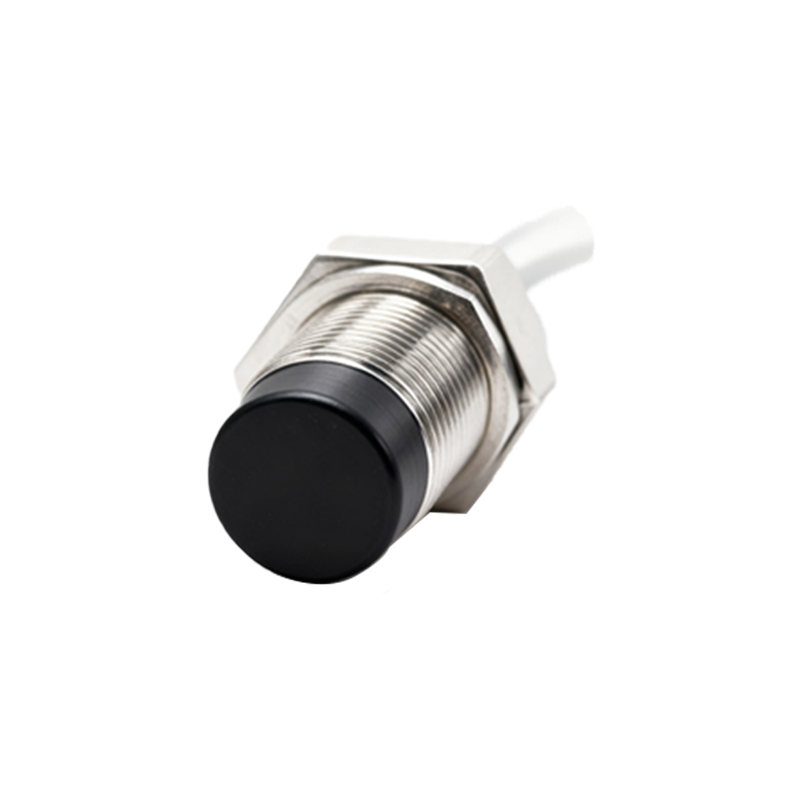
Wiring is a critical aspect. A standard three-wire DC sensor has brown (or red), blue, and black wires. The brown wire connects to the positive DC supply voltage (e.g., 10-30V DC). The blue wire connects to the negative side (0V) of the power supply. The black wire is the output signal line. In an NPN (sinking) output configuration, the black wire acts as the switched negative; the load (e.g., a PLC input, relay coil) is connected between the black wire and the positive supply. When the sensor activates, it connects the load to 0V, completing the circuit. In a PNP (sourcing) configuration, the black wire provides a switched positive voltage to the load, which is then connected to 0V. The "LN" aspect typically means the output transistor is off (non-conducting) when no target is present (normally open logic), and turns on when a target is detected.
Key technical parameters define performance. Sensing distance (Sn) is the nominal range at which a standard target can be reliably detected. Hysteresis is the difference between the switch-on and switch-off points, preventing chatter with a vibrating target. Switching frequency indicates how many on/off cycles per second the sensor can handle. Environmental factors like temperature, humidity, and the presence of chemicals or welding spatter influence housing material choices, typically nickel-plated brass, stainless steel, or PBT plastic.
The advantages of three-wire C-LN proximity sensors are manifold. Their solid-state design ensures long life, high reliability, and fast switching speeds compared to mechanical limit switches. The three-wire system offers a simple, robust connection. The defined output state (normally open) provides clear logic for control systems. They are immune to contaminants like dust, oil, and moisture when properly rated (IP67, IP69K), making them ideal for harsh industrial environments such as machining centers, material handling systems, packaging machinery, and automotive assembly lines.
When selecting and applying these sensors, several best practices must be observed. Always ensure the power supply voltage and polarity match the sensor specifications. Incorporate protective circuits like flyback diodes for inductive loads to prevent voltage spikes from damaging the output transistor. Maintain the specified mounting conditions (flush, non-flush) to achieve the rated sensing distance. Be mindful of mutual interference when mounting multiple sensors closely; maintain a minimum separation distance as per guidelines. For sensing different materials, choose the correct type (inductive for metals, capacitive for non-metals, ultrasonic for various substances).
In conclusion, the three-wire C-LN proximity switch is a cornerstone of modern industrial sensing. Its design elegantly balances simplicity, durability, and performance. A thorough understanding of its wiring, output logic, and application parameters empowers engineers to design more efficient, reliable, and maintainable automated systems. As technology evolves,