In the realm of industrial automation and robotics, precision sensing is paramount. Among the various technologies employed, black and white line laser sensors stand out for their reliability, accuracy, and versatility. These sensors are specifically designed to detect and differentiate between contrasting lines, typically black lines on a white background or vice versa, using laser-based triangulation or reflection intensity methods. This article delves into the operational principles, key applications, and critical factors for selecting the right sensor for your needs.
At its core, a black and white line laser sensor operates by emitting a focused laser beam onto a target surface. The fundamental principle often involves one of two primary methods: triangulation or diffuse reflection with intensity analysis. In a triangulation-based sensor, the laser dot is projected onto the surface. A receiver (like a CMOS or CCD array) positioned at a known angle captures the reflected light. By calculating the position of the reflected spot on the receiver, the sensor can determine the presence and precise location of a line based on height differentials or surface property changes. More commonly for line tracking, the method relies on diffuse reflection. The sensor evaluates the intensity of the reflected light. A white surface reflects most of the laser light, resulting in a high-intensity signal at the receiver. A black surface, absorbing much of the light, results in a low-intensity signal. The sensor's internal circuitry is calibrated to recognize this stark contrast, triggering a digital output when the transition is detected. Advanced models incorporate background suppression techniques to ignore objects beyond the set focal point, enhancing reliability in variable environments.
The applications for these sensors are extensive and critical across multiple industries. In automated guided vehicles (AGVs) and autonomous mobile robots (AMRs), they are the primary technology for line-following navigation. Robots equipped with an array of these sensors can accurately trace painted or taped lines on factory floors, ensuring precise material transport. In the printing and packaging industry, they are indispensable for registration mark detection. Sensors detect small black marks on moving webs of paper or film, providing a timing signal to ensure precise cutting, folding, or printing alignment, thereby minimizing waste. Furthermore, in assembly and electronics manufacturing, these sensors are used for edge detection, part positioning, and verifying the correct placement of components with contrasting features. Their high switching frequency and response speed make them suitable for high-speed production lines.
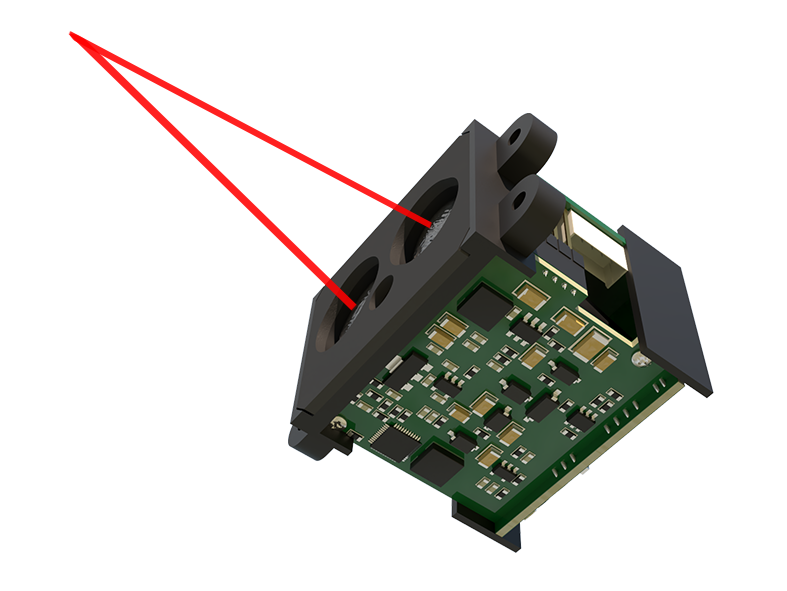
Selecting the appropriate black and white line laser sensor requires careful consideration of several technical parameters. First, the sensing distance and spot size are crucial. The required working distance must match the sensor's specified range, and a smaller laser spot allows for the detection of finer lines and more precise edge resolution. Second, the contrast sensitivity or threshold adjustability is vital. In real-world conditions, the contrast between the line and the background may not be ideal. A sensor with adjustable sensitivity or teach-in functionality can be calibrated to the specific shades of gray present, improving performance under suboptimal lighting or on worn surfaces. Third, environmental robustness is non-negotiable for industrial settings. Look for sensors with high Ingress Protection (IP) ratings (e.g., IP67) to withstand dust, moisture, and occasional washdowns. Resistance to ambient light interference, often achieved with modulated laser light, is also essential. Fourth, consider the output type. Most sensors provide digital outputs (PNP/NPN), but some offer analog outputs (0-10V, 4-20mA) for reporting reflected intensity, which can be useful for monitoring surface condition. Finally, the mechanical design, including housing size and mounting options, must be compatible with the installation space.
In conclusion, black and white line laser sensors are a mature yet continually evolving technology that provides a simple, effective solution for binary contrast detection. Their role in enabling precise automation, from guiding vehicles to ensuring print quality, cannot be overstated. By understanding the underlying principles and meticulously evaluating application requirements against sensor specifications—focusing on sensing performance, environmental durability, and output needs—engineers and system integrators can deploy these sensors to achieve new levels of operational efficiency and reliability. As lines between automation and autonomy continue to blur, the demand for such robust and accurate sensing elements will only grow.
