In the realm of industrial automation and machine control, proximity switch sensors are indispensable components for non-contact detection. Among the various configurations available, the square-type proximity sensor with a six-wire connection presents a specific and highly functional design, often chosen for its robust features and versatile output capabilities. This article delves into the technical aspects, wiring configurations, typical applications, and selection criteria for these sensors, providing a detailed guide for engineers and technicians.
Fundamentally, a proximity sensor detects the presence or absence of a target object without physical contact, typically using electromagnetic, capacitive, or inductive principles. The square form factor offers advantages in mounting stability and space utilization in control panels or machinery frames. The designation "six-wire" is crucial, as it indicates a specific internal circuit design that goes beyond the simpler two-wire (AC) or three-wire (DC) versions.
The six wires usually correspond to the following functions:
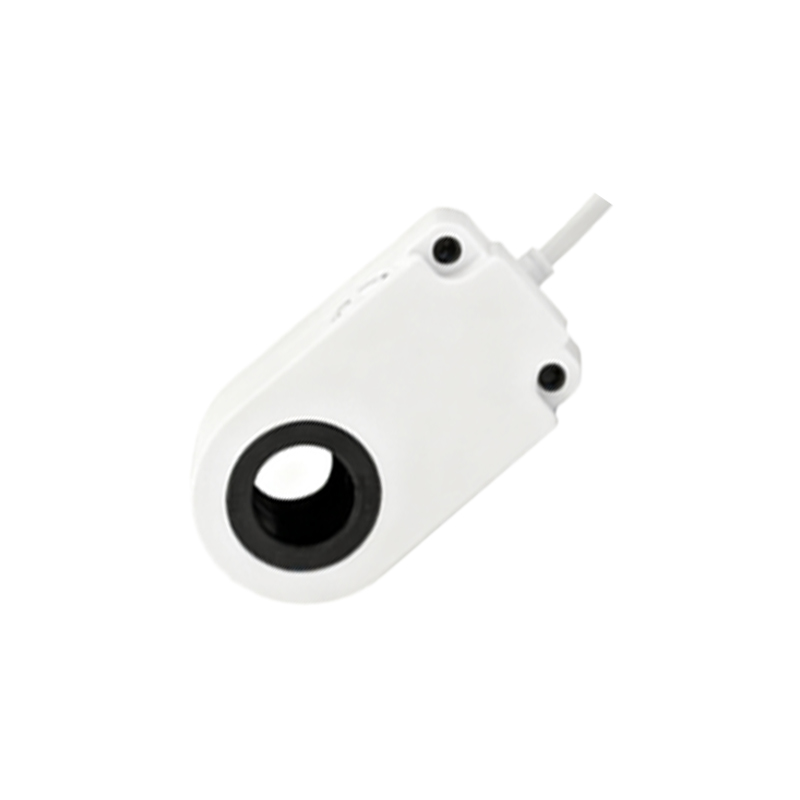
1. Power Supply Lines: Two wires for connecting the sensor to its DC power source (e.g., 10-30V DC). These are typically labeled as V+ (brown wire) and V- (blue wire).
2. Output Signal Lines: This is where the six-wire design shows its versatility. It commonly features two separate and electrically isolated output channels. You often find:
A Normally Open (NO) transistor output (e.g., black wire).
A Normally Closed (NC) transistor output (e.g., white wire).
Each output requires its own return or common line connected to the power supply's negative terminal or a dedicated common. This accounts for the remaining wires.
3. Additional Function Wire: The sixth wire might sometimes be dedicated to a specific function like an output status indicator, a diagnostic line, or a wire for enabling/disabling the sensor remotely, depending on the manufacturer and model. In some configurations, it serves as a second common for the dual outputs.
This dual-output (NO and NC) configuration is a primary advantage. It allows a single sensor to provide complementary logic signals to a Programmable Logic Controller (PLC) or other control systems. This can simplify control logic, provide built-in redundancy for critical safety or monitoring functions, or drive two different circuits simultaneously. The electrical isolation between outputs prevents interference and allows connection to different potential circuits.
Wiring a six-wire proximity sensor requires careful attention to the manufacturer's datasheet. Incorrect wiring can lead to sensor damage or malfunction. A typical procedure involves:
Ensuring the power is disconnected.
Connecting the V+ and V- wires to a stable DC power supply within the specified range.
Connecting the NO output wire to the PLC input card's positive terminal, with the corresponding return wire linked to the common of that input group.
Similarly, connecting the NC output wire to another PLC input, with its specific return path.
Verifying all connections are secure.
These sensors are widely deployed in scenarios requiring high reliability and flexible signaling. Common applications include:
Position Verification in Safety Interlocks: Using both NO and NC signals to confirm a guard door is truly closed (one signal) and not falsely latched (the other signal).
Bi-directional Counting or Sequencing: Detecting an object's position and using the dual outputs to indicate different stages in an assembly line.
Complex Material Handling Systems: Where one output triggers an action (e.g., start a conveyor) and the other provides a confirmation or ready signal to a upstream process.
Machine Tooling: Providing tool presence/absence confirmation and error state reporting through separate channels.
When selecting a square six-wire proximity sensor, key parameters must be evaluated:
Sensing Principle: Inductive (for metals) is most common, but capacitive versions exist for non-metals.
Sensing Distance: The rated operating distance, considering a reduction factor for different metals if inductive.
Output Type and Current Rating: Ensure the PNP or NPN transistor outputs are compatible with your controller, and the max current is not exceeded.
Supply Voltage Range: Typically 10-30V DC.
Switching Frequency: How fast the sensor can detect objects per second.
Housing Material and Protection Rating (IP Code): Critical for the environment (e.g., coolant, dust, washdown).
Output Configuration: Confirm the exact function of all six wires from the technical documentation.
In conclusion, the square-type six-wire proximity sensor is a sophisticated solution for advanced control tasks. Its dual, often isolated, outputs provide significant logical flexibility and reliability enhancements compared to simpler models. A thorough understanding of its wiring scheme and careful selection based on application requirements are