Laser profiling sensors, also known as laser line scanners or 3D profile sensors, have become indispensable tools in modern industrial automation and quality control. These advanced devices operate on the principle of optical triangulation to capture highly accurate, two-dimensional cross-sectional profiles of objects in real-time. By projecting a precise laser line onto a target surface and using a high-resolution camera positioned at a known angle, the sensor calculates depth and contour information by analyzing the deformation of the reflected laser line. This non-contact measurement technique offers significant advantages over traditional tactile probes or 2D vision systems, particularly for applications involving delicate, fast-moving, or complex-shaped components.
The core architecture of a laser profiling sensor typically comprises three key elements: a laser line generator, an imaging sensor (usually a CMOS or CCD camera), and a sophisticated processing unit. The laser diode emits a fan-shaped beam of visible red or blue light, forming a sharp line on the object's surface. The camera, offset at a fixed angle, captures this line. Any variation in the object's height or surface topography causes the laser line to appear distorted from the camera's perspective. The onboard processor then applies triangulation algorithms to convert these pixel displacements in the camera's field of view into precise, quantitative height (Z-axis) and position (X-axis) data, generating a dense cloud of profile points.
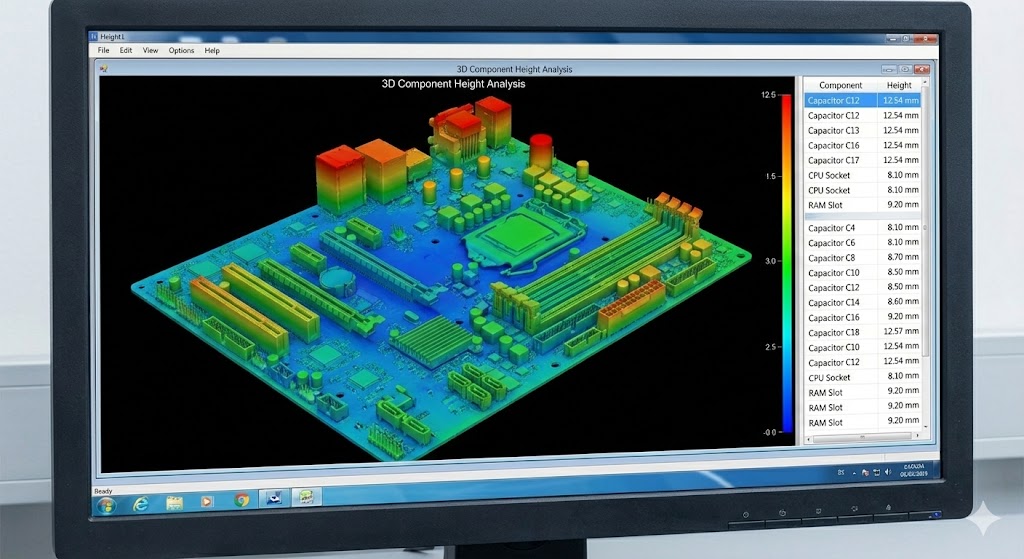
Industrial applications for these sensors are vast and varied. In automotive manufacturing, they are deployed for robotic guidance in bin picking, precise seam tracking for welding robots, and 100% inline inspection of critical components like cylinder heads or brake discs for dimensional tolerances and surface defects. In electronics assembly, they verify solder paste volume, component coplanarity, and connector pin height. The packaging industry utilizes them to monitor fill levels, check seal integrity, and inspect package dimensions. Furthermore, they are crucial in lumber and metal processing for measuring warpage, thickness, and cross-sectional area.
Selecting the appropriate laser profiler requires careful consideration of several technical specifications. Measurement range, often referred to as the Z-range or depth of field, defines the maximum height variation the sensor can accurately capture. Profile frequency, measured in Hertz (Hz), determines how many cross-sections are captured per second, which is critical for high-speed production lines. The number of points per profile affects the resolution and detail of the captured contour. Environmental factors like ambient light, surface reflectivity (from matte black to shiny metal), and vibration must also be accounted for, often necessitating models with adjustable laser power, optical filters, or robust housings with an IP67 rating for harsh conditions.

Integration of laser profiling sensors into a control system is typically facilitated through standard industrial communication protocols such as Ethernet/IP, PROFINET, or TCP/IP. The generated profile data stream can be processed by dedicated controllers or PC-based software to perform complex analyses: calculating gaps, steps, and angles; detecting presence/absence of features; and comparing profiles against a golden master CAD model for pass/fail decisions. This seamless integration enables closed-loop process control, where measurement results can instantly adjust robotic paths or machine parameters to correct deviations.
The future trajectory of laser profiling sensor technology points towards even higher speeds, greater accuracy, and enhanced intelligence. Innovations like multi-line projection for faster full-field scanning, integration with AI and machine learning for adaptive defect classification, and the development of more compact, cost-effective models are expanding their applicability. As Industry 4.0 and smart factory initiatives advance, the role of laser profilers as critical data-generating nodes in the digital thread will only solidify, providing the essential 3D metrology data needed for predictive maintenance, traceability, and ultimate manufacturing perfection.
In conclusion, laser profiling sensors represent a powerful convergence of optics, electronics, and software, delivering non-contact, high-speed, and precise 3D measurement. Their ability to provide quantitative dimensional data in challenging industrial environments makes them a cornerstone technology for automation, ensuring quality, improving efficiency, and enabling increasingly flexible and intelligent manufacturing processes.