In the realm of industrial automation, robotics, and advanced metrology, the demand for precise, reliable, and instantaneous distance measurement is paramount. Laser sensors have emerged as the quintessential technology for fulfilling this need, offering unparalleled accuracy and speed for real-time ranging applications. This article delves into the operational principles, diverse applications, and the latest technological advancements in laser-based real-time distance measurement.
The fundamental principle behind laser distance measurement is often based on time-of-flight (ToF) or phase-shift analysis. In the ToF method, a laser diode emits a short pulse of light towards a target. A high-speed photodetector then captures the reflected light. By precisely measuring the time interval between the emission and detection of the pulse, and knowing the constant speed of light, the distance to the target is calculated with extreme accuracy. This method is exceptionally fast, making it ideal for dynamic, real-time applications such as vehicle speed enforcement or level monitoring of fast-moving materials on a conveyor belt.
The phase-shift method, on the other hand, involves modulating the amplitude of a continuous laser beam at a specific frequency. The phase difference between the emitted and reflected modulated signal is measured. This phase shift is directly proportional to the distance traveled. While offering potentially higher accuracy over shorter ranges, it is also capable of high-speed measurements suitable for real-time control systems in manufacturing.

Real-time capability is defined by the sensor's measurement rate, often expressed in Hertz (Hz). Modern laser rangefinders can achieve measurement rates from a few hundred Hz to over 100 kHz. This high sampling frequency allows for the continuous monitoring of moving objects, enabling immediate feedback for control loops. For instance, in robotic guidance, a laser sensor can provide millisecond-by-millisecond updates on the position of a component, allowing the robot arm to adjust its trajectory in real time to achieve precise pick-and-place operations.
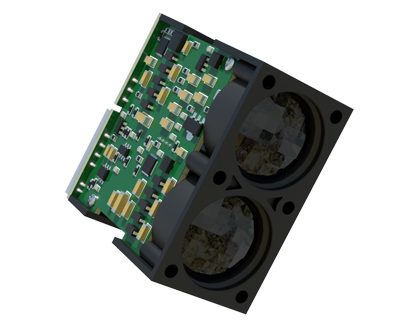
The applications of real-time laser ranging are vast and transformative. In autonomous vehicles and advanced driver-assistance systems (ADAS), LiDAR (Light Detection and Ranging) systems, which are essentially arrays of laser sensors, create real-time 3D maps of the environment. They measure distances to obstacles, pedestrians, and other vehicles continuously, providing the data necessary for navigation and collision avoidance. In industrial automation, laser sensors monitor product dimensions on high-speed production lines, instantly flagging any out-of-tolerance parts for rejection. They are also crucial in warehouse automation for palletizing, inventory management with drones, and guiding automated guided vehicles (AGVs).
Furthermore, in construction and civil engineering, laser distance meters enable real-time monitoring of structural deformations or settlements. In the aerospace sector, they are used for docking procedures and alignment of large components. The medical field utilizes them for non-contact patient positioning and in certain surgical navigation systems.

Recent advancements are pushing the boundaries of what's possible. The development of single-photon avalanche diode (SPAD) arrays has led to sensors with exceptional sensitivity, capable of measuring very low light levels over long distances. The integration of artificial intelligence and machine learning with laser sensor data is enhancing object recognition and classification in real time, moving beyond simple distance measurement to intelligent scene interpretation. Furthermore, the miniaturization of components and the reduction in cost are making high-performance laser ranging accessible to a broader range of applications, including consumer electronics and smart home devices.
However, challenges remain. Environmental factors like ambient light, fog, rain, or highly reflective surfaces can interfere with the laser signal. Manufacturers are countering this with sophisticated optical filters, advanced signal processing algorithms, and the use of eye-safe laser classes. The choice of laser wavelength (e.g., visible red, infrared) is also a critical design consideration based on the application's specific environmental conditions and safety requirements.
In conclusion, laser sensors for real-time distance measurement represent a cornerstone of modern precision engineering and automation. Their ability to deliver high-speed, accurate, and reliable data is enabling smarter machines, safer vehicles, and more efficient industrial processes. As technology continues to evolve, we can expect laser ranging systems to become even faster, more robust, and more intelligent, further embedding themselves as indispensable tools across countless industries.