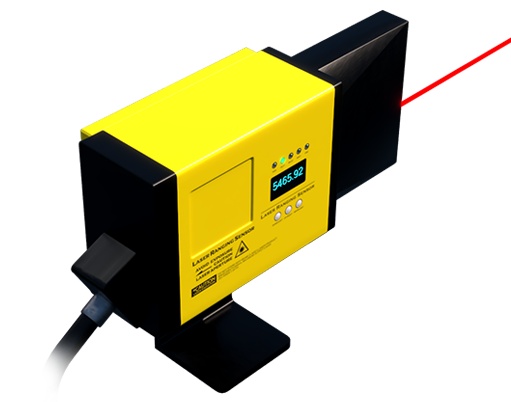
In industrial and scientific applications, the ability to measure distance with high precision under extreme thermal conditions is a critical challenge. High temperature laser distance sensors have emerged as a specialized solution, enabling reliable non-contact measurement in environments where conventional sensors would fail. These advanced devices utilize laser triangulation or time-of-flight principles to deliver accurate readings while withstanding ambient temperatures that can exceed several hundred degrees Celsius.
The core technology behind these robust sensors involves several key adaptations. First, the laser diode and optical components are housed within a thermally managed enclosure, often incorporating active cooling systems or heat-resistant materials. This isolation protects sensitive electronics from external heat sources. Second, the sensor's internal compensation algorithms are calibrated to account for thermal expansion of both the sensor housing and the target material, ensuring measurement stability. For applications involving hot targets, such as molten metal or glowing ceramics, sensors may employ specific laser wavelengths less affected by blackbody radiation or plasma interference.
Typical performance specifications for high-temperature models include an operating ambient temperature range from -40°C to over 200°C, with some specialized units rated for up to 500°C near the front lens. Measurement ranges vary from a few centimeters to several meters, with accuracies in the sub-millimeter domain. Key industries leveraging this technology include metal casting and forging, glass manufacturing, ceramics kilns, and aerospace component testing. In a steel mill, for instance, these sensors continuously monitor the thickness of red-hot slabs, while in semiconductor manufacturing, they measure wafer position inside high-temperature diffusion furnaces.
Selecting the appropriate high-temperature laser sensor requires careful analysis of the application. Engineers must consider not only the peak ambient temperature but also the thermal radiation from the target, potential presence of smoke or steam, and required measurement update rates. Regular maintenance, such as cleaning the protective window from dust or condensate, is essential for sustained accuracy. As industrial processes push toward higher efficiencies and tighter tolerances, the demand for sensors capable of operating in these harsh thermal regimes continues to grow, driving further innovation in optical design and thermal management for precision metrology.