In the rapidly evolving landscape of industrial automation and precision measurement, laser sensors have become indispensable tools. Their ability to deliver non-contact, high-accuracy, and fast-response measurements makes them critical across various sectors, including manufacturing, robotics, automotive, and aerospace. This article provides a comprehensive ranking of leading laser sensor technologies and manufacturers, based on performance metrics such as accuracy, range, speed, durability, and integration capabilities.
First in our ranking are Laser Distance Sensors, renowned for their exceptional precision in displacement and position measurement. Brands like Keyence and SICK dominate this category with models such as the Keyence IL Series and SICK DT50, offering sub-micron resolution and robust environmental resistance. These sensors excel in applications like wafer alignment, assembly verification, and thickness gauging, where minute deviations can impact product quality. Their advanced algorithms compensate for surface color and texture variations, ensuring reliable data even in challenging conditions.
Next, Laser Profilers secure a top spot for 3D contour and shape analysis. Manufacturers like Cognex and LMI Technologies lead with devices such as the Cognex DS1000 and LMI Gocator series. These sensors utilize triangulation or time-of-flight principles to generate detailed surface profiles, ideal for inspecting weld seams, detecting defects in molded parts, or guiding robotic arms in bin-picking operations. Their high-speed scanning capabilities, often exceeding 10 kHz, enable real-time quality control on fast-moving production lines, reducing waste and downtime.

Laser Micrometers and Gauges also rank highly for dimensional measurement tasks. Mitutoyo and OMRON are prominent players, with products like the Mitutoyo LSM Series providing non-contact diameter, thickness, and gap measurements with accuracies up to ±0.1 µm. These sensors are vital in industries producing wires, tubes, or precision components, where contact-based tools might cause deformation or wear. Their compact designs and easy integration with PLCs or HMIs facilitate seamless automation.
For long-range detection and positioning, Laser Rangefinders from Leica Geosystems and Bosch are top contenders. Used in large-scale metrology, warehouse logistics, and construction, these sensors offer ranges extending beyond 100 meters with millimeter-level accuracy. Models like the Leica DISTO series incorporate Bluetooth connectivity and intuitive software, enhancing usability in field applications. Their durability against dust, moisture, and temperature fluctuations makes them suitable for both indoor and outdoor environments.
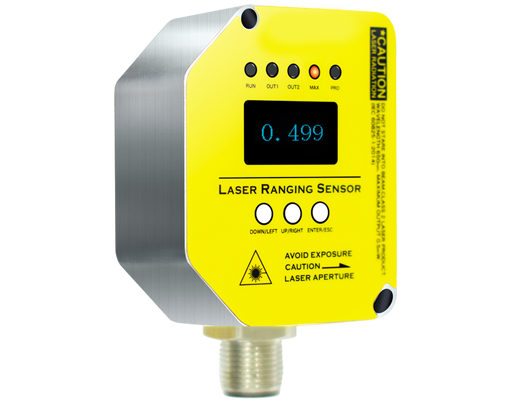
Emerging trends include Embedded Laser Sensors with IoT connectivity, enabling predictive maintenance and data analytics. Companies like Banner Engineering and Panasonic are integrating smart features such as cloud-based monitoring and adaptive calibration. Additionally, advancements in blue laser technology, as seen in Z-LASER products, improve visibility and reduce eye safety concerns compared to traditional red lasers, expanding applications in biomedical and electronics sectors.
When selecting a laser sensor, engineers should consider factors like measurement object (e.g., reflective metals, transparent materials), ambient light interference, required sampling rate, and compliance with safety standards (e.g., IEC 60825). Regular calibration and proper mounting are essential to maintain performance. As Industry 4.0 drives demand for higher precision and connectivity, laser sensors will continue to evolve, with innovations in AI-driven image processing and miniaturization paving the way for next-generation solutions.
In summary, this ranking highlights the diversity and sophistication of laser sensors available today. By leveraging these technologies, industries can achieve unprecedented levels of efficiency, quality, and automation, ultimately fostering innovation and competitiveness in the global market.