In the realm of industrial automation and electrical engineering, proximity sensors are indispensable components for detecting the presence or absence of objects without physical contact. Among the critical specifications that define their operation, the concepts of Normally Open (NO) and Normally Closed (NC) configurations stand out as fundamental. Grasping these terms is essential for proper sensor selection, circuit design, and troubleshooting in control systems. This article delves into the principles, applications, and practical considerations of NO and NC proximity sensors, tailored for professionals in the field.
At its core, the "normal" state of a proximity sensor refers to its electrical condition when no target is within its sensing range. This is a de-energized or resting state, independent of the power supply being connected. A Normally Open (NO) proximity sensor has an output circuit that is open (non-conducting) in this normal state. When a target enters the sensing field, the output switch closes, allowing current to flow. Conversely, a Normally Closed (NC) proximity sensor has an output circuit that is closed (conducting) in the normal state. The approach of a target causes this switch to open, interrupting the current flow.

The choice between NO and NC is not merely academic; it directly impacts system logic, safety, and wiring. NO configurations are often employed in standard "start" or "activate" functions. For instance, an NO sensor might be used to initiate a process, such as starting a conveyor belt when a part is detected. The circuit remains inactive until the sensor is triggered, which aligns with intuitive control logic for initiating actions.
NC configurations, however, are frequently chosen for safety-critical and monitoring applications. Their inherent "fail-safe" characteristic is a key advantage. In a typical safety interlock, an NC sensor might monitor the position of a guard door. As long as the door is closed (normal state), the circuit is closed, allowing the machine to operate. If the door opens, the sensor switch opens, breaking the circuit and causing an immediate machine halt. This design ensures that a wire break or sensor power loss mimics the "door open" state—opening the circuit and stopping the machine—thereby enhancing personnel safety. This principle is a cornerstone in safety circuit design per standards like IEC 60204-1.
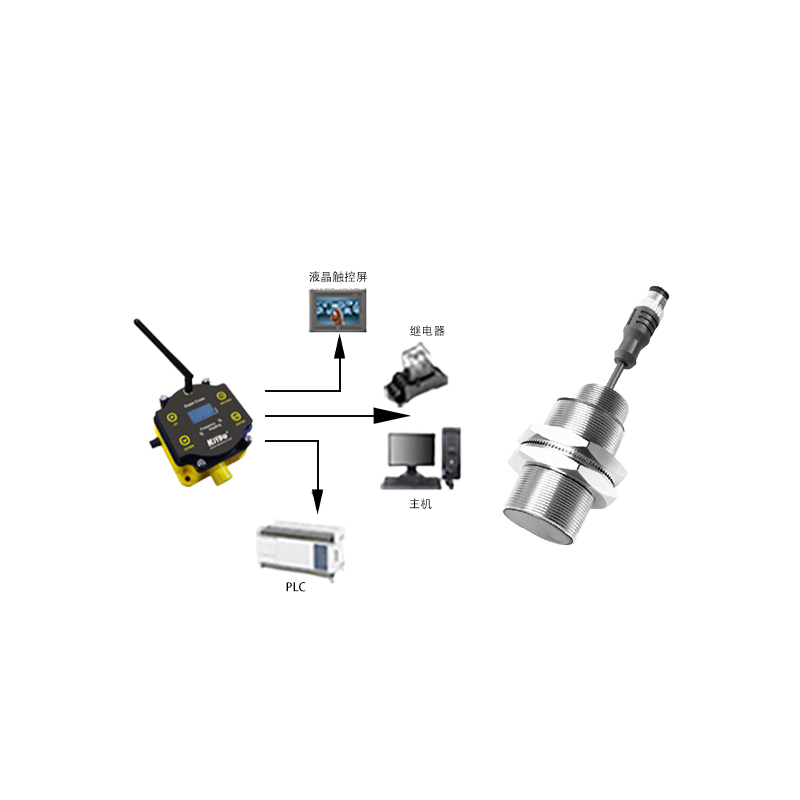
From an electrical wiring perspective, the distinction influences how the sensor integrates into a control system, most commonly with Programmable Logic Controllers (PLCs). An NO sensor is typically wired to provide an input signal (e.g., 24V DC) to the PLC only when activated. An NC sensor, in contrast, provides a constant signal in the normal state, and the PLC input goes "false" or "0" when the target is detected. Understanding this is vital for programming the correct ladder logic. Misinterpreting the sensor state can lead to inverted logic in the control program, causing operational faults.
Many modern proximity sensors offer a complementary output, often labeled as NO/NC or featuring both a black (NO) and a white (NC) wire. This provides tremendous flexibility, allowing engineers to select the required output mode within the same hardware unit, simplifying inventory and design changes. The internal solid-state switching mechanism, typically a transistor (PNP or NPN), facilitates this dual functionality.

When specifying a sensor, the application's functional and safety requirements dictate the choice. Consider a material level monitoring system in a silo. An NC sensor positioned at a "low-level" point would keep the circuit closed when material is absent. If material rises and covers the sensor, the circuit opens, signaling the control system to stop the filling process. This setup can help prevent overfilling. In contrast, an NO sensor at a "high-level" point would close its circuit when material reaches it, signaling to stop the filling pump.
Environmental and operational factors also play a role. In environments with significant vibration or potential for target oscillation, the choice of NO or NC can affect output stability. An NC sensor might produce a continuous "on" signal for a vibrating target that briefly moves away, causing rapid on/off cycling (chatter) of the output. System designers must account for such dynamics, possibly incorporating timers or filters in the PLC logic.
In conclusion, the distinction between Normally Open and Normally Closed in proximity sensors is a foundational concept with profound implications for control system design, safety, and reliability. The decision hinges on the desired circuit behavior in both the normal and activated states, with a strong emphasis on fail-safe principles for protective functions. A thorough understanding of these configurations, coupled with careful consideration of the application context, enables engineers to build robust, efficient, and safe automated systems. Always consult sensor datasheets and adhere to relevant electrical standards during design and implementation.