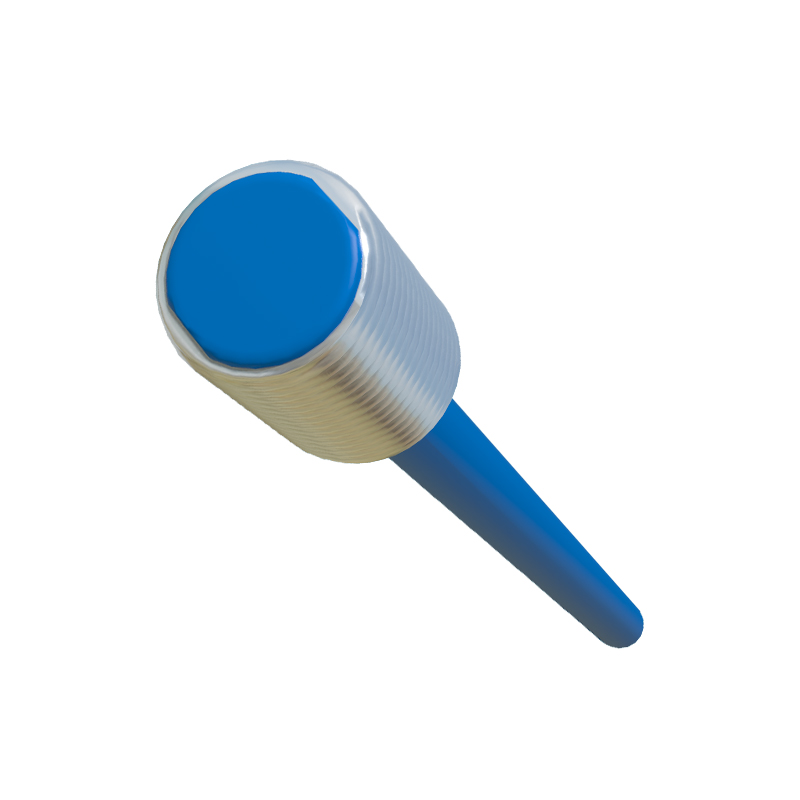
Proximity sensor H211 represents a high-performance inductive proximity switch designed for robust industrial automation environments. Engineered with a cylindrical M18 housing typically constructed from nickel-plated brass or stainless steel, the H211 offers reliable non-contact detection of metallic objects. Operating on the principle of electromagnetic induction, this sensor generates an oscillating electromagnetic field from its active face. When a ferrous or non-ferrous metal target enters this field, eddy currents are induced, causing a change in oscillation amplitude. This change is detected by the sensor's internal circuitry, which subsequently triggers a solid-state switching output.
The H211 series commonly features a sensing range up to 8 mm for mild steel, with a repeat accuracy of within 3% of the sensing distance. It is available in both normally open (NO) and normally closed (NC) output configurations, supporting DC voltage supplies ranging from 10-30 VDC. The output stage typically utilizes a PNP (sourcing) transistor, capable of driving loads up to 200 mA. A key characteristic is its short-circuit and reverse polarity protection, enhancing durability in electrically noisy environments. The housing is rated IP67, ensuring resistance against dust ingress and temporary immersion, making it suitable for harsh manufacturing, packaging, and material handling applications.
Installation requires attention to mounting conditions. Non-flush mountable versions allow for increased sensing distances but require adequate clearance from surrounding metal to prevent false triggering. The sensor's LED status indicator provides visual confirmation of power and output state, facilitating quick diagnostics. In automotive assembly lines, the H211 is frequently deployed for part presence verification, such as detecting engine blocks on conveyors or confirming robotic end-effector positions. In metal machining centers, it serves as a limit switch for tool changer positioning or workpiece detection.
Performance can be influenced by target material, size, and temperature. For optimal operation, the target should be at least equivalent to the sensor's face diameter. Temperature drift is typically compensated within an operating range of -25°C to +70°C. When compared to capacitive or ultrasonic proximity sensors, the H211's inductive nature provides immunity to non-metallic contaminants like dust, oil, or coolant mist, though it is inherently limited to metal detection.
Maintenance is minimal, primarily involving periodic cleaning of the sensing face to remove metal swarf or adhesive debris. Wiring should follow manufacturer guidelines, with shielded cables recommended for long runs in high-interference areas. The H211's compatibility with programmable logic controllers (PLCs) and standard industrial interfaces ensures seamless integration into existing control systems. Its longevity, often rated for millions of operation cycles, underscores its role as a critical component for enhancing operational safety and automation efficiency. Future developments may see integration of IO-Link capability for advanced diagnostics, but the current H211 remains a staple for reliable, cost-effective metallic object detection in diverse industrial sectors.