Laser sensors have become indispensable tools across a multitude of industries, from advanced manufacturing and robotics to autonomous vehicles and precision metrology. Their ability to provide non-contact, high-speed, and exceptionally accurate measurements hinges on a sophisticated interplay of core components. Understanding this internal architecture is crucial for engineers and system integrators to select, deploy, and maintain these systems effectively. This article delves into the fundamental building blocks of a typical laser sensor, explaining the function and significance of each.
At the heart of every laser sensor lies the Laser Diode. This component generates the coherent, monochromatic light beam that serves as the measurement probe. Common types include Visible Red Lasers (e.g., 650 nm) for easy alignment and Infrared Lasers (e.g., 850 nm, 1550 nm) for applications requiring eye safety or specific material properties. The diode's wavelength, output power, and beam quality are primary determinants of the sensor's range, resolution, and suitability for different target surfaces.
The emitted light is then conditioned by Optical Components. A collimating lens is typically the first element, transforming the diverging beam from the diode into a parallel, focused stream. This ensures a small, consistent spot size on the target, which is vital for high spatial resolution. In sensors based on triangulation or time-of-flight principles, additional lenses, beam splitters, or diffractive optical elements (DOEs) shape and direct the light. For line lasers or structured light sensors, a cylindrical lens or DOE fan the point beam into a precise line or pattern.

Once the projected laser interacts with the target—be it through reflection, scattering, or absorption—the returning light is captured by the Receiver or Detector System. This is a critical subsystem. For distance measurement via triangulation, a Position Sensitive Device (PSD) or, more commonly today, a CMOS or CCD image sensor is used. The detector precisely locates the position of the laser spot. In Time-of-Flight (ToF) sensors, a single-point photodiode or an array (like a SPAD array) captures the returned light pulse with extreme temporal sensitivity. The choice of detector directly impacts speed, accuracy, and robustness to ambient light.
Raw signals from the detector are weak and noisy. This is where the Signal Processing Electronics take over. This stage includes transimpedance amplifiers to convert photocurrent to voltage, analog-to-digital converters (ADCs), and dedicated processing units (often FPGAs, ASICs, or high-speed microprocessors). These components perform critical tasks: filtering out noise, calculating time delays for ToF, determining centroid positions for triangulation, and executing complex algorithms for edge detection or profile analysis. The processing power defines the sensor's real-time performance and measurement stability.
No sensor operates in isolation. The Interface and Communication Module provides the vital link to external control systems. This can include digital I/O for triggering and outputting discrete signals, and standard industrial communication protocols like RS-232, USB, Ethernet/IP, PROFINET, or EtherCAT. Analog outputs (0-10V, 4-20mA) are also common for continuous value transmission. This component dictates how easily the sensor integrates into a larger automation or data acquisition network.
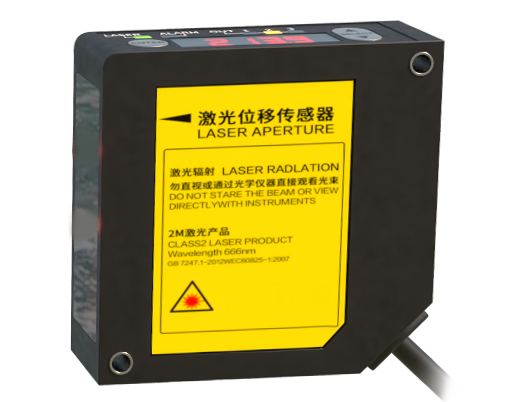
Encasing and protecting this delicate ensemble is the Mechanical Housing and Alignment Fixtures. The housing is designed to be robust, often meeting IP67 or higher ratings for dust and water ingress protection. It provides thermal stability to minimize drift and includes precise mechanical adjustments (e.g., goniometers or screw-based mounts) for initial beam alignment. The material (often aluminum or stainless steel) is chosen for durability and heat dissipation.
Finally, sophisticated laser sensors are governed by embedded Software and Firmware. This is the intelligence layer that manages calibration routines, compensates for environmental factors like temperature, implements user-configurable parameters (e.g., measurement windows, filtering), and handles the communication stack. Advanced firmware enables features like multi-echo processing for measuring through transparent surfaces or background suppression in cluttered environments.
In summary, the performance of a laser sensor is a symphony conducted by its components. From the genesis of light in the laser diode to the final digital output delivered by the interface, each element—optical, electronic, mechanical, and computational—plays a specialized and indispensable role. A deep understanding of this composition empowers engineers to push the boundaries of precision measurement and automation.
