Time-of-Flight (TOF) laser sensors have become indispensable components in modern industrial automation, robotics, and safety systems. Their ability to provide accurate, non-contact distance measurements and 3D imaging makes them critical for precision tasks. However, a key operational consideration for system designers and maintenance engineers is the lifespan of these sophisticated devices. Unlike simple mechanical components, the lifespan of a TOF laser sensor is not defined by a single "hours of operation" figure but is a complex interplay of its internal components, operating environment, and application-specific stresses.
At its core, a TOF sensor's longevity is primarily determined by the lifespan of its laser diode, the heart of the system. These semiconductor lasers emit the pulsed light used for measurement. Laser diodes are subject to gradual degradation over time. The primary failure mechanism is often the growth of defects within the semiconductor crystal, leading to a decrease in optical output power. This degradation is accelerated by several factors. Operating the diode at or above its maximum rated current and temperature is the most significant contributor to shortened life. High temperatures increase non-radiative recombination and accelerate defect migration. Therefore, effective thermal management is not just about performance stability; it is the single most critical factor for maximizing laser diode lifespan. Proper heat sinking, ambient temperature control, and adherence to duty cycle specifications are non-negotiable best practices.
The second major component governing sensor life is the photodetector, typically an Avalanche Photodiode (APD) or Single-Photon Avalanche Diode (SPAD). These sensitive components detect the reflected light pulse. APDs can degrade if subjected to excessive optical power or reverse bias voltage, leading to increased noise (dark current) and reduced sensitivity. While generally more robust than the laser diode in typical use, the photodetector's lifespan can be compromised by exposure to intense ambient light outside its specified range or by voltage transients in the power supply.
Beyond the core optoelectronics, the supporting electronics play a crucial role. Power supplies with poor regulation or high ripple can induce electrical stress on both the laser driver circuit and the sensitive analog front-end for signal detection. Voltage spikes and electrical noise are silent killers of electronic components. Similarly, the microcontroller or dedicated processing unit that calculates the time-of-flight operates continuously. While modern semiconductors are highly reliable, sustained operation at high ambient temperatures can affect long-term stability.
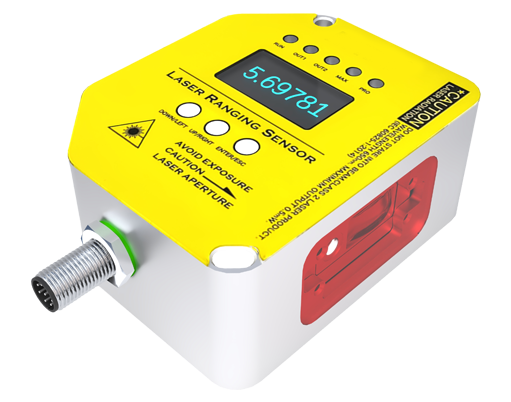
Environmental factors are perhaps the most variable element affecting sensor lifespan. Industrial environments present numerous challenges. Particulate contamination (dust, oil mist) accumulating on the sensor's optical window will attenuate both the outgoing laser beam and the incoming reflected signal, forcing the system to operate at higher power levels to compensate, thereby stressing the laser diode. Condensation or direct exposure to liquids can cause short circuits, corrosion, and lens fogging. Mechanical vibration and shock can loosen internal connections, misalign optical elements, or crack solder joints. Even constant exposure to strong ambient light, especially from other lasers or intense sunlight, can potentially saturate or damage the photodetector over time.
Therefore, maximizing the operational lifespan of a TOF laser sensor requires a holistic approach from selection to deployment and maintenance:

1. Proper Selection: Choose a sensor with specifications (optical power, range, housing) that comfortably exceed the minimum requirements of the application. Avoid running any component at its absolute maximum rating.
2. Environmental Protection: Utilize sensors with appropriate Ingress Protection (IP) ratings (e.g., IP67 for dust and temporary immersion). Install protective housings or baffles to shield the optics from direct contamination and physical impact. Ensure installation away from excessive heat sources.
3. Stable Power and Installation: Provide a clean, regulated power source with adequate filtering. Securely mount the sensor to minimize vibration, using anti-vibration mounts if necessary.
4. Preventive Maintenance: Establish a routine maintenance schedule to clean the optical window with approved materials. Periodically verify the sensor's calibration and output signal strength. Monitor operating temperatures.
5. Operational Awareness: Understand the duty cycle. A sensor used for continuous scanning will experience different thermal loads than one used for intermittent triggering. Allow for adequate cooling in high-duty-cycle applications.
In conclusion, the lifespan of a TOF laser sensor is a system-level characteristic. While manufacturers may provide a Mean Time Between Failures (MTBF) estimate based on component testing, the real-world service life is directly shaped by how the sensor is integrated and cared for. By focusing on mitigating thermal, electrical, and environmental stressors, engineers can ensure these critical sensors deliver reliable, accurate performance throughout their maximum potential service life, thereby reducing downtime and total cost of ownership in demanding industrial applications.