In the world of industrial automation, the seamless interaction between control systems and the physical environment is paramount. At the heart of this interaction are sensors, and among the most critical are those connected to Programmable Logic Controllers (PLCs). PLC proximity sensors stand as silent sentinels, providing the essential data that drives modern manufacturing, packaging, and material handling processes. Unlike their mechanical switch counterparts, these sensors detect the presence or absence of an object without any physical contact, offering unparalleled reliability, speed, and longevity.
The fundamental principle behind a proximity sensor is simple: it emits an electromagnetic field or a beam of radiation and looks for changes in the field or return signal. The sensor's output is then fed into a PLC input module. The PLC, acting as the industrial computer, scans this input data according to its programmed logic. Based on this data, it makes decisions and activates outputs to control machinery—starting a motor, shifting a conveyor, or alerting an operator. This closed-loop system forms the backbone of automated control.
Several key types of proximity sensors are commonly interfaced with PLCs, each suited for specific materials and environments. Inductive proximity sensors are the workhorses for metal detection. They generate an oscillating electromagnetic field. When a metallic object enters this field, it induces eddy currents within the object, which dampens the sensor's oscillation and triggers a switching signal. These are ideal for counting metal parts, detecting piston position in cylinders, or as limit switches. Capacitive proximity sensors can detect both metallic and non-metallic materials, including liquids, plastics, and wood. They work by measuring changes in capacitance caused by the presence of any material that alters the dielectric constant of the space around the sensor's active face. This makes them perfect for level detection in tanks, paper or glass handling, and detecting filled vs. empty containers.
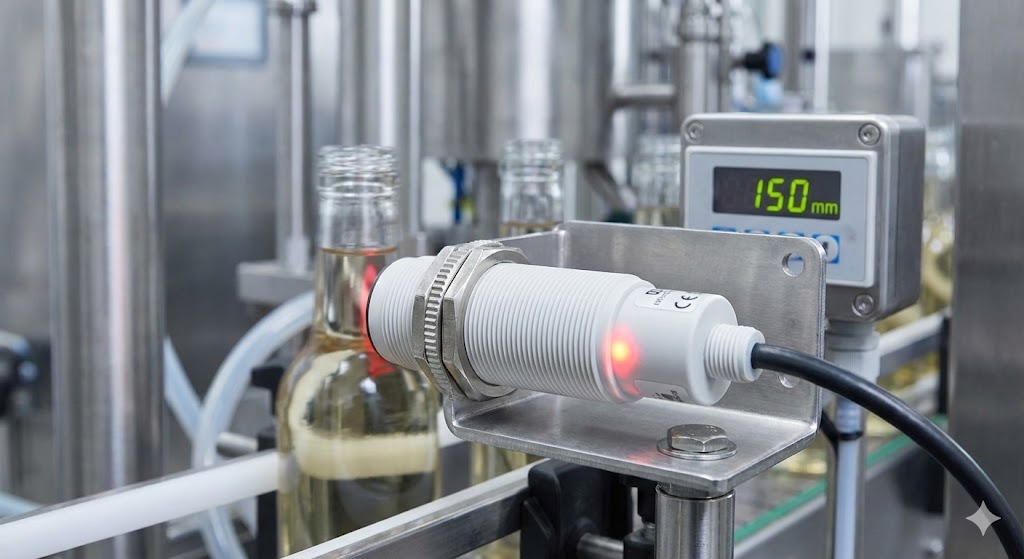
For longer ranges and precise detection of any solid object, photoelectric sensors are often the choice. These use a light beam (visible red, infrared, or laser) and consist of a transmitter and a receiver. They come in thrubeam, retro-reflective, and diffuse (proximity) modes. A thrubeam sensor has separate units; breaking the beam signals an object's presence. A diffuse sensor houses both emitter and receiver, detecting light reflected directly from the target object. Ultrasonic sensors operate on a similar principle but use sound waves instead of light. They measure the time taken for an emitted sound pulse to bounce back from an object, making them excellent for distance measurement, level sensing of bulk materials, and detecting clear or irregularly shaped objects where photoelectrics might struggle.
Selecting the right PLC proximity sensor requires careful consideration of several factors. First, the target material dictates the sensor type: inductive for metals, capacitive for a broader range, photoelectric/ultrasonic for most solids. The sensing distance, or range, must be specified with a safety margin, considering the sensor's rated operational distance. Environmental conditions are crucial; sensors may need specific Ingress Protection (IP) ratings for dust and water resistance, resistance to oils/coolants, or extended temperature tolerances. The electrical output must be compatible with the PLC input module—typically a DC PNP (sourcing) or NPN (sinking) transistor output, or a relay contact. The physical housing (barrel, rectangular, limit-switch style) must fit the mounting space and withstand vibration.
The integration with the PLC is straightforward but vital. The sensor's output wire is connected to a discrete input point on the PLC module. The PLC program, written in ladder logic or another language, uses a contact instruction (like an XIC - Examine If Closed) associated with that input address. When the sensor detects an object, it closes the circuit, the PLC input becomes TRUE, and the logic rung can activate outputs. Proper shielding, grounding, and sometimes the use of surge suppressors are necessary to prevent electrical noise from causing false triggers, especially in environments with large motors or welders.
The advantages of using PLC-integrated proximity sensors are immense. They enable high-speed operation, critical for modern production lines. Their non-contact nature eliminates mechanical wear, leading to minimal maintenance and a long service life. They provide consistent and repeatable detection, improving product quality and process reliability. From automotive assembly robots sensing part placement to food packaging machines verifying lid presence, and from warehouse automated guided vehicles (AGVs) navigating to pharmaceutical bottling lines ensuring fill levels, these sensors are indispensable.
In conclusion, PLC proximity sensors are more than just simple switches. They are sophisticated, application-specific devices that translate physical-world events into the digital language of the controller. A deep understanding of their types, operating principles, and selection criteria empowers engineers and technicians to design robust, efficient, and intelligent automated systems. As Industry 4.0 and the Industrial